
AI Bubble Signs Are Flashing: Why Mark Yegge Says Don’t Sell Everything
AI Bubble Signs Are Flashing: Why Mark Yegge Says Don’t Sell Everything
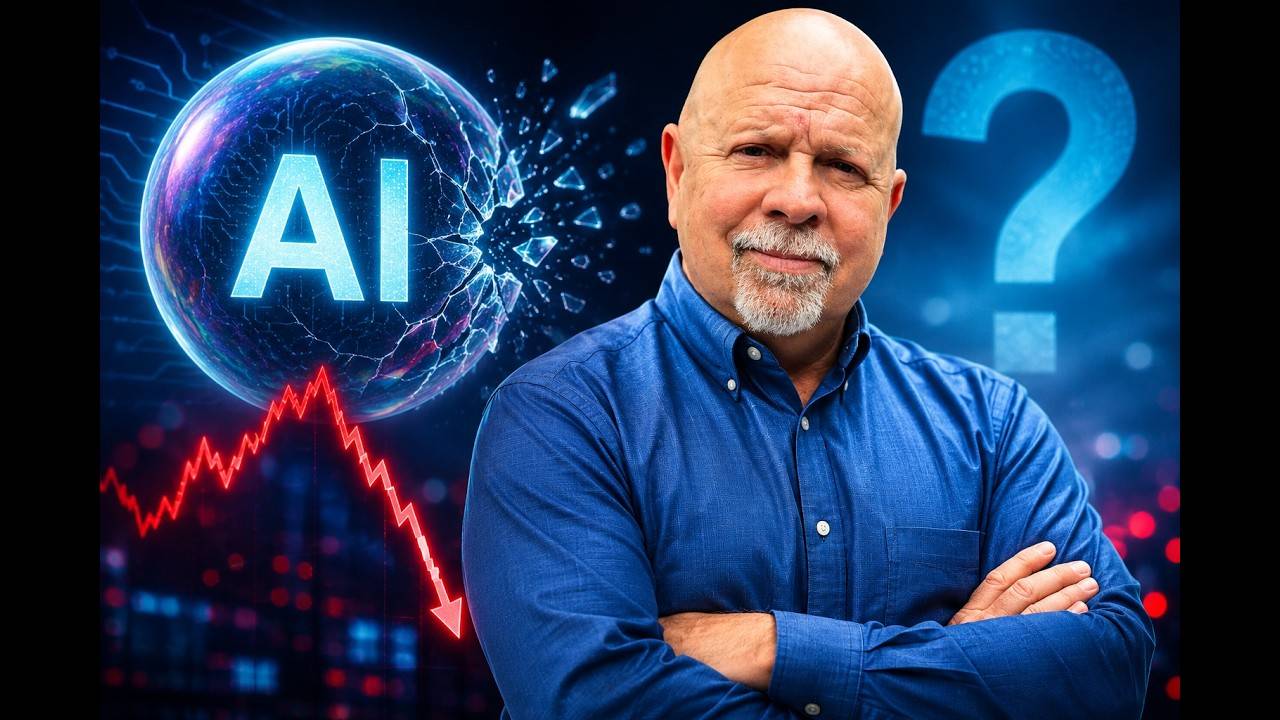
Ray Dalio says the AI boom has bubble signs. A high-profile AI-focused fund reportedly suffered a 67% drawdown in July. And suddenly, the question many investors are asking is simple: should you sell everything?
Mark Yegge’s answer is no — not because AI is automatically safe, not because every AI stock is cheap, and not because anyone knows exactly what happens next. The answer is no because “sell everything” is usually an emotional response to a serious market question.
Educational Note
This article is for educational purposes only and is not personalized financial advice. Investors should make their own decisions based on their goals, risk tolerance, income needs, and portfolio situation. No investment strategy guarantees future results.
Key Takeaways
AI Can Be Real and Overpriced
Mark’s key point is that AI may still be useful and world-changing while some AI stocks may still be priced too aggressively.
Mood Is Changing
The market tone has shifted from fear of missing out to fear of buying the top. That matters, but it is not the same as proof.
Leverage Is the Real Danger
A hot theme, concentrated exposure, and borrowed money can create serious damage when prices move against the investor.
Preparation Beats Prediction
Instead of guessing the next move, Mark believes investors should prepare for three futures: higher, sideways, or lower markets.
Covered Calls Can Help, But They Are Not Magic
Covered calls may create income in choppy markets, but they do not eliminate stock risk if the underlying position falls hard.
The AI Trade Is Facing a Sentiment Shift
For a long time, the message around AI stocks was simple: get in or get left behind. That kind of message creates FOMO. Investors buy because they do not want to be the person who missed the next major market move.
Now, according to Mark, the fear is changing. Instead of only worrying about missing the AI boom, investors are asking whether they may be buying at the top. That shift matters because markets are not moved by facts alone. They are also moved by people reacting to facts, rumors, videos, headlines, and emotion.
Mark’s Core Point
A change in mood is a signal to pay attention. It is not a command to panic.
That distinction is important. Doubt can move prices quickly, especially after a long stretch of optimism. But Mark does not view fear by itself as a complete investment thesis. The better response is to slow down and build a plan before the next headline creates another emotional reaction.
What the 67% AI Fund Drawdown Really Shows
The event that grabbed attention was the reported 67% July drawdown at an AI-focused fund called Situational Awareness. A one-month decline of that size is not a normal bad month. It can force a manager to sell positions, reduce risk, and rethink the entire investment strategy.
But Mark is careful about what this actually proves. It does not prove AI is dead. It does not prove every AI company is a fraud. It proves something much more basic about investing: combining a hot theme, big concentration, and borrowed money can become dangerous very quickly.
In Mark’s view, the lesson is not that AI failed. The lesson is that risk management failed.
AI Can Change the World While Some AI Stocks Fall
One of the most important distinctions in Mark’s analysis is that the technology story and the stock-price story are not the same thing. AI can be real, useful, and potentially world-changing while some AI stocks may still be too expensive.
Mark compares the current debate to the internet era. The internet was real in 1999. It changed the world and remains part of daily life. But many internet stocks were still terrible investments at the prices investors paid during the bubble.
The same logic can apply to other powerful themes. Electric vehicles are real. Solar is real. Crypto is real. But each of those areas has had moments where prices ran far ahead of reality.
The Better Question
Instead of asking whether AI is a bubble, Mark would rather ask: which stocks are priced for perfection, and what happens if perfection does not show up?
That is a more disciplined investing question. It avoids the extremes of “AI is fake” and “buy everything.” The middle ground is where risk management matters most.
Why This Is Not Exactly 1999
Mark believes the 1999 comparison is useful, but also too easy. During the dot-com era, many companies had little revenue, no profits, and business models built more on hope than proven results.
Today, some AI leaders are large companies with real customers, real earnings, and massive cash flow. That matters. It does not make them immune from a large decline, but it does make the current situation different from a market filled only with unprofitable speculation.
A great company can still have a stock that is too expensive. That is the point investors need to keep in focus.
Leverage Can Turn a Pullback Into a Crisis
Leverage means using borrowed money or borrowed exposure to make a bigger bet than cash alone would allow. When prices rise, leverage can feel brilliant because it makes the gains bigger.
But when prices fall, leverage makes the losses bigger too. The worst part is that leverage can force investors to sell at the worst possible time. A stock may recover later, but that does not help if the investor has already been forced out near the bottom.
Mark describes this as the kind of monster investors want to kill while it is still small. In other words, risk control must happen before the market forces a decision.
Retirees Need a Different Risk Mindset
For retirees or investors approaching retirement, this is not only a chart problem. It is also an income problem.
A 25% drop is painful for any investor. But for someone who is retired and withdrawing from a portfolio at the same time, the damage can be worse. Mark refers to this as sequence of returns risk.
The concept is simple: losses early in retirement can be more dangerous because investors may have to sell shares while they are down. Then they own fewer shares when the recovery arrives.
That is why retirees need more than hope and long-term averages. They need cash flow, risk control, and a plan before the decline happens.
Prepare for Three Market Futures
Mark does not believe investors should try to predict one future perfectly. The goal is preparation, not prediction.
1. The Market Moves Higher
If AI stocks continue higher, Mark believes investors should stay disciplined and avoid chasing bad entries.
2. The Market Moves Sideways
If the market chops sideways, income strategies may become more useful because time becomes part of the plan.
3. The Market Drops
If the market falls, investors need position sizing, defense rules, cash reserves, and a process that reduces emotion.
Prediction says, “I know what happens next.” Preparation says, “I have a plan no matter what happens.” That is the difference Mark wants investors to understand.
Covered Calls Can Help in Uncertain Markets
Mark believes covered calls can be useful in uncertain markets, but he is clear that they are not magic. A covered call does not remove stock risk. If the stock falls far enough, the option premium will not protect the investor from all losses.
However, the premium can help. It can lower cost basis, create cash flow, and give investors a more disciplined way to manage a position instead of simply hoping.
The key is to use covered calls only on stocks an investor is willing to own, at position sizes they can handle, with a clear defense plan already in place.
What Investors Should Watch
Instead of reacting to every video or headline, Mark suggests watching the evidence. He specifically mentions QQQ, Nvidia, Microsoft, Meta, Alphabet, Broadcom, and Tesla as areas to monitor.
Major Moving Averages
Watch whether key AI leaders and QQQ are trading above or below major moving averages.
Leadership
Are the leaders still leading, or is leadership starting to weaken?
Market Breadth
Is market breadth improving, or are fewer stocks participating in the move?
Volatility
Watch whether volatility is rising or falling as sentiment changes.
Earnings Estimates
Are earnings estimates still holding up, or are expectations starting to come down?
Option Premiums
Are option premiums rich enough to justify the risk for income strategies?
Better Questions Beat Emotional Decisions
Mark’s answer to “should you sell everything?” remains no as a blanket rule. Instead, he wants investors to ask better questions.
Questions Investors Should Ask
- Has the business story changed?
- Are the fundamentals changing?
- Is the stock still technically healthy?
- Is the position too big?
- Are you using leverage?
- Do you need the money soon?
- Are you retired and pulling income from the portfolio?
Selling everything may feel safe for a few hours, but it can create a new problem: what happens if the market turns back up? Without a plan, investors can end up reacting emotionally in both directions.
A real plan should tell investors when to reduce, when to hold, when to hedge, and when to collect income.
Practical Action Plan
1. Audit AI Exposure
Look at direct positions such as Nvidia or Microsoft, but also review funds that may have heavy AI exposure under the hood.
2. Reduce Oversized Positions
If one stock can ruin the year, the position is too big. Mark suggests thinking through what happens if the stock declines 10% or 15%.
3. Review Covered Calls Carefully
Only consider covered calls where the stock quality, trend, and premium make sense. Do not sell calls just because income sounds attractive.
4. Write Down Defense Rules
Decide in advance when to adjust, reduce, roll, defend, or exit. A written plan beats a strong opinion every time.
The Bottom Line
AI may be stretched. Some stocks may be priced too high. Some investors may be taking too much risk. And yes, there could be more downside.
But Mark’s conclusion is clear: the collapse of one leveraged AI fund is not proof that AI is over. It is proof that concentration and leverage can be dangerous when risk is not managed properly.
The right response is not blind optimism, and it is not panic. The right response is disciplined risk management: know what you own, know why you own it, understand how much risk you are taking, and decide what you will do before the market forces you to decide.
Want to Learn How We Generate Income Regardless of Market Direction?
Watch the free Cash Flow Machine masterclass and learn how we approach income, risk management, and disciplined trading strategies in different market environments.
Watch the Free MasterclassSerious Investors Join Us Inside Elite
Elite teaches the broader Cash Flow Machine system, including income strategy, portfolio process, risk control, and disciplined execution. No unrealistic income guarantees — just a structured approach to the market.
Learn More About Elite