
Insider Tips - Weekly Stock Market Report - Week July 27, 2026
Insider Tips — July 27, 2026
Yellow Market, Red Flags in Tech: Rotation, Resilience, and Risk Control
The market remains in a Yellow condition, which means investors can participate—but only with selectivity, patience, and a clear defense plan. The major indexes are telling different stories: technology remains under pressure, the broader market is holding up better, and leadership continues to rotate rather than expand decisively.
Tesla’s sharp post-earnings decline is this week’s clearest reminder that a compelling company story does not guarantee a rising stock price. Investors can admire the long-term vision behind a business and still respect what the chart is saying in the present. When price trends lower, especially into a major event such as earnings, downside protection matters.
This is not an environment for trying to be a hero. It is a market for managing exposure, removing weak holdings, and concentrating research on stocks and industry groups that are demonstrating genuine relative strength.
Technical Analysis
A Mixed Index Picture
The market-timing signal remains Yellow after spending most recent sessions in that cautious condition. QQQ and the Dow are showing Red readings, while SPY and the broader market remain Yellow. That combination does not support an aggressive, broad-based risk posture.
The Nasdaq is testing a short-term support area after a gap lower. That support needs to hold, ideally with constructive volume. Price remains the primary signal, while volume helps judge the conviction behind the move. A decisive failure at support would increase the probability of another leg lower.
The S&P 500 is behaving somewhat better. It has responded positively to an upward-sloping trend line, but it still needs to reclaim the 50-day moving average with meaningful volume before the picture becomes more constructive.
The Dow is holding above its 50-day moving average and appears healthier on that basis, despite weakness in some of its large components. The NYSE Composite is stronger still, trading above its key moving averages and showing that the broader market is in better condition than the technology-heavy indexes.
Volatility Is Elevated, Not Extreme
The VIX is moderately elevated but remains close to its moving averages. That points to uncertainty rather than panic. The message is not to abandon the market entirely; it is to reduce impulsive decisions and demand better confirmation before increasing exposure.
Market Trends I’m Calling Out
1. Technology Is No Longer Carrying the Whole Market
The market’s weakness is concentrated primarily in technology and AI-infrastructure-related names. At the same time, capital is rotating toward healthcare, industrials, transportation, refining, and selected hardware companies. That rotation is keeping the broader market healthier than the Nasdaq alone would suggest.
2. Leadership Is Narrow and Selective
There are stocks moving higher, but there is not enough synchronized leadership to call this a strong Green market. In this environment, industry-group strength matters. A reasonably good stock in a leading group can receive a tailwind, while a weaker stock in a deteriorating group can continue falling even when the overall market stabilizes.
3. Earnings Risk Requires Protection Before the Event
Tesla demonstrates why earnings should be treated as a risk-management event, not a prediction contest. Once a stock gaps sharply lower, investors have fewer attractive defensive choices. Protection needs to be planned before the report through position size, strike selection, covered-call structure, or a willingness to reduce exposure.
4. The Story and the Stock Can Diverge
Strong products, charismatic leadership, and exciting long-term projects can support an investment thesis, but they do not override price action. The chart reflects what buyers and sellers are doing now. When the story remains exciting but the stock is in a sustained downtrend, investors should respect the market’s message.
5. Portfolio Maintenance Is Productive
A Yellow market is a useful time to “weed the garden.” Review positions that are lagging their groups, violating technical levels, or being held mainly because of hope. Removing weak holdings can improve both portfolio quality and decision-making clarity.
Individual Stocks and ETFs: What I’m Seeing
Tesla
Tesla remains in a clear downtrend and suffered a severe post-earnings gap. The company’s long-term ambitions in autonomy, robotics, and related technologies may remain compelling, but the chart has not supported aggressive buying. Existing shareholders using covered calls may be able to generate income and create some cushion, but a covered call reduces risk rather than eliminating it.
Nvidia
Nvidia is beginning to look more constructive after testing its 200-day moving average and avoiding an immediate rollover. It is now near the 50-day moving average. A stronger market could support a move toward the prior high around 236, but the stock still needs confirmation; the area around 215 may offer a level to watch for an early setup rather than a reason to chase.
Apple
Apple is showing real resilience and relative leadership. After recovering strongly from its prior low, the stock has held up well despite a few weaker sessions. With earnings approaching, some of the current strength may reflect positioning ahead of the report. The stock also appears extended from its earlier buy area, so disciplined investors should avoid confusing strength with a low-risk entry.
SanDisk
SanDisk has experienced a major retreat from its highs, yet its relative strength has not collapsed as much as the price decline might suggest. The stock remains below its 50-day moving average and has not produced a decisive, high-volume recovery. A failed bounce could develop into an “H” pattern—a rebound followed by another rollover—so this remains a watchlist name rather than a clean entry.
Roundhill Memory ETF (DRAM)
DRAM is trading below its 50-day moving average and remains technically weak. Selling pressure has not reached outright capitulation levels, but the ETF could still form a bearish continuation pattern. Until it recovers important technical levels, the trend deserves more weight than the attraction of a lower price.
Micron
Micron is acting better than some other memory-related names. It is clustering around the 50-day moving average while maintaining strong relative strength, suggesting that it may be digesting prior gains rather than breaking down decisively. Continued support near the 50-day line would keep the setup constructive.
AMD
AMD is holding above its 50-day moving average and appears relatively healthy. That does not remove broader semiconductor risk, but it places AMD among the technology names showing better technical behavior. The key is whether it can maintain that advantage if the Nasdaq weakens further.
Eli Lilly
Eli Lilly is showing genuine leadership, with improving relative strength and price action near a potential buy zone after a breakout. The stock may also be benefiting from rotation away from technology and into healthcare. It stands out because both the stock and its broader theme are attracting capital.
GE Aerospace
GE Aerospace initially reacted poorly after reporting results but has since recovered much of that weakness. The rebound is constructive and fits the broader strength in transportation equipment and industrial groups. Holding the recovery would reinforce the view that buyers are supporting the stock after the earnings volatility.
Bloom Energy
Bloom Energy has been pulled lower with the broader AI-infrastructure and energy trade. Its decline has been significant, and the chart may be setting up for another test, potentially toward the 200-day moving average. Covered-call income can soften the damage for existing holders, but investors should watch volume closely: light volume on further weakness would be less concerning than heavy institutional selling.
Carvana
Carvana remains vulnerable as it repeatedly struggles around the 50-day moving average. The automotive group is not showing broad leadership, and the stock’s technical behavior supports a cautious view. This is a situation where the chart and industry context matter more than trying to justify the valuation through narrative alone.
Dell and Leading Industry Groups
Computer hardware and peripherals rank among the market’s strongest groups, and Dell is showing relative strength near a potential buy point. Oil and gas refining, transportation equipment, and rail-related groups are also improving. These rankings provide a useful starting point for research because leading stocks often emerge from leading industries.
Key Takeaways
-
The market remains Yellow: participate selectively, but keep risk controlled.
-
Technology is weaker than the broader market, creating a mixed rather than uniformly bearish environment.
-
The Nasdaq must hold support, while the S&P 500 needs to reclaim its 50-day moving average with volume.
-
Tesla reinforces a crucial rule: a great story does not override a weak chart.
-
Earnings protection must be established before the report, not after a damaging gap.
-
Healthcare, industrials, transportation, refining, and selected hardware names are benefiting from rotation.
-
Use this period to remove weak positions and build watchlists around stocks showing real relative strength.
Conclusion
The market is offering opportunities, but it is not offering permission to be careless. Mixed index signals, weaker technology, and narrow leadership all argue for smaller, more deliberate decisions. Focus on stocks that are holding key moving averages, attracting volume, and operating within leading industry groups.
Most importantly, define the downside before entering a position. Use position sizing, predetermined exits, and—when appropriate—covered-call protection to manage uncertainty. If the major indexes regain key technical levels with stronger volume, the market may become more constructive. Until then, patience is a position too.
Current Market Condition
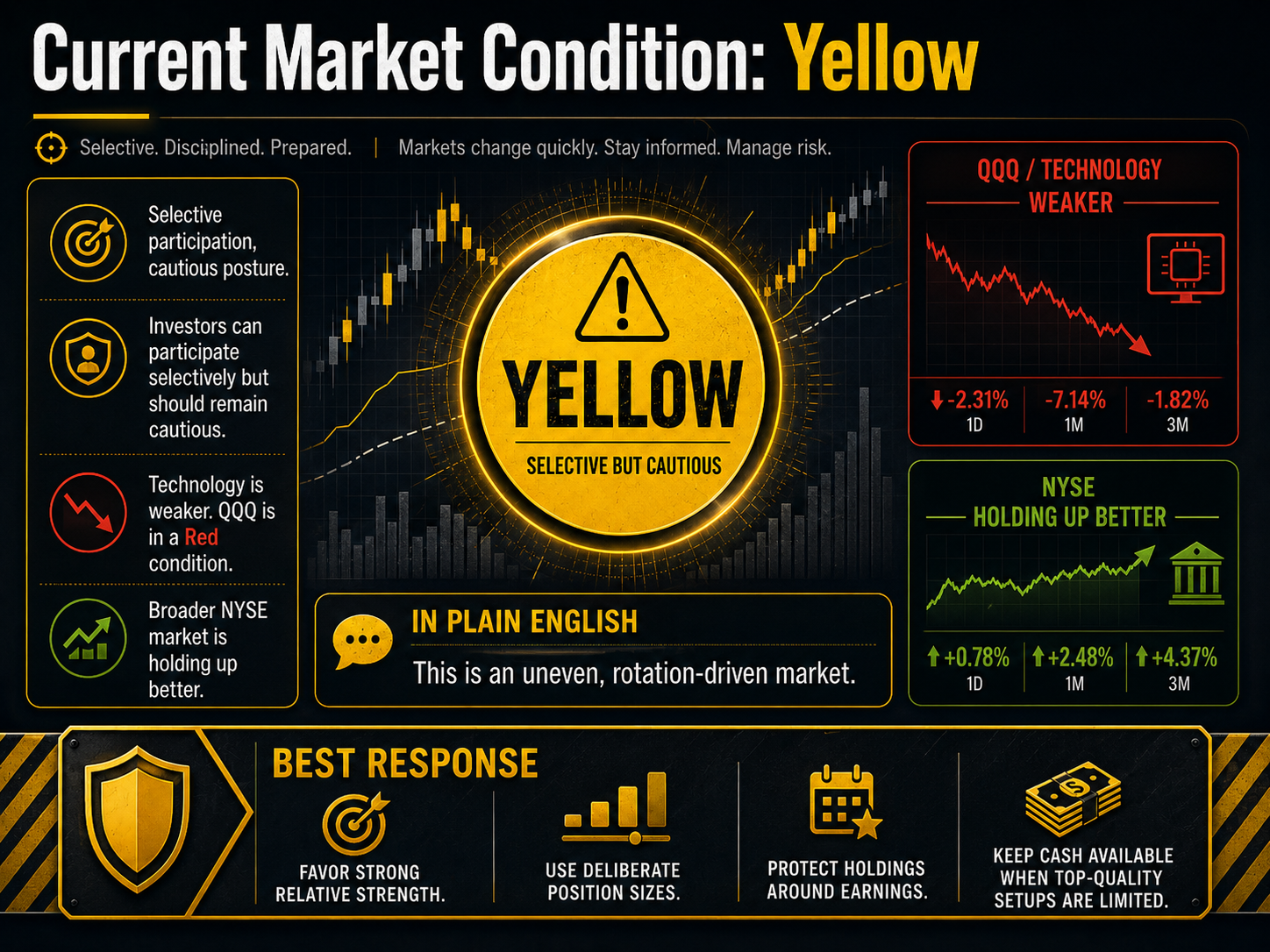
The current market condition is Yellow, meaning investors can participate selectively but should remain cautious. Technology is weaker, with QQQ showing a Red condition, while the broader NYSE market is holding up better.
In plain English, this is an uneven, rotation-driven market. Favor stocks with strong relative strength, use deliberate position sizes, protect holdings around earnings, and keep cash available when high-quality setups are limited.
Stock Tips This Week

SpaceX Covered Call Math: How Defense Helped Reduce a Major IPO Pullback
In this video, Mark uses a difficult SpaceX position to show how deep in-the-money covered calls and repeated roll-downs can reduce the damage from a major decline. The trade was not made painless or automatically profitable; the practical lesson is that disciplined defense can keep a poor entry from becoming a catastrophic loss.

Tesla Earnings and Covered Calls: Why Downside Protection Matters More Than Guessing the Move
In this video, Mark explains why earnings should be approached through risk control rather than directional prediction. He reviews the chart, estimates the implied move, and shows how a deeper in-the-money covered call may create additional downside cushion—while emphasizing that premium never eliminates the underlying stock risk.
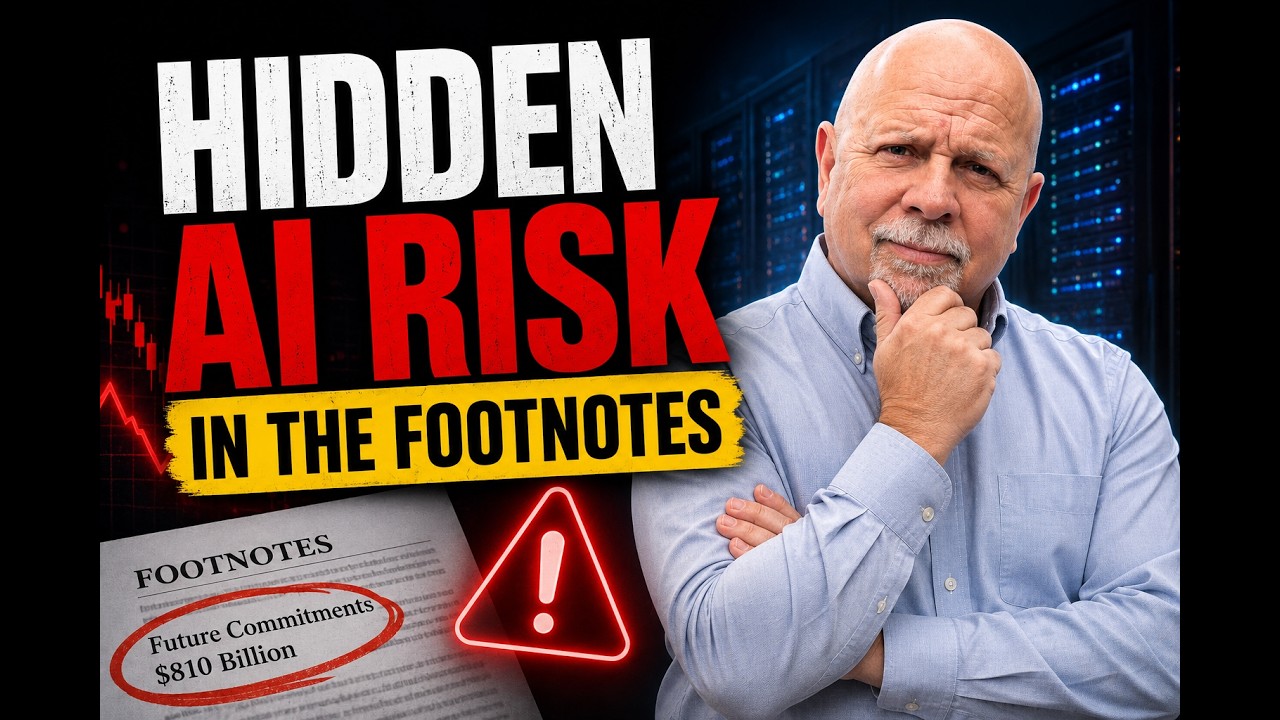
The Mag 7 AI Footnote Debt Problem: What Investors Should Watch Next
In this video, Mark looks beyond the excitement surrounding AI and examines the future commitments tied to data centers, chips, power, leases, and compute capacity. The lesson is to evaluate whether future AI revenue and free cash flow can justify today’s infrastructure spending rather than treating every large AI company as the same trade.
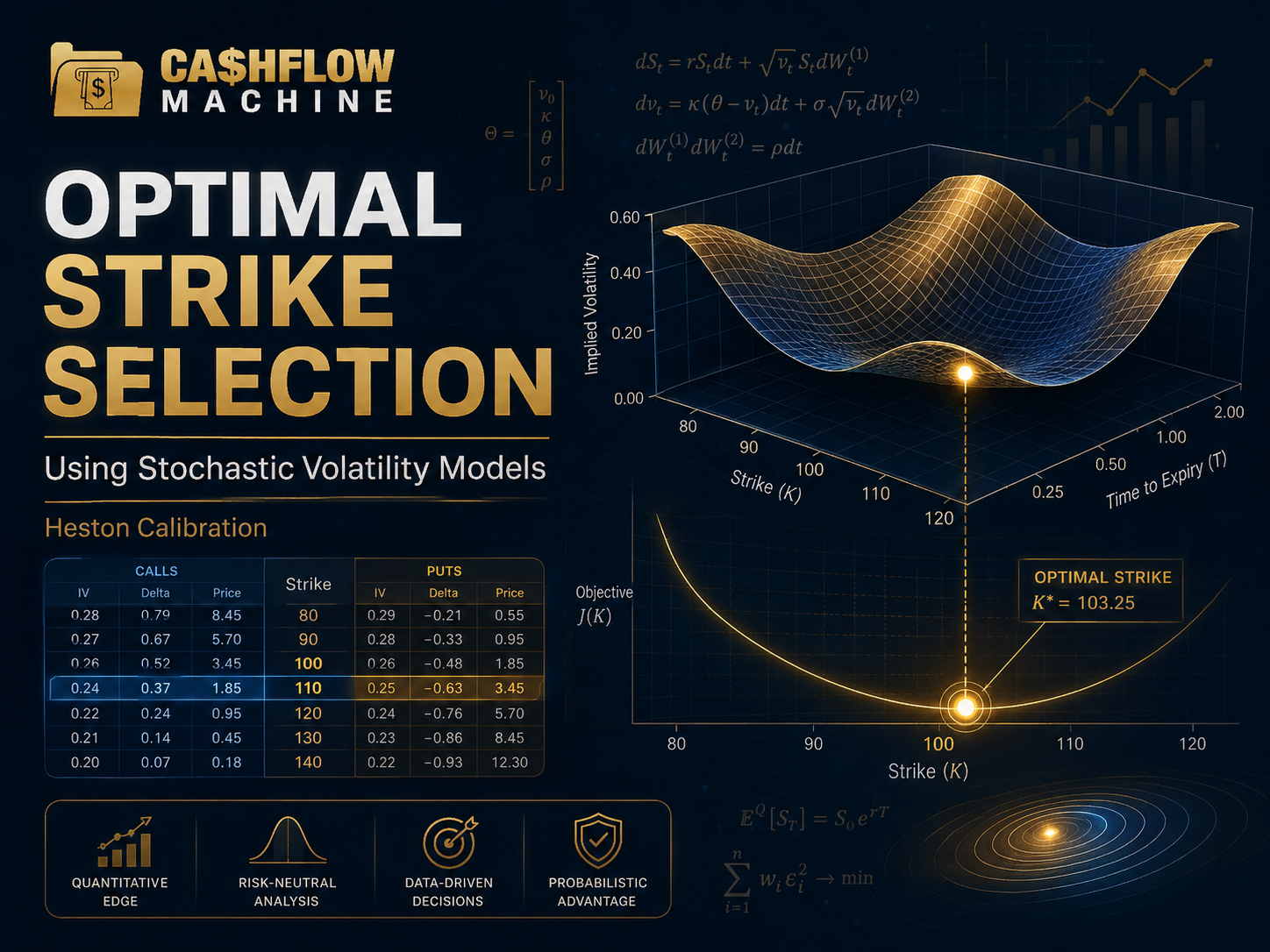
Covered Call Optimal Strike Selection Using Stochastic Volatility Models
In this blog, strike selection is framed as a volatility and probability decision rather than a simple choice based on distance from the current stock price. The Heston model accounts for volatility clustering and mean reversion, helping investors compare the time decay being collected with the volatility risk being assumed.
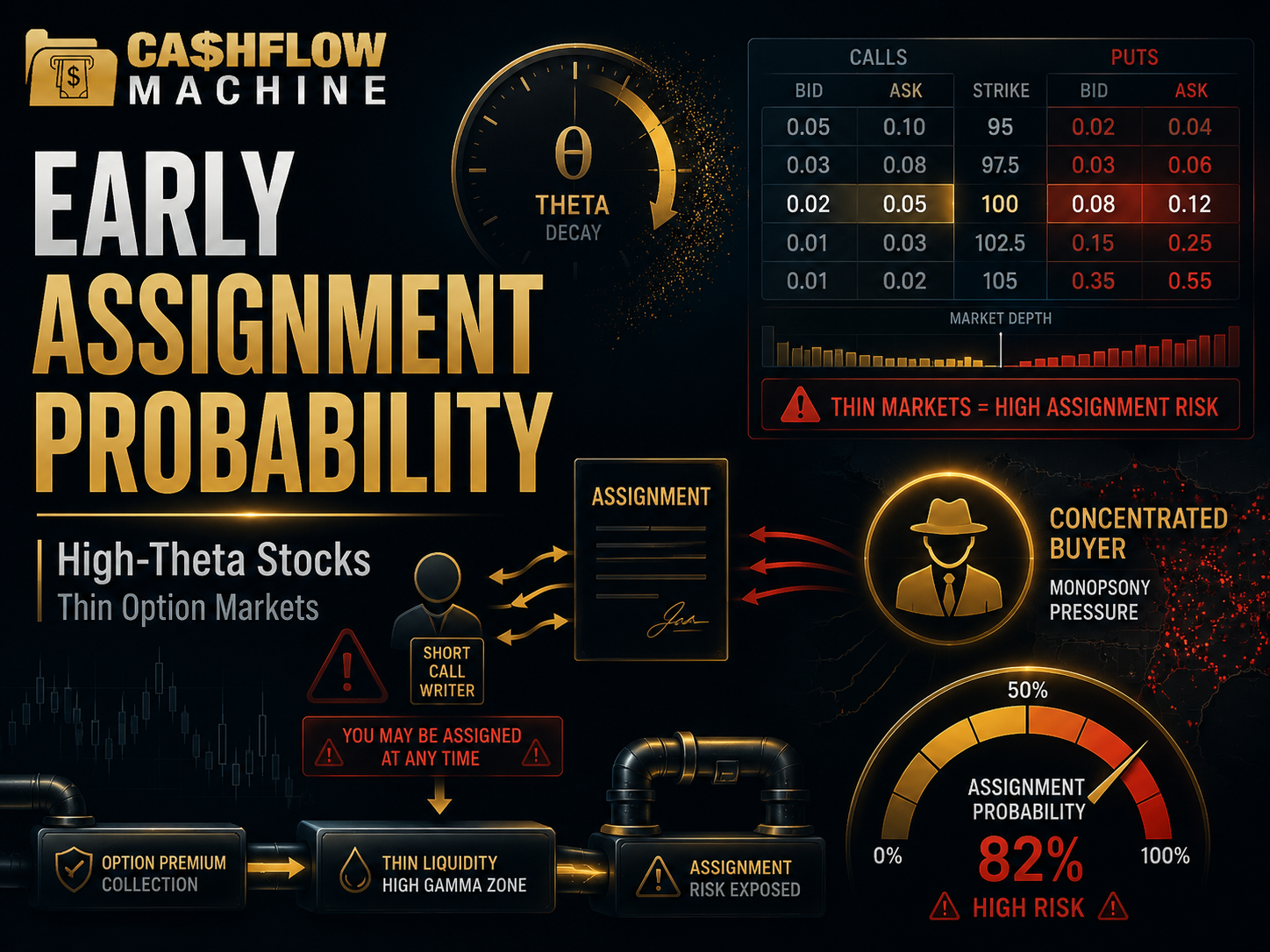
Early Assignment Probability on High-Theta Stocks
In this blog, the focus is on assignment risk in thin, high-theta option markets where concentrated buyers can distort pricing and order flow. Covered-call sellers are encouraged to monitor liquidity, open-interest concentration, ex-dividend dates, and expiration structure—and to roll proactively when assignment risk increases.

Covered Call Tax Efficiency in Taxable vs. Retirement Accounts
In this blog, the key issue is how account type can change the after-tax outcome of a covered-call strategy. Taxable and retirement accounts can treat premium, assignment, gains, and withdrawals differently, so investors should judge the strategy on after-tax results and consult a qualified tax professional for their circumstances.
Podcast Episode This Week

EP-192: The Importance of Planning with Mark Miller
In this episode of the Wealth Architect Podcast, Mark Yegge speaks with Mark Miller, CEO of Hilton Tax & Wealth Advisors, about why durable wealth is built through planning rather than chasing returns. Their conversation covers how high-net-worth families approach investing, taxes, risk management, wealth protection, and legacy planning.
