
Insider Tips - Weekly Stock Market Report - Week August 10, 2026
Insider Tips — August 10, 2026
Green Market, Better Breadth: A Constructive Shift With AI Still Uneven
After several months of mixed signals, false starts, and uneven momentum, the market is beginning to look more constructive. This week’s market timing signal moved into green territory, suggesting that the probability balance has shifted more toward the bullish side. That does not guarantee a sustained rally, but it does change how investors should think about opportunity and risk.
The encouraging part is that the improvement is not limited to one narrow corner of the market. The S&P 500, Dow Jones Industrial Average, and the broader New York Stock Exchange Composite are showing stronger technical behavior, while volatility has declined and money appears to be moving back into risk assets. At the same time, bonds and precious metals are also improving, giving us a broader picture of healthier market participation.
The important qualification is that this is not an everything-is-bullish market. Parts of the AI and semiconductor trade remain damaged, housing continues to struggle, and several major technology names are still repairing post-earnings declines. The right stance is therefore constructive but selective: participate where the evidence supports it, scale into positions rather than chase, and continue managing downside risk.
Technical Analysis
The strongest technical message this week is the improvement in overall market breadth.
The Nasdaq Composite has rebounded sharply from its recent low and filled an earlier gap. It has also moved back above its 50-day moving average, which is a positive development. However, compared with the other major indexes, the Nasdaq still has more technical repair work ahead of it. A developing flag-like consolidation could eventually support another attempt toward its prior high, but some digestion of the recent rebound would be normal.
The S&P 500 looks considerably healthier. It has pushed above previous resistance, remains above its major moving averages, and has shown constructive volume around its advance. That matters because the S&P represents a broader section of the market than the technology-heavy Nasdaq.
The Dow Jones Industrial Average is showing similar strength, with recent gap-ups and a move through prior highs.
Perhaps the most encouraging chart is the NYSE Composite. As one of the broadest indexes discussed in this week’s update, its strength suggests that participation is expanding beyond a small group of mega-cap technology companies. When broader indexes participate, rallies generally have a healthier foundation than when only a few large stocks are carrying the market.
Volatility is also helping the bullish case. The volatility reading discussed this week had declined to roughly 14.9. Lower volatility often accompanies greater willingness to deploy capital, although extremely low volatility should never be interpreted as a guarantee that risk has disappeared.
The bigger picture is straightforward: price, breadth, moving averages, and volatility are increasingly supporting the bullish side of the argument.
Market Trends I’m Calling Out
- Breadth Is Becoming More Important Than the Nasdaq
For much of the recent market cycle, technology has attracted most of the attention. This week, however, some of the strongest technical behavior is coming from broader indexes.
That is important. A rally supported by the S&P 500, Dow, and NYSE Composite is fundamentally different from a market where a handful of AI stocks are responsible for nearly all the gains.
- Lower Volatility Is Encouraging Capital Deployment
The decline in volatility suggests that investors are becoming more comfortable putting money to work again.
That does not mean risk has disappeared. It means the environment has shifted from one where defense dominated toward one where investors can begin looking more seriously for attractive setups.
- Bonds and Precious Metals Are Sending Constructive Signals
The bond market is beginning to show more meaningful trend improvement after a difficult multi-year period. Strength in longer-duration Treasuries can affect liquidity, interest-rate expectations, and valuations across multiple asset classes.
Gold and silver are also rebounding. Gold moved above its 50-day moving average with strong volume in the market update, although it had not yet cleared its 200-day moving average.
The combination of improving stocks, bonds, gold, and silver is worth monitoring. Looking at multiple asset classes gives investors a broader picture than simply watching the Nasdaq every day.
- The AI Trade Is No Longer One Trade
One of the clearest themes this week is divergence within AI-related stocks.
Some companies remain technically healthy or are beginning to recover, while other areas—particularly memory-related names—continue to trade poorly.
That is why investors need to stop treating “AI” as a single position. Leadership can rotate quickly within a powerful long-term theme.
- A System Matters More Than a Market Prediction
No one knows with certainty whether this green market will remain green next week.
The practical objective is not perfect prediction. It is having rules that determine how aggressively you participate when conditions improve and how quickly you become defensive when they deteriorate.
That means using position sizing, defined entries, moving averages, support and resistance, option structures, and predetermined exit rules instead of reacting emotionally to every headline.
Individual Stocks: What I’m Seeing
Tesla
Tesla is still repairing technical damage following its earnings-related decline. The stock experienced a significant gap down on heavy volume and has since recovered part of that move.
The recovery is encouraging, but the gap above remains an important technical area. A damaged chart can recover, but investors should allow price action to prove that buyers are genuinely regaining control rather than assuming one bounce has solved the problem.
SpaceX
The SpaceX setup remains highly volatile, particularly following the sharp decline from its earlier highs and concerns surrounding unlocked insider shares.
The stock has bounced from its recent low, and the covered-call position discussed this week has shifted from a heavily defensive posture toward a slightly more offensive one as broader market conditions improve.
The useful lesson is less about predicting where SpaceX goes next and more about position management. When conditions weakened, deeper in-the-money calls were used defensively. As momentum improved, the strike could be moved higher to allow greater upside participation while still generating option premium.
Nvidia
Nvidia has broken above a short-term downward trend line and is beginning to form a more constructive technical setup.
The missing ingredient is stronger volume confirmation.
This is also a situation where position sizing matters. An investor who likes the developing setup does not necessarily need to make an all-or-nothing decision. Scaling into a position as the chart confirms itself can reduce the risk of committing too aggressively before a breakout is established.
Apple
Apple continues to recover from its post-earnings decline and has moved back above its 50-day moving average.
The company may not offer the explosive momentum of some higher-beta technology stocks, but that relative stability can make it interesting for income-oriented strategies such as covered calls.
The trade-off is predictable: lower volatility normally means smaller option premiums, but it can also mean a more manageable underlying position.
SanDisk and the Memory Trade
This remains one of the weaker areas of the market.
After an extraordinary previous advance, SanDisk experienced a major drawdown as investors took profits. More importantly, the broader industry group has fallen sharply in relative ranking and has not participated meaningfully in the latest market improvement.
That relative weakness deserves attention. When the broader market rallies and a previously powerful group refuses to participate, the market may be telling investors that leadership is changing.
Micron
Micron is telling a similar story. The stock remains below its 50-day moving average and has not yet demonstrated the type of technical recovery that would restore confidence.
Until that changes, patience may be more valuable than trying to anticipate the exact bottom.
AMD
AMD looks healthier than several other semiconductor and memory-related names despite remaining below its 50-day moving average.
Its relative strength remains comparatively strong, and the technical repair required is less severe than in some of its peers.
That makes AMD a useful example of why investors should compare charts within a sector, not simply decide that an entire industry is bullish or bearish.
Alphabet
Alphabet is currently more neutral than compelling.
The stock has been moving around its 50-day moving average after previously finding support near the 200-day moving average. That 200-day bounce is constructive, but there is not yet an obvious reason to become aggressive.
Sometimes the correct trading decision is simply to wait.
Microsoft
Microsoft is one of the cleaner large-cap technology charts discussed this week.
The stock responded positively to earnings, gapped higher on volume, and moved through a technical buy area. Its cloud business continues to be an important driver of the story.
Microsoft demonstrates why breakout preparation matters. Investors who understand the setup beforehand do not need to chase after the move has already become obvious.
Meta Platforms
Meta remains one of the less attractive charts in the group this week.
That does not necessarily make the company fundamentally unattractive. It simply means the current technical evidence is not as compelling as what can be found elsewhere.
Capital does not have to be committed equally across every mega-cap technology company.
Amazon
Amazon is sitting near an important technical breakout area and appears to be working up the right side of a broader cup-like formation.
That makes it one of the more interesting charts to monitor. The next question is whether price can decisively confirm the setup with sufficient participation and volume.
Biotechnology
Biotechnology is showing an interesting consolidation pattern following an earlier advance.
After a long period of relatively flat performance, the group moved higher and is now digesting those gains. That kind of pause does not automatically signal weakness; it can represent normal profit-taking after a strong move.
Housing
Housing remains one of the weaker areas.
The sector has struggled for an extended period, and reports of price reductions among major homebuilders reinforce the idea that this is not currently one of the market’s strongest themes.
The key lesson is that a green overall market does not automatically repair every weak industry.
Data Storage and Disk Drives
Disk-drive stocks remain a notable area of strength.
The group benefited significantly from the demand for data infrastructure and continues to show strong technical action even as some other AI-related areas weaken.
That distinction is important. AI-related demand may still be supporting specific parts of the infrastructure chain even while enthusiasm fades elsewhere.
Key Takeaways
- The broader market has improved. A green market signal, stronger major indexes, and improving breadth support a more constructive stance.
- The Nasdaq is recovering, but other indexes currently look healthier.
- Lower volatility is helping bring capital back into the market, but low volatility should never be confused with zero risk.
- AI leadership is fragmenting. Nvidia and AMD look materially different from weaker memory-related names.
- Relative strength matters. Focus on stocks and sectors showing strength compared with their peers rather than forcing trades in damaged charts.
- Scale into opportunities instead of making all-or-nothing bets.
- Have a system before entering. Market conditions, chart structure, position size, income objectives, and risk rules should all be considered before capital is committed.
Conclusion
This week’s market is more encouraging than what we have seen during much of the recent choppy period. Broader indexes are participating, volatility has declined, several asset classes are strengthening, and there are once again technical setups worth researching.
But green does not mean reckless.
Some sectors remain weak. Several technology leaders are still repairing damage. AI-related stocks are increasingly moving on their own individual merits rather than as one unified trade.
That makes discipline especially important.
Instead of trying to predict exactly where the market will be next week, focus on what the market is showing now. Favor stronger charts, respect moving averages and support levels, size positions appropriately, and adjust when the evidence changes.
A good trading system does not need to know the future. It needs to give you a disciplined response to whatever the future brings.
Current Market Condition
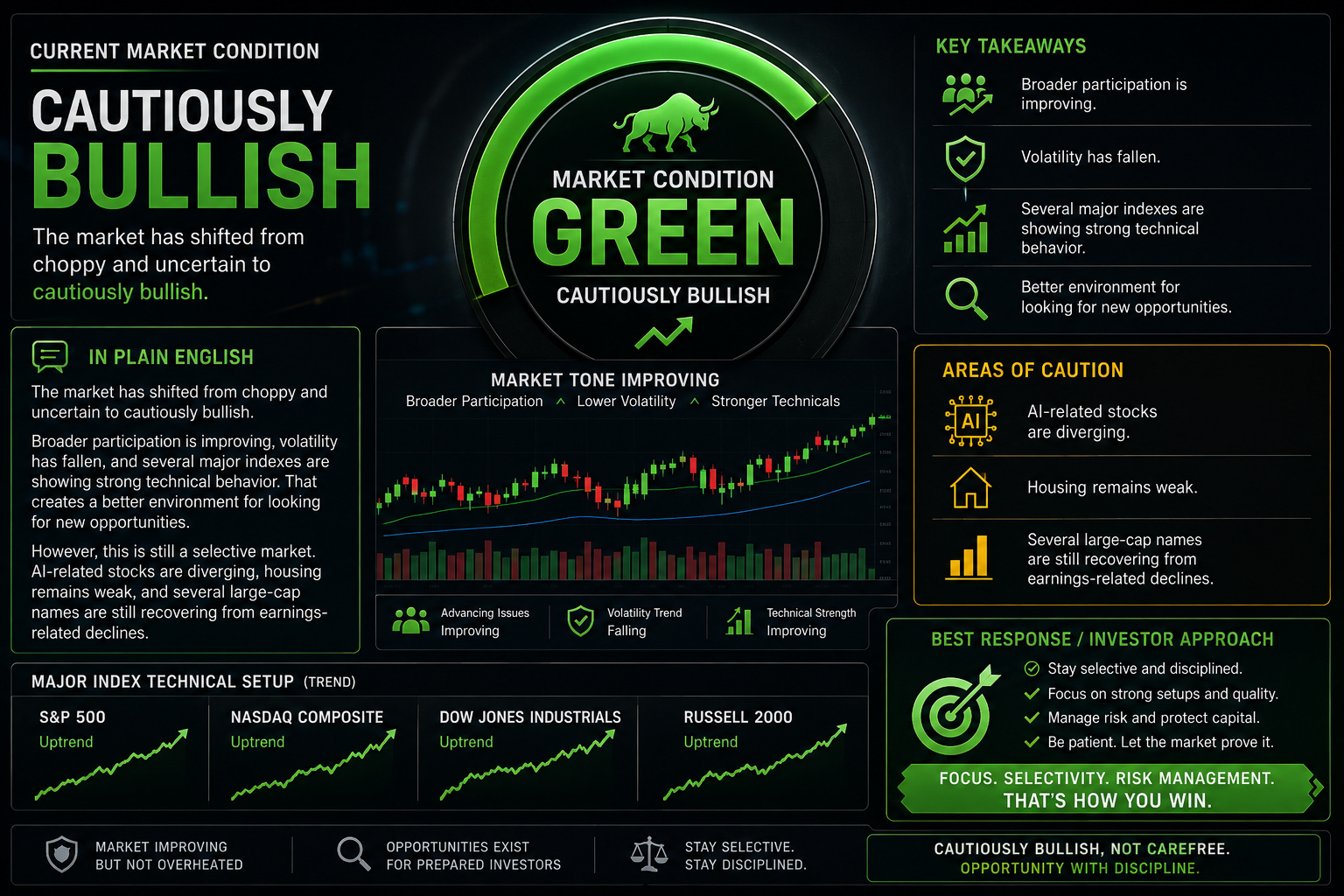
In plain English, the market has shifted from choppy and uncertain to cautiously bullish.
Broader participation is improving, volatility has fallen, and several major indexes are showing strong technical behavior. That creates a better environment for looking for new opportunities.
However, this is still a selective market. AI-related stocks are diverging, housing remains weak, and several large-cap names are still recovering from earnings-related declines.
The current approach: participate, but stay selective and manage risk.
Stock Tips This Week

AI Bubble Signs Are Flashing: Why Mark Yegge Says Don’t Sell Everything
In this video, the focus is on separating the long-term promise of artificial intelligence from the valuation and risk surrounding individual AI stocks. The practical lesson is not to react to bubble concerns by selling everything—or by blindly buying the dip. Instead, investors are encouraged to evaluate concentration, leverage, moving averages, market breadth, and position size while preparing for bullish, sideways, and bearish scenarios.

SpaceX Earnings Preview: Starlink Growth, Starship Spending, and the Share Unlock Risk
In this video, SpaceX is evaluated through several moving parts rather than a single earnings number. The discussion highlights Starlink growth, launch activity, Starship investment, valuation, and potential selling from unlocked shares. The broader takeaway is useful for any earnings trade: understand both the opportunity and the risk before the announcement instead of making an oversized directional bet on one expected outcome.

Cash Flow IQ: Using AI to Practice Covered Calls, Chart Patterns, and Better Trading Decisions
In this video, the emphasis is on using repetition and simulated decision-making to improve chart reading and covered-call execution. Traders practice identifying price-and-volume behavior, moving averages, reversals, and breakouts while working with historical market situations. The broader lesson is that trading skill is developed through structured practice and probability-based decision-making rather than relying on headlines or emotion.

SpaceX Covered Call Trade Update: Rolling From the 115 Strike to the 130 as Momentum Improves
In this video, a SpaceX covered-call position moves from defense toward a more balanced, slightly offensive structure as market conditions improve. The 115 calls are rolled to the 130 strike, illustrating an important covered-call trade-off: a trader can accept less immediate premium in exchange for more upside room when momentum strengthens. The central lesson is to adjust the structure as conditions change rather than trying to predict every short-term move.

How Cash Flow IQ Uses Market Timing and Super Scan to Find Covered Call Ideas
In this video, the covered-call selection process begins with the broader market rather than an individual stock. After determining whether conditions are green, yellow, or red, a scanner narrows the stock universe before fundamentals, chart structure, option liquidity, strike selection, premium, and risk are reviewed. The important principle is that a scanner produces ideas—not automatic trades; the final decision still requires research and a defined trading plan.
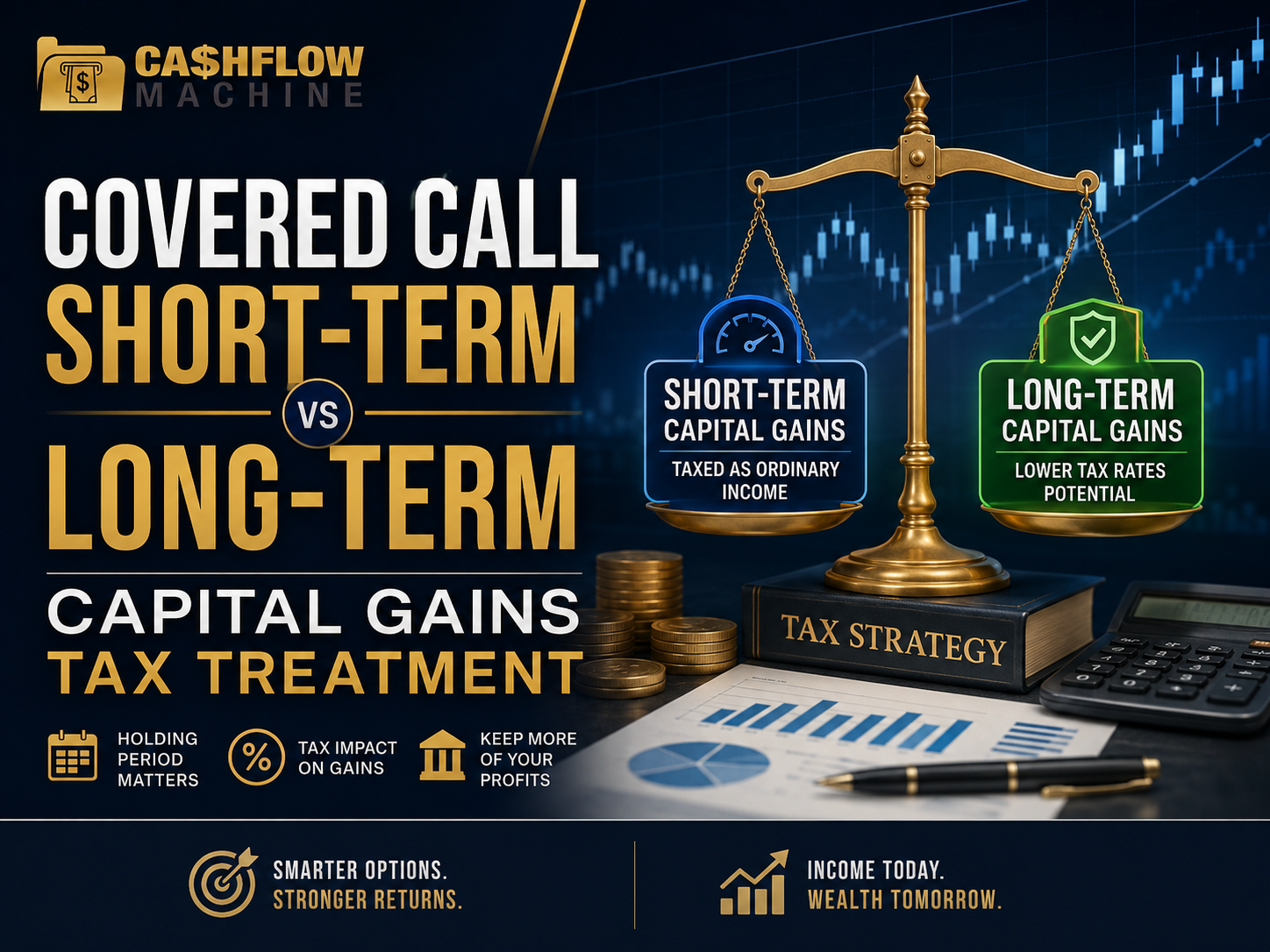
Covered Call Short-Term vs. Long-Term Capital Gains Tax Treatment
In this blog, the focus shifts from gross option income to what investors may actually keep after taxes. It discusses how option premiums, assignment, holding periods, and the structure of covered calls can influence tax outcomes. The practical lesson is to consider tax consequences as part of trade planning rather than treating them as an afterthought, and to work with a qualified tax professional when applying these rules to an individual situation.
Upcoming Event

The Cash Flow Blueprint Intensive / Wealth Accelerator Strategy Room is scheduled for October 30 through November 1 in Clearwater, Florida.
The three-day program is expected to focus on developing trading plans, covered-call strategies, chart reading, AI-assisted trading workflows, implementation, and risk management. For investors who want a more structured approach to managing positions and building repeatable trading processes, those will be the central themes of the event. Check out our event page to learn more and be the first to know when tickets go on sale later this week!
