
Insider Tips - Weekly Stock Market Report - Week August 17, 2026
Insider Tips - Weekly Stock Market Report - Week August 17, 2026
Green Market, Falling Volatility, and the Setups That Matter This Week
The market enters the week with a clear positive bias. Major indexes have been holding green signals for multiple sessions, volatility has continued to fall, and even areas that had been lagging are beginning to participate. That combination creates a meaningful tailwind for stocks, and it argues against fighting the broader trend simply because the market has already moved higher.
At the same time, a strong market does not mean every stock deserves to be bought. Leadership remains uneven. Some names are breaking above important moving averages and rebuilding momentum, while others are still trapped below resistance or carrying heavy overhead supply from recent declines.
The practical stance this week is straightforward: respect the bullish market trend, participate selectively, and keep risk controls in place. A favorable market increases the probability of successful trades, but it does not remove the need for circuit breakers, stop-loss rules, and disciplined position management.
Technical Analysis
The broad market has now maintained a positive trend for roughly eight sessions in the framework used for this weekly update. The Dow Jones Industrial Average is also showing sustained strength, while the QQQs—previously one of the weaker areas—have recovered from their lows and have been solidly positive for about a week.
SPY continues to confirm the bullish backdrop. Within the Cash Flow IQ market-timing framework, the broad market remains in a “full go” environment. That matters because individual stocks generally have an easier time advancing when the larger market is moving in the same direction.
Another important signal is volatility. The volatility index has moved back toward historically low territory, suggesting that much of the recent fear and panic has left the market. Falling volatility is supportive of risk assets, although extremely low volatility can eventually create complacency. That makes continued monitoring important even while conditions remain constructive.
The Dow Jones Transportation Average is also trending higher. Strength in transportation stocks can be an encouraging confirmation signal because it suggests continued movement of goods and economic activity alongside strength in the industrial averages.
Overall, the technical picture remains bullish, but the market is becoming more selective beneath the surface.
Market Trends I’m Calling Out
Liquidity Continues to Matter
One of the broader themes behind this market is liquidity.
My view is that currency intervention, government spending, fiscal deficits, and continued monetary support are contributing to an environment where financial assets remain attractive relative to holding idle cash.
Whether investors agree with every part of that macro argument or not, the practical market takeaway is important: when purchasing power is being pressured over time, capital often searches for productive or scarce assets.
That can help explain continued interest in equities as well as renewed strength in assets such as gold and silver.
Fear Has Come Out of the Market
The decline in volatility is another significant development.
When fear falls while major indexes continue advancing, investors tend to become more willing to deploy capital. That provides a favorable backdrop for stocks already showing strong technical setups.
But low volatility should not be mistaken for zero risk. Markets can change quickly, and periods of extreme calm sometimes precede sharper moves. The goal is to benefit from the current environment without becoming complacent.
Technology and AI Are Recovering Unevenly
Technology remains one of the most interesting areas of the market.
The earlier weakness across semiconductors and AI-related names damaged several charts, but signs of recovery are beginning to appear. Nvidia has improved technically, memory-related stocks are approaching important moving averages, and Dell remains one of the more constructive charts.
The key is confirmation. A rebound toward a major moving average is encouraging; a strong close above it with volume is much more meaningful.
Hard Assets Are Rebuilding Momentum
Gold and silver are also improving after recent weakness.
Rather than exploding immediately higher, these assets appear to be working on the right side of larger technical bases. That is generally a healthier development than a sudden vertical move because it gives the market time to establish support.
Individual Stocks: What I’m Seeing
Nvidia
Nvidia has improved considerably from its recent weakness.
The stock has broken above a descending trend line and moved back above major moving averages, including the 50-day and 200-day levels. The next major area to watch is around 234, which could become an important breakout zone.
The setup is improving, but upcoming earnings add event risk. A breakout supported by strong volume would provide much better confirmation than simply anticipating the move beforehand.
Tesla
Tesla remains much less convincing.
The stock suffered roughly a 10% earnings-related decline and is now attempting to stabilize around its 21-day moving average. There is still significant overhead resistance created by the earnings gap, while the broader technical channel continues to point lower.
Tesla can produce sharp short-term rallies, but the larger uptrend has not been re-established. Until that changes, this remains more of a trading stock than a clean momentum setup.
SpaceX
The SpaceX position discussed in this week's update remains technically stronger than several other names.
Price is holding above the short-term 8-day and 21-day moving averages. After approaching the 150 area, it pulled back toward roughly 136, but the decline occurred on relatively light volume.
That matters. Light-volume pullbacks are generally less concerning than heavy-volume selling because they suggest fewer investors are rushing for the exits.
Apple
Apple remains in an uncertain technical position.
The stock is below its 50-day moving average and several other important technical levels. It also has substantial resistance to work through following its previous gap lower.
Upcoming product announcements could change sentiment quickly, but right now the chart itself is not offering a compelling reason to become aggressive. Apple needs to rebuild technical strength before the setup becomes more attractive.
Alphabet
Alphabet attempted to break through the 380 area but failed to hold the move and subsequently declined on stronger volume.
That failed breakout deserves attention. Good fundamentals do not automatically produce a strong stock chart, especially if investors are questioning competitive positioning or future growth.
For now, Alphabet needs to prove that buyers can regain control before the failed breakout can be ignored.
Roundhill Memory ETF (DRAM)
Memory stocks have been hit hard, making the recent recovery worth watching.
The Roundhill Memory ETF fell from above 81 to roughly 44 before beginning its rebound. It is now working back toward the 50-day moving average with improving volume.
That 50-day level becomes the major test. A decisive move above it would provide stronger evidence that the memory and semiconductor recovery is becoming sustainable.
SanDisk
SanDisk is showing a similar pattern.
The stock has reached its 50-day moving average after recovering from its recent decline. Relative strength remains respectable, although it has fallen from the extremely strong levels seen several weeks ago.
A convincing close above the 50-day moving average, ideally accompanied by stronger volume, would materially improve the setup.
Meta Platforms
Meta remains one of the weaker charts in this group.
The market appears increasingly focused on the amount of capital being committed to AI and other initiatives and whether those investments can translate into sufficient future earnings growth.
Technically, the stock has not provided the type of constructive setup I would want on the long side. Until the chart improves, caution remains warranted.
Amazon
Amazon attempted a breakout after a rapid recovery from its lows but could not maintain the move.
That is not necessarily catastrophic. Stocks that rise quickly often need time to absorb profit-taking from investors who bought near the bottom.
Importantly, the recent weakness has occurred on relatively low volume. That makes the pullback less concerning than a high-volume institutional selloff, although Amazon still needs additional consolidation before another breakout attempt becomes more attractive.
Dell
Dell remains one of the more constructive technical setups.
The stock has built a healthy consolidation, tested its breakout area more than once, and previously found support near its 50-day moving average.
It is now making another attempt to move through resistance. Considering the recent headwinds across AI and semiconductor-related stocks, Dell's relative resilience stands out.
Bloom Energy
Bloom Energy remains in technical limbo.
The stock produced a solid rebound from its 200-day moving average, but it is still below the 50-day moving average.
Reclaiming that level and holding above it would materially improve the picture. Failure to do so would leave the possibility of another move lower.
GE Aerospace
GE Aerospace has experienced some understandable profit-taking after a strong advance.
So far, the pullback has not occurred with the type of heavy volume that would suggest major institutional distribution.
That leaves open the possibility that the stock is simply consolidating and could eventually form another constructive base or cup-and-handle-style setup.
Gold and Silver
Gold and silver are recovering from their recent lows and appear to be rebuilding the right side of larger bases.
The action is constructive rather than explosive, which can be a positive characteristic when looking for sustainable trends.
These assets remain worth monitoring as both technical setups and potential beneficiaries of the broader liquidity and currency-debasement theme.
Key Takeaways
-
The broad market trend remains bullish. Major indexes are producing sustained green signals, so fighting the overall market currently carries additional risk.
-
QQQ participation is improving. Former laggards beginning to participate can strengthen the broader rally.
-
Low volatility supports risk-taking, but complacency is a risk. Favorable conditions should not replace stop-loss and circuit-breaker rules.
-
Technology is recovering selectively. Nvidia, Dell, memory stocks, and semiconductors deserve attention, but confirmation at major technical levels remains important.
-
Not every mega-cap is participating equally. Apple, Alphabet, Meta, Tesla, and Amazon each have technical issues that still need resolution.
-
Gold and silver are quietly improving. Both are attempting to rebuild constructive bases after recent weakness.
-
Protect the gains already made. The objective in a strong market is not simply to make money—it is to avoid giving back large portions of profitable trades when conditions eventually change.
Conclusion
The market is currently providing traders with a tailwind, and that deserves respect.
Being bullish when the market is trending higher does not mean blindly buying everything. It means allowing the overall market environment to influence probabilities while still demanding quality setups from individual positions.
The most important discipline now is protecting progress. Strong markets can encourage traders to become too comfortable, increase position sizes unnecessarily, or abandon stop-loss rules because recent trades have worked.
Keep the circuit breakers in place. Know where a trade becomes invalid before entering it. If the market proves the analysis wrong, accept a small, controlled loss rather than allowing a manageable mistake to become a portfolio problem.
For the coming week, watch the major indexes, volatility, semiconductor participation, key 50-day moving-average tests, and whether recent breakout attempts begin attracting stronger volume.
Current Market Condition
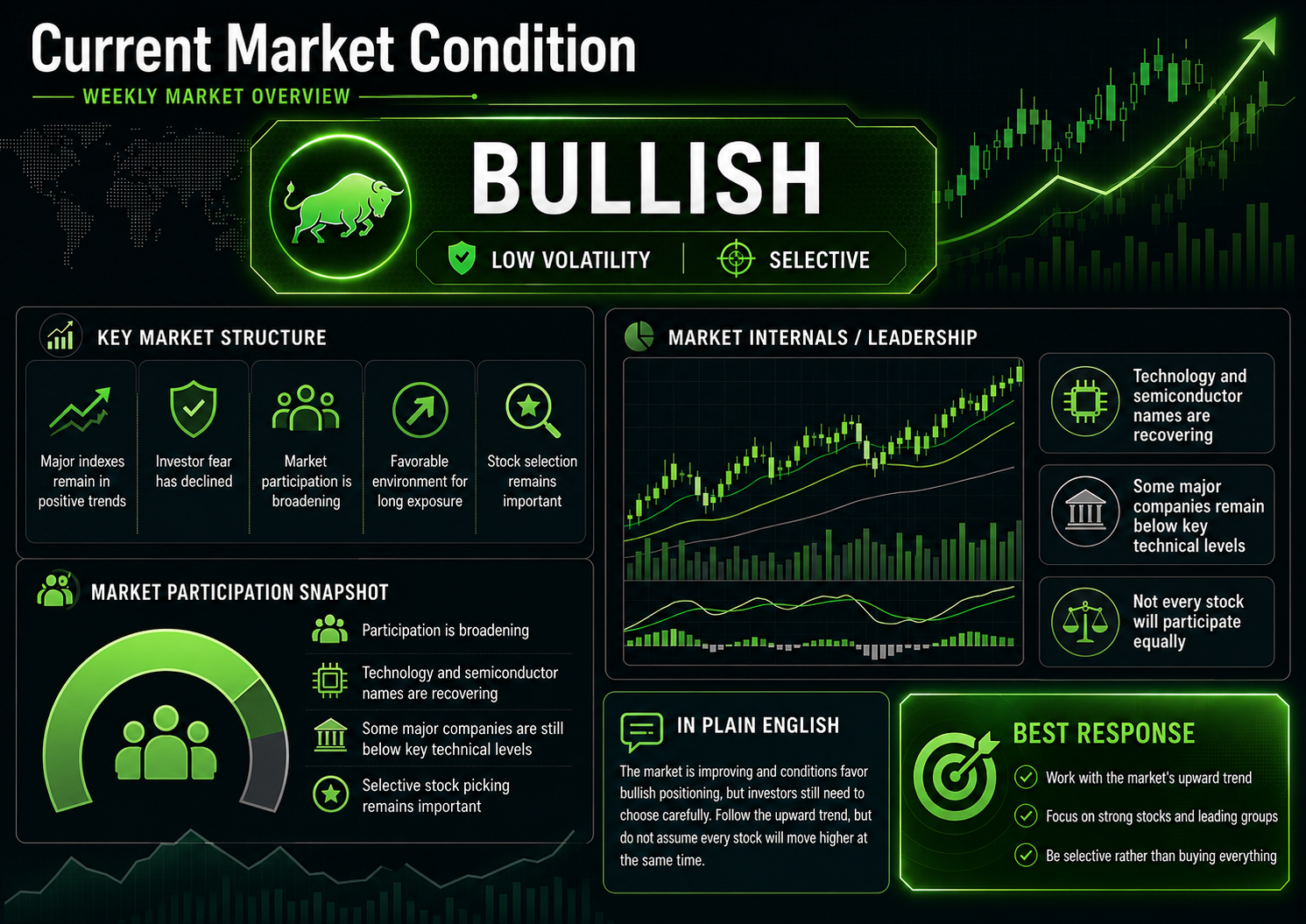
Current environment: bullish, low-volatility, but selective.
The major indexes remain in positive trends, investor fear has declined, and market participation is broadening. That creates a favorable environment for long exposure, but individual stock selection remains important.
Several technology and semiconductor names are recovering, while some major companies are still below important technical levels. The best approach is to work with the market's upward trend without assuming that every stock will participate equally.
Stock Tips This Week

Are You Overtrading? How a Trading Plan Can Protect Your Returns and Your Mindset
In this video, the focus is on one of the easiest ways traders sabotage otherwise reasonable strategies: unnecessary activity. Constantly checking positions, making adjustments without technical triggers, and reacting to FOMO can increase both trading costs and emotional fatigue. The practical lesson is to establish rules before entering a trade and act when those rules provide a reason—not simply because the market is moving.

Why Every Trader Needs a Trading Plan: Mark Yegge’s Cash Flow Machine Framework
In this video, Mark explains why the trading plan should come before questions about individual option strikes or adjustments. A complete plan should define the objective, position size, market conditions, stock conditions, circuit breaker, entry rules, and how the position will be managed if circumstances change. The central idea is simple: make difficult decisions before money and emotion are involved.

SpaceX Covered Calls: Rolling for Income While Managing Downside Risk
In this video, a SpaceX covered-call position is used to demonstrate how an income-focused trader can adapt as a stock changes direction. The discussion emphasizes capturing remaining option premium, rolling calls as conditions improve, maintaining some downside protection, and avoiding an aggressive adjustment that could create a whipsaw if the stock suddenly reverses.
The 3% Rule: How Covered Calls Can Turn Stock Holdings Into Monthly Income
In this video, Mark presents his “3% rule” as a framework for thinking about covered calls as a recurring income strategy rather than relying exclusively on share-price appreciation. The key considerations are strike selection, available option premium, volatility, assignment risk, and repeating a disciplined process. The 3% figure is presented as a target within the framework, not a guaranteed return.

SPY at an All-Time High: Turning a Bullish Breakout Into Covered-Call Income
In this video, SPY's bullish breakout is used to compare two different ways of structuring covered-call exposure. A more defensive “Fortress” approach places greater emphasis on current option income and downside cushion, while a higher-strike “Rocket” approach leaves more upside available but depends more heavily on continued market appreciation. The lesson is to understand exactly how much of a trade depends on income already collected versus a future market move.
Covered Call Drawdown Protection With Collar Strategy
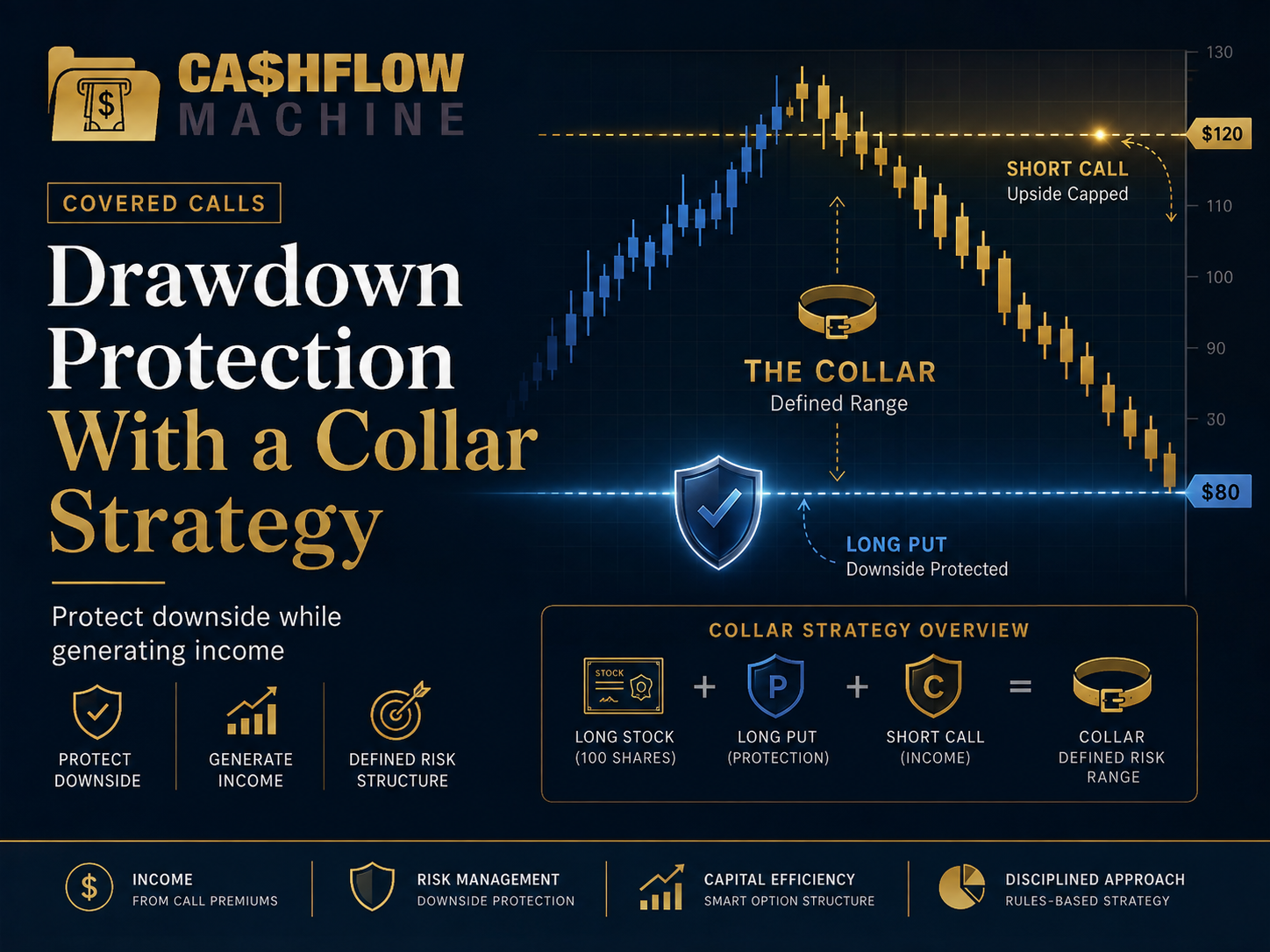
In this blog, the focus shifts from generating income to controlling what happens when the underlying stock falls sharply. A collar combines stock ownership and a covered call with a protective put, creating a predefined downside floor in exchange for the cost of that protection. The broader lesson is that premium income alone does not eliminate stock risk; a serious risk-management framework needs to define what happens when the market moves substantially against the position.
Upcoming Event

Wealth Accelerator Strategy Room — Clearwater, Florida
The Wealth Accelerator Strategy Room is scheduled for October 30 through November 1 in Clearwater, Florida.
Rather than a large conference format, the event is designed as a smaller, workshop-oriented gathering where participants can bring their laptops and work through trading plans, market opportunities, Cash Flow IQ and AI-assisted trading tools, and potential setups heading into the final months of the year and the beginning of the next.
The emphasis is intended to be practical: applying the concepts, reviewing strategies, and discussing how to approach changing market conditions in a smaller group environment. Hope to see you there!
