
The Mag 7 AI Footnote Debt Problem: What Investors Should Watch Next
The Mag 7 AI Footnote Debt Problem: What Investors Should Watch Next
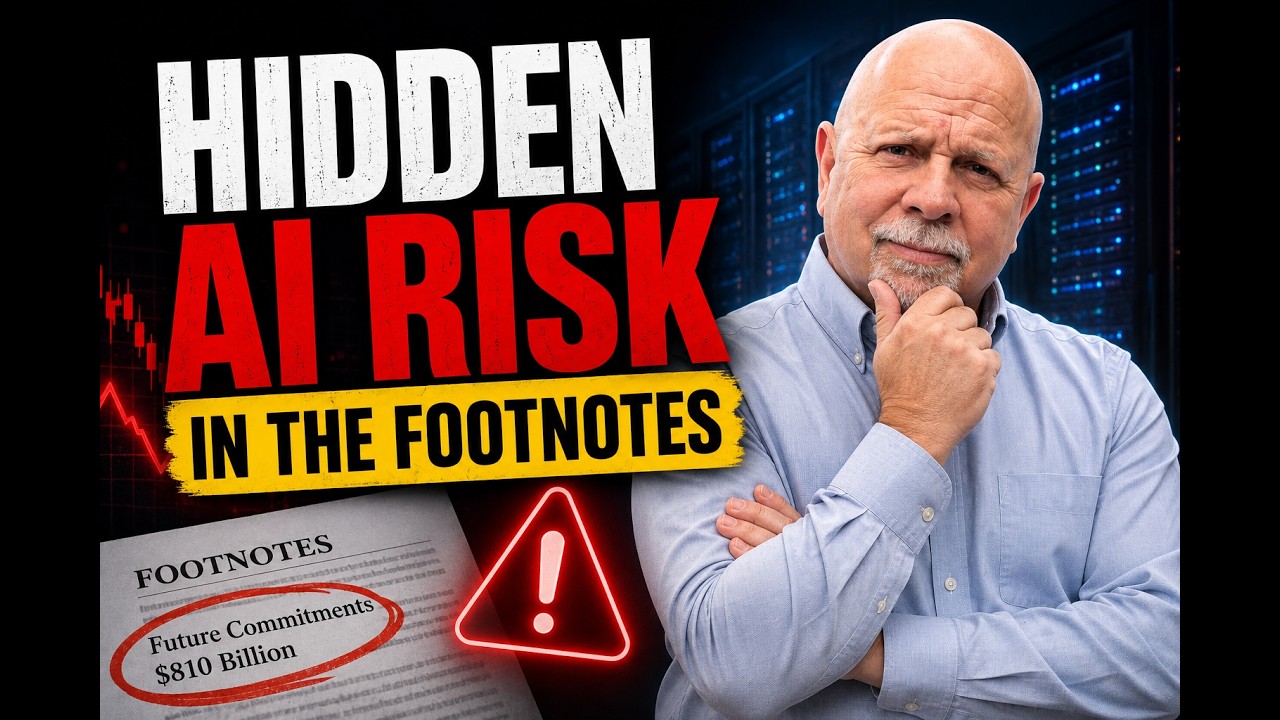
The AI trade has become one of the biggest forces in the market. But Mark’s message is that investors should look beyond the headline excitement and pay attention to what may be hiding in the footnotes.
In this Market Pulse update, Mark discusses the massive AI infrastructure buildout across the largest technology companies, the future obligations attached to data centers and compute capacity, and why cheaper open-weight models may pressure the economics of the entire AI boom.
The key lesson is simple: AI may still be the future, but expensive growth stories can carry risks that do not always show up clearly in headline earnings numbers.
Key Takeaways
The Big AI Trade Has a Footnote Problem
Mark begins by acknowledging the obvious: AI is a major force in the market. He believes AI is important and likely to remain a powerful long-term theme.
But the warning is that investors should not only look at the exciting part of the story. They also need to look at the footnotes, commitments, and future obligations connected to the AI buildout.
In Mark’s view, the danger is not that the largest technology companies are suddenly insolvent. The danger is that investors may be underestimating how much future spending has already been committed.
Why the Footnotes Matter
Traditional balance-sheet debt does not always tell the whole story. Mark explains that companies can make large future commitments for data centers, power, chips, leases, cloud capacity, and construction that may not yet appear like normal debt in the headline numbers.
Those commitments may become more visible later as facilities become active, leases begin, or purchase obligations move from future commitments into operating reality.
That is why investors need to look past the simple earnings headline. The real risk may be in the scale of what companies have promised to spend over the next several years.
Commitments Mark Says Investors Should Watch
- Data center construction commitments
- Power supply agreements
- Chip and compute capacity purchases
- Cloud infrastructure leases
- Long-term purchase commitments
- Useful life assumptions for AI hardware
The AI Buildout Is Expensive
The largest technology companies are spending enormous amounts of capital on AI infrastructure. That includes chips, servers, memory, power, cooling, networking, cloud capacity, and data centers.
This spending may be justified if AI demand continues to grow and if the revenue from that demand is strong enough to support the cost of the buildout.
But if AI pricing comes under pressure, or if capacity grows faster than profitable demand, the return on that spending could become a major market concern.
Why Cheaper Open-Weight Models Matter
Mark highlights the rise of lower-cost open-weight AI models as a potential threat to the economics of the AI boom.
His argument is straightforward: if customers can access a strong AI model at a much lower cost, pricing pressure may increase across the industry. That could reduce the revenue expectations that justify today’s aggressive infrastructure spending.
This does not mean the AI opportunity disappears. It means the market may need to reprice which companies actually earn strong returns on AI investment.
Different Mag 7 Companies Have Different Exposure
Mark walks through how the Magnificent 7 companies are not all exposed to AI in the same way. Some are spending heavily on data centers and compute. Others have more asset-light strategies or benefit from selling the tools that everyone else needs.
Microsoft, Amazon, Alphabet, and Meta are tied closely to cloud, software, advertising, and AI infrastructure. Apple may be less directly exposed to the same data-center spending burden if it relies more heavily on partners and licensing. Nvidia benefits from powering much of the buildout, while Tesla has its own AI, autonomy, robotics, and infrastructure story.
The main point is that investors should not treat the Mag 7 as one single trade. Each company has a different obligation stack, business model, and AI return profile.
Questions to Ask About Each AI Leader
- How much capital is being committed to AI infrastructure?
- How much of that spending is already visible on the balance sheet?
- How much is still sitting in future commitments?
- How durable is the company’s AI revenue model?
- Could cheaper competitors pressure pricing?
- Will free cash flow support the spending plan?
What to Watch During Earnings Season
Mark says investors should pay close attention to AI spending commentary during earnings. The headline numbers are important, but the guidance and footnotes may reveal more about the future risk.
The key issue is whether capital expenditures and future commitments are being matched by strong free cash flow and credible revenue growth.
If companies continue to spend aggressively while AI revenue expectations weaken, the market may begin to question the valuation of the entire AI trade.
Earnings Season Checklist
- CapEx guidance versus free cash flow
- Growth in leases and future commitments
- Purchase obligations for chips, power, and data centers
- Useful life assumptions for AI hardware
- Revenue proof behind AI spending
- Credit-market reaction to rising obligations
The Bull Case and the Bear Case
Mark presents both sides of the argument. In the bull case, AI demand absorbs the capacity, margins hold up, customers keep paying, and the biggest technology companies earn strong returns on their investment.
In the bear case, competition increases, cheaper models pressure prices, infrastructure costs stay high, and the future cash yield on AI capacity falls below the cost of locking it in.
Mark is not saying the bear case must happen. He is saying investors should understand that it can happen and prepare accordingly.
Why This Matters for Covered Call Investors
For covered call investors, expensive AI stories can still be useful income candidates. High investor interest and elevated volatility can create attractive option premium.
But Mark warns against blindly buying the story. A strong theme does not eliminate downside risk, and a high-premium stock often carries higher risk for a reason.
That is why he prefers a conservative covered call approach, often using deeper in-the-money structures when risk is elevated.
Education Beats Storytelling
The larger lesson is that investors need to understand what they own and why they own it. AI is a powerful trend, but powerful trends can still become crowded, overvalued, or vulnerable to changing assumptions.
That is why education matters. Investors need to understand the balance sheet, footnotes, option premium, valuation, free cash flow, and the risks behind the narrative.
Markets often price the exciting headline first. The footnotes usually matter later.
The Bottom Line
The AI trade may still have enormous long-term potential, but Mark warns that investors should not ignore the hidden obligation side of the story.
Data centers, power agreements, chip commitments, cloud capacity, leases, and future obligations can change the real economics of the Mag 7 AI buildout.
If AI demand remains strong and pricing holds, the spending may prove justified. If cheaper models pressure revenue, the market may need to reassess the valuations attached to the AI boom.
For covered call investors, the answer is not panic. The answer is discipline: know the stock, understand the story, respect the risk, and use income strategies conservatively.
Want to learn how to generate income with covered calls?
Watch the free masterclass and learn how covered calls, risk management, chart reading, and disciplined income strategies can help investors avoid blindly chasing market stories.
