
SpaceX Covered Call Defense: Rolling From 155 to 145 for More Downside Cushion
SpaceX Covered Call Defense: Rolling From 155 to 145 for More Downside Cushion
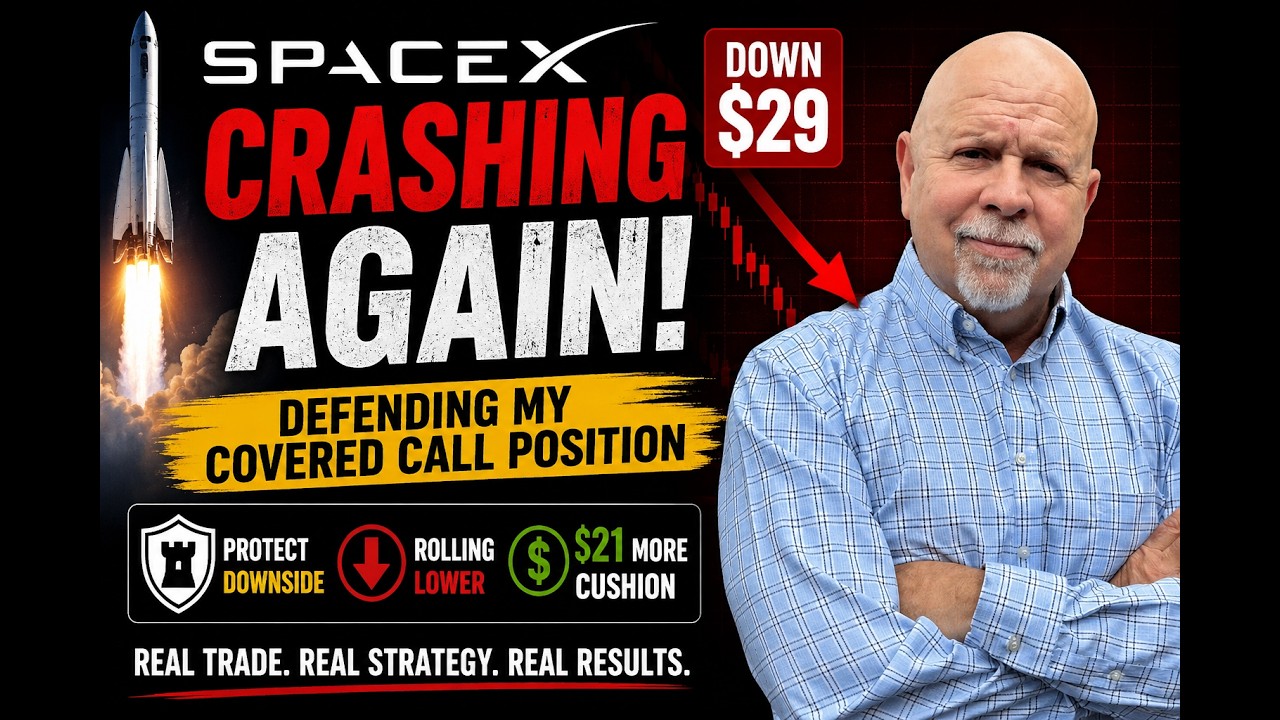
SpaceX continued to sell off, forcing another live covered call adjustment. Mark uses the move to show why defending the position matters when a volatile stock keeps falling.
In this update, Mark rolls the short call from the 155 strike down to the 145 strike. The goal is not to chase upside. The goal is to protect the in-the-money amount and create another layer of downside cushion.
The key lesson is simple: covered calls are not automatically safe. They need to be managed, especially when the stock is dropping quickly after an IPO surge.
Key Takeaways
Why Mark Made Another Update
Mark opens the video by explaining that he is recording for the second time in one day because SpaceX is falling again. The stock had already dropped sharply, and it was trading near the strike he had just defended earlier.
That created another important decision point. If the stock continued to move below the short strike, the in-the-money protection could begin to disappear.
Rather than waiting and hoping, Mark chose to defend the position again.
The Setup: From 170 to 155, Then 155 to 145
Earlier, Mark had rolled the short call from the 170 strike down to the 155 strike. That gave the position more room as SpaceX continued to pull back.
But as the stock fell toward the 155 area, the new short strike became the next level to defend. That is why Mark decided to roll again, this time from 155 down to 145.
This is the core idea behind the defense process: move the protection lower when the stock threatens the current protective strike.
The Defensive Roll Path
- Initial defense level: 170 strike
- First roll: down to the 155 strike
- Second roll: down to the 145 strike
- Goal: preserve downside protection
- Priority: protect the account before chasing upside
Why the 145 Strike Was the Next Defensive Level
Mark chooses the 145 strike because it creates another layer of cushion below the current stock price.
The lower strike means the short call has more in-the-money amount. That in-the-money amount can help offset further losses if SpaceX continues to decline.
The trade-off is that the lower strike reduces upside flexibility. But when the stock is falling hard, Mark’s priority is defense, not maximum upside.
The Cost of the Roll: Giving Up Some Juice
Rolling down is not always free. In this case, Mark explains that he had to buy back the 155 calls with more juice than he originally collected earlier that day.
He then sold the 145 calls, which still had significant extrinsic value. The net effect was that the roll cost some premium, but created more downside cushion.
This is an important point for covered call traders. Sometimes the best defensive decision is not the one that collects the most premium immediately. It is the one that protects the position from a larger loss.
What the Roll Accomplished
- Bought back the 155 short calls
- Sold the 145 short calls
- Accepted some juice cost
- Created additional downside cushion
- Protected more of the in-the-money amount
- Reduced the risk of waking up below the defended strike
Why Small Float Can Make Defense More Important
Mark also points out that SpaceX has a small float. When fewer shares are freely trading, the stock can swing more aggressively in both directions.
That means a trader cannot assume the stock will move smoothly. A sharp move lower can happen quickly, and a sharp rebound can also happen quickly.
Because of that, Mark wants protection in place before the stock opens below the next important level.
Why Traditional Covered Calls Can Fail Traders
Mark warns that many traders learn covered calls the simple way: buy the stock, sell an out-of-the-money call, and collect income.
That can work in calm markets, but it may not provide enough protection when a stock drops quickly. The investor may think they are protected, but the premium may only cover a small part of the decline.
That is why Mark prefers the Fortress strategy in situations like this. The goal is to start with more protection and then adjust as the stock moves.
The Fortress Strategy in Action
Mark describes this as an example of using the Fortress strategy correctly. The Fortress approach uses in-the-money covered calls to create more downside protection than a traditional out-of-the-money covered call.
The strategy does not eliminate risk, and Mark is clear that the position can still lose money. But compared with simply owning the stock through a large decline, the covered call structure has helped reduce the damage.
That is the main lesson: the structure is designed to help the trader survive volatility.
Protecting the Account Comes First
Mark makes it clear that he would rather pay some premium to defend the position than wake up the next morning with the stock far below the strike.
This is a major mindset shift. Many traders focus on maximizing income. Mark is focused first on protecting the account.
When the stock is moving fast, the defensive decision may feel uncomfortable. But waiting too long can be worse.
The Bottom Line
This SpaceX update shows another real-time example of defending an in-the-money covered call position. As the stock fell toward the 155 strike, Mark rolled down to the 145 strike to create more downside cushion.
The roll cost some juice, but it added protection at a time when the stock was moving quickly. For Mark, that trade-off made sense because defense was more important than squeezing maximum premium.
The broader lesson is that covered call traders need to understand more than income. They need to understand in-the-money protection, rolling, extrinsic value, and how to respond when a stock keeps falling.
In volatile stocks, the trader who defends early may be in a much better position than the trader who waits and hopes.
Want to learn how to generate income with covered calls?
Join the Income Accelerator and learn how to use covered calls, Fortress-style protection, rolling rules, and trade adjustments.
