
Insider Tips - Weekly Stock Market Report - Week June 08, 2026
Insider Tips — June 08, 2026
The market remains technically green this week, but the tone underneath the surface feels more complicated than the headline numbers suggest. Broad indexes are still holding up, volatility remains contained, and the broader trend has not fully broken. However, several major technology and AI-related names are starting to show weakness after strong runs, and that deserves attention.
The main message this week is simple: stay constructive, but do not ignore the warning signs. A green market does not mean every sector is healthy. In fact, this week’s action shows a clear difference between the broader market and the technology trade. Some areas are still working, while parts of the AI, semiconductor, crypto, and high-growth leadership group are beginning to roll over.
The key opportunity remains disciplined participation in a market that is still trending higher. The key risk is complacency. When leaders start to weaken, when volume increases on selling days, and when major stocks gap down after earnings, investors need to pay close attention. This is not a panic environment, but it is a market that requires sharper risk management.
Technical Analysis
The market timing model remains fully green, and that matters. When the broader trend is still positive, the base case should remain constructive. However, the chart action this week is less clean than the indicator alone suggests.
The Nasdaq and QQQ are the biggest concerns. Technology has seen several consecutive days of selling, and the selling pressure appears to be increasing. That does not automatically mean the rally is over, but it does show that momentum is cooling in the market’s most important leadership area. When high-growth technology names stop leading, the broader market can still rise, but the quality of the rally becomes more questionable.
The S&P 500 is holding up better. It is pulling back toward support rather than breaking down aggressively. That kind of action can be normal after a strong move, especially if the selling remains controlled. The Dow, meanwhile, looks healthier, recently making a strong move higher and giving back only part of that gain on lighter volume. That suggests investors may be rotating rather than fully exiting risk.
The NYSE Composite is more mixed. It has not made a recent all-time high while other indexes have pushed higher, and that raises a breadth question. If the market is truly strong, broader participation should eventually confirm it. A rally led by fewer and fewer names can continue for a while, but it becomes more fragile over time.
Volatility remains relatively calm. The VIX has lifted slightly, but not enough to signal broad fear. That creates a mixed setup: the market is not in panic mode, but some of the former leaders are clearly under pressure.
Market Trends I’m Calling Out
The first major trend is technology fatigue. AI-related names have had a powerful run, but several charts now look extended, tired, or vulnerable to gap fills and moving-average tests. This does not mean the AI theme is dead. It means the trade may be entering a more selective phase.
The second theme is liquidity risk around the SpaceX IPO. A major IPO can attract capital from other areas of the market. Whether investors are selling Bitcoin, MicroStrategy, or high-growth technology names to raise cash is impossible to prove from the chart alone, but the timing is worth noting. When a heavily hyped deal enters the market, retail investors should be careful not to become exit liquidity for earlier holders.
The third theme is interest-rate pressure. A strong jobs report may sound positive for the economy, but it can complicate the market’s outlook if it reduces the odds of rate cuts or increases concern about tighter monetary policy. Higher rates generally make money more expensive, which can pressure growth stocks and long-duration assets.
The fourth theme is earnings risk. Broadcom’s sharp decline is an important reminder that a strong chart can still break quickly when expectations are too high. Earnings reports can reset a stock’s technical structure overnight, especially when the reaction comes with heavy volume.
Individual Stocks: What I’m Seeing
Apple
Apple remains one of the stronger technology names on the board. While many tech stocks are weakening, Apple has continued to hold up and recently pushed into new-high territory. That relative strength matters.
However, after a strong move, Apple no longer looks early. It may still be acting well, but the risk-reward is not as attractive as it was near the earlier buy zone. For investors already in the name, the chart remains constructive. For new entries, patience is more important.
Nvidia
Nvidia is sending a more complicated message. The company remains the symbol of the AI trade, but the stock’s recent action is not as strong as many investors might expect from a market leader.
After a powerful breakout and rally, Nvidia gave back a meaningful portion of the move. That raises an important question: is this simply normal digestion after a major run, or is the AI trade becoming too crowded? The answer is not obvious yet, but the chart deserves respect. When the leading stock in the leading theme stops acting cleanly, investors should pay attention.
Micron
Micron had a sharp run and now appears to be losing momentum. The recent gap-down action and follow-through selling suggest the stock may need to cool off and possibly fill a gap below.
This is not necessarily a long-term bearish call, but in the short term the chart looks vulnerable. Momentum traders should be careful when a stock shifts from a clean upward run into repeated selling days.
AMD
AMD is also pulling back, but the volume profile looks less alarming. Weakness on lighter volume is different from heavy institutional selling. That makes AMD less concerning than some of the other technology names at this stage.
The key is whether buyers defend support and whether volume expands on a rebound. If the stock continues lower on rising volume, the view changes. For now, it looks more like a controlled pullback than a major breakdown.
Bloom Energy
Bloom Energy has been part of the broader AI infrastructure and energy theme, especially around data center demand. The stock had a major run in a short period, which means some profit-taking is normal.
The concern is that the chart now looks like it wants to test lower levels. The gap area and major moving averages may come into play if selling continues. After a fast move higher, the best approach is to avoid chasing and wait for the stock to prove it can stabilize.
SanDisk
SanDisk is giving back part of a large move, but the volume does not suggest a severe breakdown yet. That matters. A pullback after a huge run can be healthy if it happens in an orderly way.
This does not look like an obvious short setup based on the visible action. It looks more like a stock digesting gains. The next clue will be whether buyers step in near support or whether sellers begin to gain control on heavier volume.
GE Aerospace
GE Aerospace stands out as one of the cleaner-looking charts this week. While many technology names are under pressure, GE Aerospace appears to be acting well and holding strength.
The chart shows a constructive base, with a referenced buy point around 319.14. The strongest part of the setup is the pattern of up days followed by lighter-volume pullbacks. That type of action often suggests institutions are still supporting the stock. For watchlist purposes, this is one of the more constructive names mentioned this week.
Gold and Silver
Gold has weakened and failed to hold an important support area. The more important lesson here is not the metal itself, but the discipline around circuit breakers. When a position breaks a predefined risk level, hope cannot become the strategy.
Silver looks weaker than gold in this update, with a gap down on higher volume. That type of action suggests sellers are more active. Until the chart stabilizes, the precious metals trade looks defensive rather than attractive.
Bitcoin and MicroStrategy
Bitcoin and MicroStrategy are both under pressure. MicroStrategy had a large advance earlier in the year, but it has now given back a meaningful portion of that move.
This is a reminder that high-beta trades can move both ways very quickly. When Bitcoin weakens, MicroStrategy often amplifies that move. Traders need to be careful with position size and risk levels in names tied to crypto momentum.
Carvana
Carvana is being viewed from the short side in this week’s commentary. The concern is both the business model and the chart pattern. The stock appears to be showing a setup that may favor downside if selling pressure continues.
Short selling requires extra discipline because risk can move quickly against the trader. The key is not simply having a bearish opinion. The key is having a defined pattern, a clear invalidation level, and a plan before entering.
Broadcom
Broadcom may be the most important warning sign of the week. The stock sold off sharply after earnings, falling significantly in a very short period. That kind of move can damage a chart because it creates overhead supply.
The lesson is bigger than Broadcom alone. When a major technology stock breaks after earnings, it can become a warning for the broader tech sector. It does not automatically mean the market is turning bearish, but it does mean investors should be careful about assuming every dip is a buying opportunity.
Key Takeaways
- The market remains green, but leadership is becoming less clean.
- Technology and AI stocks are showing early signs of fatigue.
- Strong jobs data may reduce hopes for easier monetary policy.
- IPO excitement can create liquidity shifts and emotional buying risk.
- Broadcom’s earnings drop is a warning about expectations and gap risk.
- Relative strength matters; Apple and GE Aerospace look stronger than many tech peers.
- Circuit breakers and predefined exits matter more when volatility returns.
Conclusion
This is still a market to respect on the long side, but it is no longer a market where investors should ignore risk. The broader trend remains constructive, yet several important leaders are weakening. That combination calls for discipline, not fear.
The best approach is to stay aligned with the market’s current condition while tightening risk controls. Watch the Nasdaq, watch the AI leaders, watch volume on selling days, and pay close attention to whether support levels hold. If the weakness remains contained, the market can repair itself. If selling accelerates, capital protection becomes the priority.
The goal is not to predict every turn. The goal is to recognize when the character of the market is changing and adjust before damage becomes expensive.
Current Market Condition
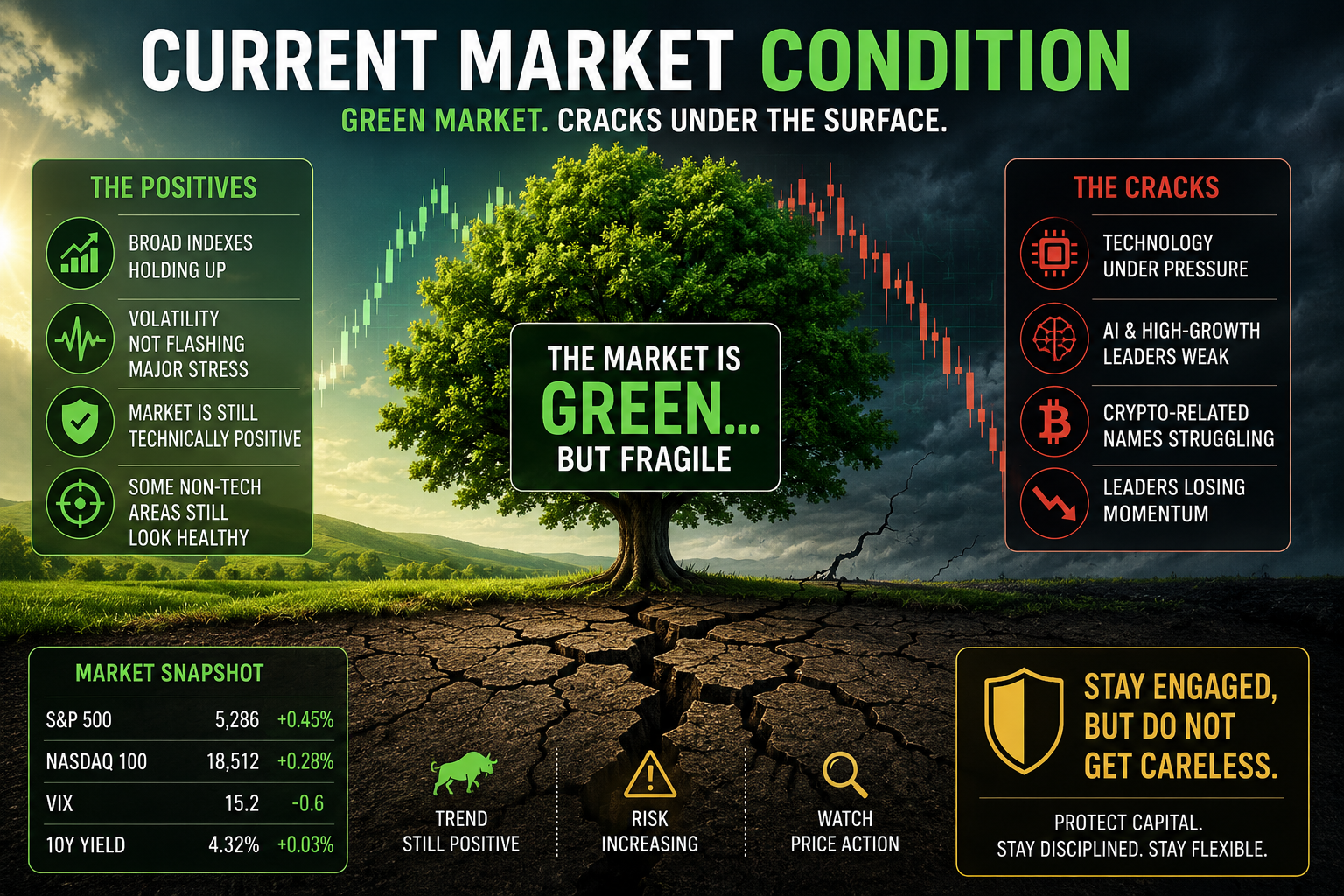
The market is still technically positive, but it feels more fragile than it did a week ago. Broad indexes are holding up, volatility is not flashing major stress, and some non-tech areas still look healthy. At the same time, technology, AI, crypto-related names, and some high-growth leaders are under pressure.
This is a green market with cracks under the surface. Stay engaged, but do not get careless.
Stock Tips This Week
The One Mistake That Could Cost Retirees $500K — And How to Fix It in 10 Minutes a Week
In this video, the main lesson is that investors cannot improve what they do not measure. The discussion focuses on the “mediocrity trap,” where people accept average returns without knowing whether those results are actually enough for retirement income. The practical takeaway is to track performance, understand your real return, and build a repeatable process instead of relying on hope.

Broadcom Earnings Drop: A Market Warning Traders Should Not Ignore
In this video, Broadcom is used as a case study in earnings risk. Even a strong stock can fall sharply if expectations are too high or if the market reacts poorly to results. The key lesson is to respect high-volume gap downs, avoid emotional decisions after earnings, and wait for a damaged chart to rebuild before assuming the stock is ready to recover.

Best Stocks For Covered Calls 2026
In this blog, the covered-call focus is on selecting liquid, high-quality names with strong trends and active options markets. The article emphasizes stocks in confirmed uptrends, proper position sizing, and reviewing the list regularly. The lesson is that covered-call income starts with stock selection; the option premium only matters if the underlying stock is worth owning and managing.
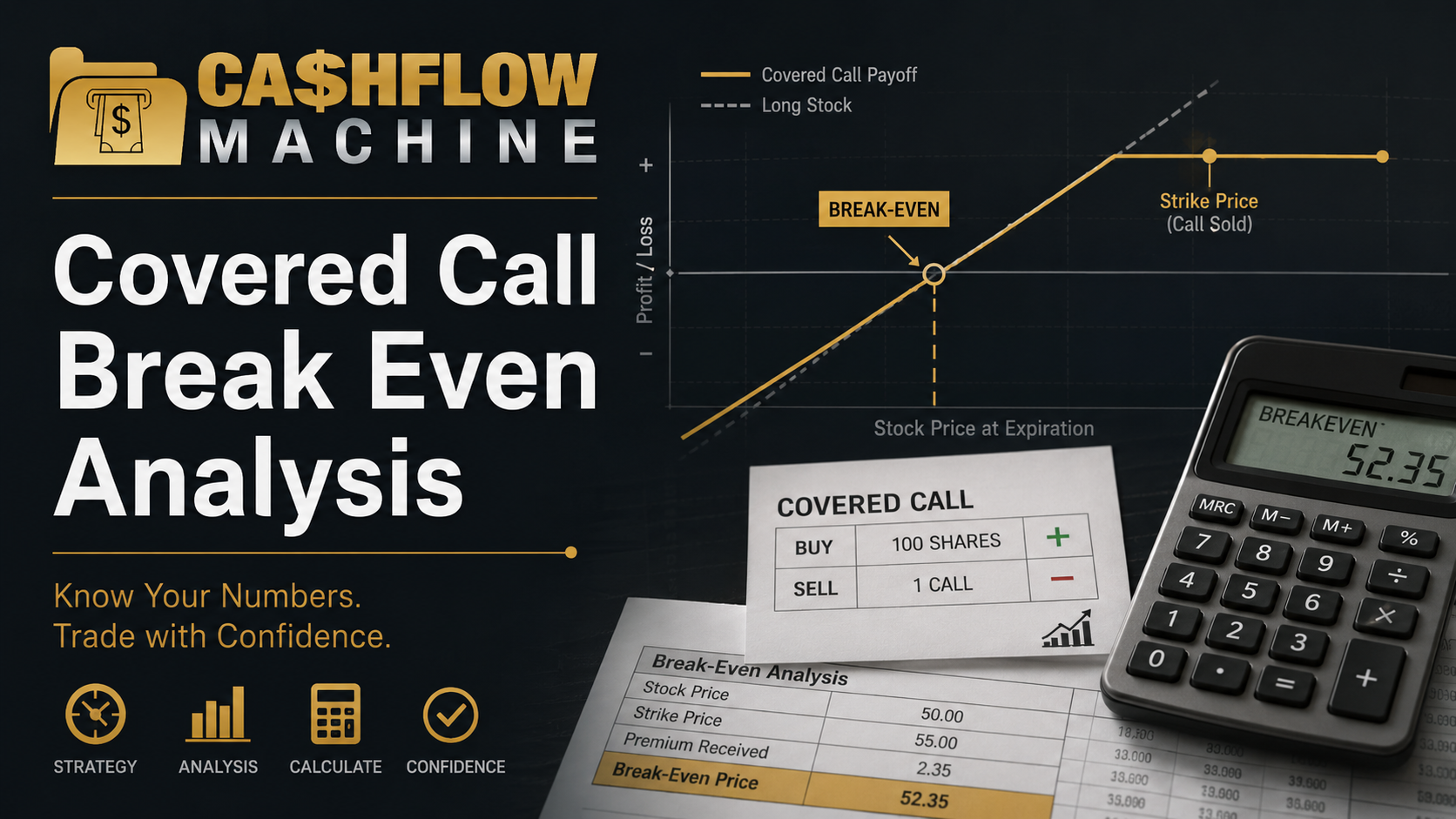
Covered Call Break Even Analysis
In this blog, the key idea is that every covered-call trade needs a clear break-even plan before entry. Investors should know what happens if the stock stays flat, moves higher, or drops. The premium collected can provide a cushion, but it does not eliminate downside risk. The practical takeaway is to write down the real break-even level before placing the trade.

Covered Call Theta Decay Timing
In this blog, theta decay is explained as the income engine behind covered calls. The article focuses on timing, especially the importance of selling calls with enough time for premium but not so much time that decay becomes inefficient. The useful takeaway is to track days to expiration, monitor extrinsic value, and treat time decay as a process rather than a guess.
🤖 NEW: CFM AI Has Arrived

🤖 NEW: CFM AI Has Arrived
We're excited to announce that Cash Flow Machine is embracing AI with the launch of CashFlowIQ—our new AI-powered trading companion designed to help you learn faster, improve execution, and get even more value from the CFM system.
CashFlowIQ is built to reinforce the principles you already know, helping you think through trades, strengthen your process, and become a more disciplined investor.
For Elite & Mastermind Members
You can learn more about CashFlowIQ by logging into your Elite Course Library and navigating to:
Module 2 → Toolbox
There you'll find an overview of the program along with information on the available Monthly and Annual membership options.
Not an Elite Member Yet?
CashFlowIQ is currently available exclusively to our Elite and Mastermind members.
If you'd like to learn more about becoming an Elite member and unlocking access to CashFlowIQ, along with our complete Cash Flow Machine training system:
👉 Learn More: https://cashflowmachine.net/cashflowiq/
We're incredibly excited about the future of AI and believe this technology will help our members accelerate their learning, improve their execution, and build greater confidence in their trading decisions.
We look forward to hearing your feedback as we continue to develop and improve the platform!
We're incredibly excited about the future of AI and believe this technology will help our members accelerate their learning, improve their execution, and build greater confidence in their trading decisions.
We look forward to hearing your feedback as we continue to develop and improve the platform!
