
Insider Tips - Weekly Stock Market Report - Week June 29, 2026
Insider Tips — June 29, 2026
Yellow Market Warning: Technology Weakness, Rising Volatility, and a Time to Weed the Garden
This week’s market tone is cautious, not outright bearish, but clearly no longer in “press the accelerator” mode. The market has moved back into a yellow condition, which means investors do not need to panic, but they do need to become more selective. This is the kind of environment where the goal is not to chase every bounce. The goal is to protect quality, reduce weak exposure, and stay alert for a cleaner signal.
The biggest issue right now is the behavior of technology. The Nasdaq recently bounced from its 50-day moving average, but the failure to make a new high is important. When a major index loses momentum near prior highs and then begins testing support again, it often signals rotation, fatigue, or a change in leadership. That does not guarantee a major breakdown, but it does tell us the market is no longer giving investors the easy green-light setup we had earlier.
The practical stance this week is simple: this is a time to “weed the garden.” Strong positions can still be held and managed, but weaker names deserve closer review. If a stock is breaking support, losing relative strength, or showing heavy selling volume, this is not the moment to ignore it and hope. Discipline matters more than prediction.
Technical Analysis
The Nasdaq is the main concern. After a healthy bounce off the 50-day moving average about a month ago, the index pushed higher but failed to make a new high. That failure matters because strong markets typically push through prior highs with conviction. Instead, the Nasdaq rolled over and moved below the 50-day moving average with notable volume.
That creates a potential “dreaded H” pattern: a drop, a weak recovery, and then another rollover toward support. The key area discussed was around the prior pivot near 24,980. If that level cannot hold, the next logical areas to watch are lower support and gap-fill zones, potentially closer to the 24,000 area or the 200-day moving average.
The S&P 500 looks slightly better, but not strong enough to ignore the warning. It also tested the 50-day moving average and was trying to reclaim it. A single close below the 50-day is not necessarily fatal, but it becomes meaningful if the index cannot quickly recover and hold above that level. The S&P also has a smaller version of the same rollover pattern, with nearby downside levels that could come into play if buyers fail to defend support.
The New York Stock Exchange Composite remains relatively stronger. It has been holding up better than the Nasdaq and recently approached all-time-high territory. That tells us the weakness is not universal across the entire market. However, technology has enough weight and influence that Nasdaq weakness can eventually pull the S&P 500 and broader market lower.
Volatility is also rising. When volatility moves above its 50-day moving average, it usually means the market is becoming more nervous. For options sellers, higher volatility can create more premium, or “juice,” but it also comes with faster downside moves and sharper reactions. That is why higher volatility is both an opportunity and a warning.
Market Trends I’m Calling Out
The first major theme is technology weakness. Nasdaq leadership has started to look tired, and several large-cap technology names are no longer acting like unquestioned market leaders. When the biggest sector begins to lose momentum, the broader market often becomes more vulnerable.
The second theme is rotation. Some areas, such as aerospace, select semiconductors, and certain hardware-related names, are still showing strength. This is not a market where everything is falling apart. It is a market where leadership is becoming more selective.
The third theme is risk management. Yellow markets are often frustrating because they can head-fake both bulls and bears. They may flash green for a few days, then weaken again. That makes this a poor environment for emotional decision-making. Investors should be cleaning up weak positions, tightening rules, and focusing capital on names that continue to show real strength.
The fourth theme is volatility expansion. Higher volatility can improve option income opportunities, but it also increases the need for stops, circuit breakers, and position sizing discipline. More premium is useful only if the trade is structured with risk in mind.
Individual Stocks: What I’m Seeing
Apple
Apple showed one of the more concerning technical moves this week: a gap down on volume below the 50-day moving average. That combination is usually a warning sign. A gap lower is one thing. A gap lower on meaningful volume, below a key moving average, suggests institutions may be reducing exposure.
Technically, Apple appears vulnerable to further testing of support, potentially toward its 200-day moving average if buyers cannot stabilize the stock. The fundamental story is more balanced. Apple’s hardware demand appears strong, and price increases could support revenue growth over time. But the chart is currently sending a caution signal, and in a yellow market, the chart deserves respect.
Nvidia
Nvidia remains one of the most important tells in the market. For a company associated with AI leadership and massive market-cap strength, the stock has not been acting as powerfully as expected. Its relative strength has weakened, and the chart no longer looks like a clean leadership setup.
That matters because Nvidia is not just another stock. It is a symbol of the AI trade. If Nvidia loses leadership, it can affect sentiment across semiconductors, AI infrastructure, and the Nasdaq more broadly. The key question is whether Nvidia can regain momentum or whether it continues toward deeper support, including the 200-day moving average.
SanDisk
SanDisk continues to look strong on a relative basis. The stock has been hitting all-time highs and remains one of the clearer outperformers. However, even strong stocks can pause in yellow markets. The current inside-day action is not necessarily bearish, but it does suggest some hesitation after a powerful move.
The main takeaway is that strength remains strength until it breaks. SanDisk still belongs on the watchlist, but investors should avoid assuming that high-relative-strength names are immune to broader market pressure.
GE Aerospace
GE Aerospace stands out as one of the stronger charts discussed this week. The stock has been pushing higher, showing multiple weeks of constructive action and moving into breakout territory. The lack of heavy breakout volume is worth noting, but the repeated strong candles near all-time highs suggest buyers remain in control.
When a stock is trading near all-time highs, there are fewer overhead sellers. That can allow momentum to continue as long as the broader market does not deteriorate sharply. GE Aerospace remains one of the cleaner strength names in this environment.
Bloom Energy
Bloom Energy is in a more fragile position. The stock is testing its 50-day moving average on the weekly chart and has formed a concerning outside or bearish engulfing-style candle. That does not automatically mean the trend is broken, but it does make the current candle important.
If Bloom can hold near the 50-day moving average, the longer-term structure may remain intact. If it loses that area with volume, lower levels could come into play quickly. This is exactly the type of stock where investors need a predefined circuit breaker rather than an emotional reaction after the damage is done.
AMD
AMD continues to act well. The stock has shown excellent relative strength and recently reached new highs. This kind of strength is important because it shows that not all semiconductor names are under pressure.
The key difference between AMD and weaker technology names is relative performance. In yellow markets, the best stocks tend to reveal themselves by holding up better than the indexes. AMD remains one of the stronger names on the board, but after a strong run, discipline still matters.
Micron
Micron had a powerful move following earnings and continued to show strength. Earnings-driven moves can be important because they often reset institutional expectations. When a stock gaps or pushes higher after results and then follows through, it suggests buyers are willing to support the new price level.
For now, Micron remains a stock to watch within the semiconductor and memory space. The important question is whether it can hold the earnings move rather than give it back quickly.
Iron
Iron is at an important technical decision point. The stock previously broke out from a downward triangle pattern, but it is now retesting that breakout area. Retests can be healthy if support holds. They become dangerous if the breakout fails.
If Iron cannot hold the breakout area, the $30 level becomes more important. A failure there would change the tone from constructive pullback to potential breakdown. This is a stock that needs confirmation, not blind confidence.
Tesla
Tesla still does not offer a strong near-term technical reason to be aggressive. Long-term themes like robotics and full self-driving remain interesting, but the current chart has been under pressure. A stock can have a compelling future story and still be a poor short-term setup.
For now, Tesla looks like a name to watch rather than chase. There may be a better time to revisit it, but in the current market environment, patience is more valuable than excitement.
SpaceX
SpaceX has been volatile after its IPO surge, and that volatility makes it an important case study for covered-call investors. The stock moved sharply higher after coming public, but it has also pulled back quickly. That is common with exciting IPO-style names: early enthusiasm can create a fast pop, but the first major pullback often tests whether investors had a real plan or were simply chasing the story.
For income-focused traders, the lesson is not to predict every move. The lesson is to structure trades with downside cushion, understand option premium, and manage risk actively when the stock moves against the position.
Key Takeaways
- The market remains in a yellow condition, which means caution and selectivity are more important than aggression.
- The Nasdaq is the biggest concern because it failed to make a new high and moved below the 50-day moving average.
- Technology weakness should not be ignored, especially when major names like Apple and Nvidia are flashing caution.
- Rising volatility creates more option premium, but it also increases the speed and size of market moves.
- This is a good time to review portfolios, remove weaker positions, and focus on higher-quality leadership.
- Strong names still exist, including select semiconductor, aerospace, and hardware-related stocks.
- Risk management matters more than market prediction in this environment.
Conclusion
This is not a market that requires panic, but it is a market that requires respect. The indexes are no longer showing broad, effortless strength, and technology is beginning to show real signs of pressure. When leadership weakens and volatility rises, investors should slow down, review their exposure, and become more intentional.
The best approach right now is to stay disciplined. Keep quality positions that continue to act well, but do not ignore breakdowns. Use stops, circuit breakers, and position sizing. The market may recover and move back into a cleaner green condition, but until that happens, this is a time to protect the garden before planting more seeds.
Current Market Condition
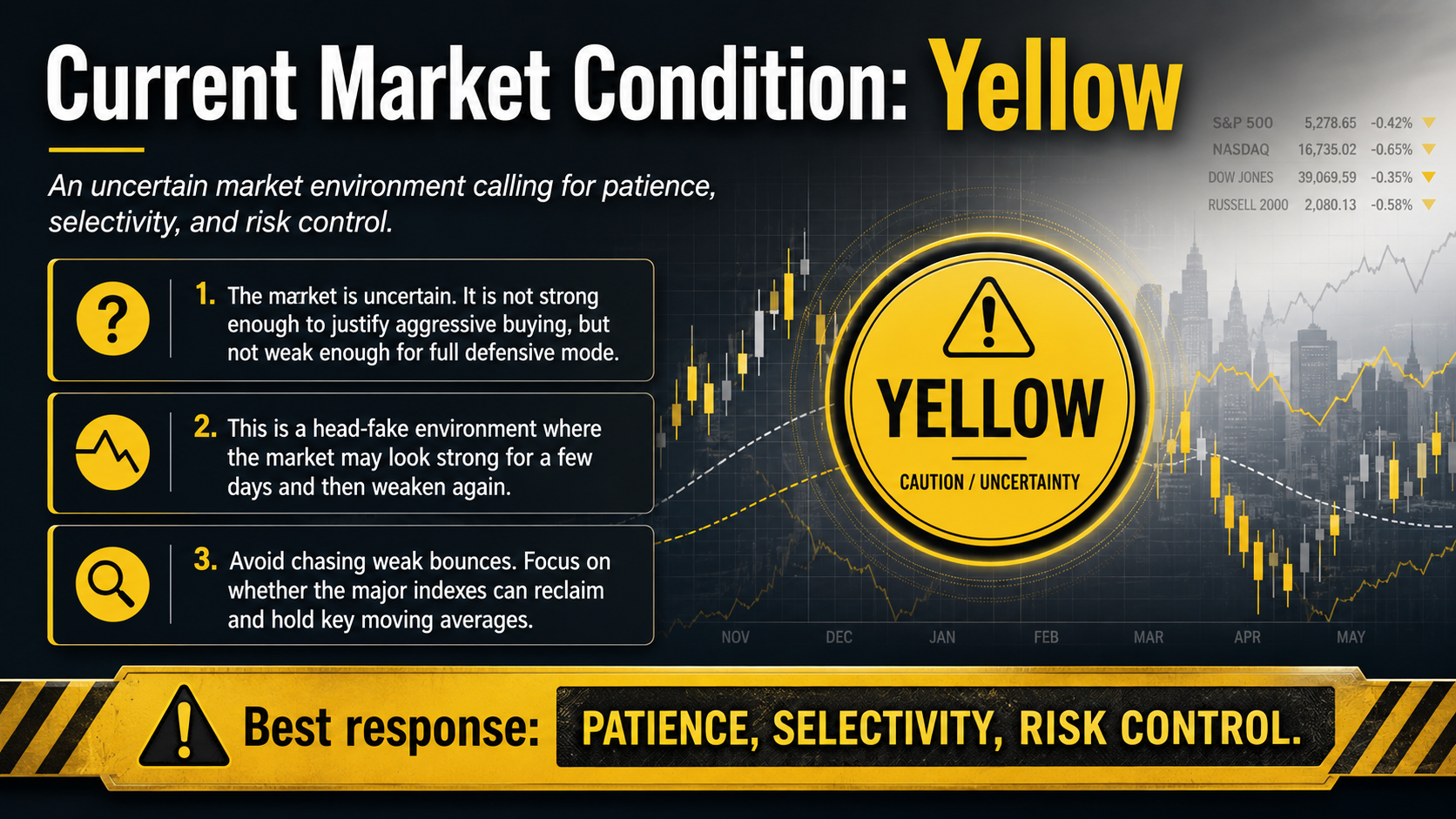
The current market condition is yellow. In plain English, that means the market is uncertain. It is not strong enough to justify aggressive buying, but it is not weak enough to automatically justify full defensive mode either.
This is a head-fake environment where the market can look strong for a few days and then weaken again. The best response is patience, selectivity, and risk control. Investors should avoid chasing weak bounces and instead focus on whether the major indexes can reclaim and hold key moving averages.
Stock Tips This Week

SpaceX Covered Call Case Study: How to Collect “Juice” While Managing IPO Risk
In this video, Mark uses SpaceX as a live covered-call case study after the stock’s post-IPO volatility. The lesson is that investors do not need to predict every price move if they have a structure. By focusing on option premium, downside cushion, and a clear trade plan, covered-call traders can approach volatile names with more discipline instead of simply buying and hoping.

SpaceX Covered Call Update: How to Defend Your Position When the Stock Drops
In this video, the focus shifts from entering a covered-call trade to defending it when the underlying stock moves lower. The key idea is that a trader should not wait passively while a volatile stock approaches a danger zone. Rolling down can add more downside cushion, even if it means giving up some premium. Defense comes first when the stock is falling quickly.

SpaceX Covered Call Update: Rolling Down, Delta, and Defending the Trade
In this video, Mark continues the SpaceX covered-call management lesson by explaining how delta and defensive rolls matter during a sharp pullback. The main takeaway is that covered calls are not passive income machines. They require active management, especially when a fast-moving stock begins to challenge the original structure.
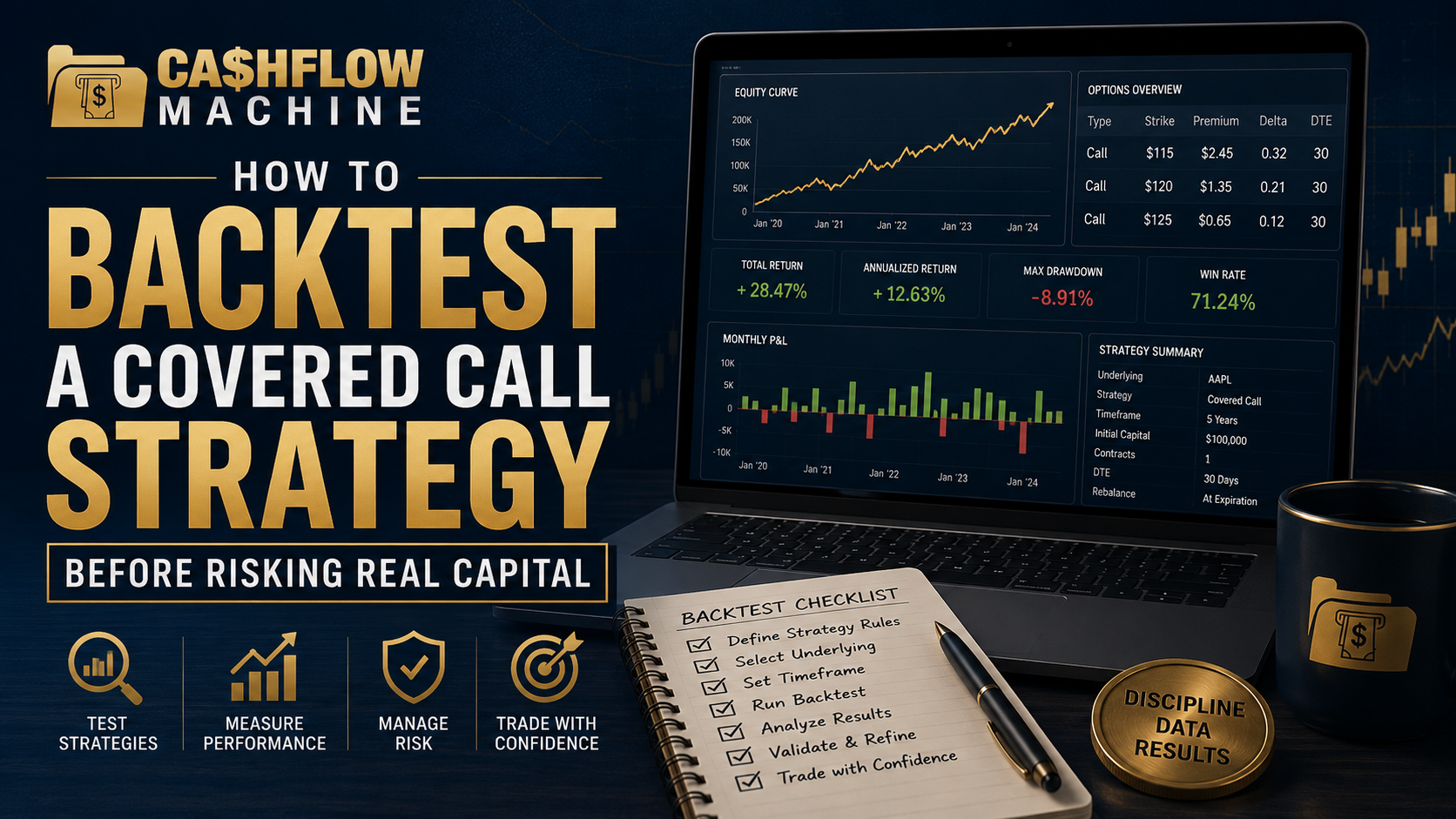
How to Backtest a Covered Call Strategy Before Risking Real Capital
In this blog, the lesson is that covered-call strategies should be tested before real money is committed. A useful backtest should include different market regimes, realistic costs, slippage, commissions, drawdowns, and clear rules for entries, exits, and rolls. The goal is not to create a perfect spreadsheet. The goal is to understand how the strategy behaves under pressure.

Covered Call on Real Estate Stocks: Property Cycle Strategy
In this blog, the focus is on using covered calls with real estate stocks and REITs through the property cycle. The strategy is built around owning quality real-estate assets during recovery or expansion phases, then selling calls to generate income while waiting. The bigger lesson is that covered calls work best when the investor understands the underlying business cycle, not just the option premium.

Poor Man’s Covered Call vs Traditional Covered Call: Which Income Strategy Wins?
In this blog, Mark compares traditional covered calls with poor man’s covered calls. The traditional covered call offers durability, dividends, and simplicity, while the poor man’s covered call offers more capital efficiency but adds LEAP decay and more complexity. The right choice depends on account size, time horizon, income needs, and risk tolerance.
