
Insider Tips - Weekly Stock Market Report - Week August 31, 2026
Insider Tips — August 31, 2026
Market Breadth Improves as Volatility Falls: NVIDIA Stalls, Microsoft Strengthens, and the Income Trade Stays Relevant
The market is finishing August on firmer footing. After a stretch of mixed signals, the broad indexes are beginning to line up more constructively: the broad market has returned to an uptrend, the Dow has strengthened, the S&P 500 has put together several positive sessions, and the QQQ is finally recovering from its weaker technical position.
That does not mean every part of the market is healthy. Leadership remains uneven, particularly among some of the largest technology names. NVIDIA’s earnings reaction showed that strong fundamentals do not automatically translate into an immediate breakout, while Alphabet, Meta, Amazon, and Tesla are still dealing with varying degrees of technical resistance.
My overall stance remains constructive but selective. Falling volatility and improving index charts support a more positive outlook, but this is still a market where stock selection, entry points, and position management matter. Rather than assuming every major stock will rise together, I want to focus on the charts that are confirming strength and remain patient with the ones that are not.
Technical Analysis
The broad market continues to improve.
The VTI, which provides a broad view of U.S. equities, has spent several sessions in positive territory after a short period of indecision. The larger trend has been moving higher, suggesting that the recent weakness was more of an interruption than a complete change in direction.
The Dow Jones Industrial Average has also strengthened. It remains below its recent highs and could use stronger volume to confirm the move, but the underlying technical picture has improved.
The S&P 500 may be the cleaner chart of the major indexes right now. Its recent price action has formed a rounded recovery pattern, and the index has been moving steadily higher. That keeps the possibility of another challenge of the highs firmly on the table.
The QQQ has been the laggard, but even that picture is getting better. After spending multiple sessions below its 50-day moving average, the index has reclaimed that level and filled a recent downside gap. Getting back above the 50-day average matters because it restores a healthier intermediate trend.
There is still work to do. The QQQ needs to continue holding above the 50-day moving average and push through overhead resistance before the technical recovery becomes more convincing. But compared with where the index was several sessions ago, the improvement is meaningful.
Volatility is providing another encouraging signal. The volatility index has continued moving lower, suggesting that investors are becoming less defensive. Falling volatility does not guarantee higher stock prices, but when it appears alongside improving index charts, it generally creates a more supportive backdrop for equities.
The result is a market where three of the four major signals I’m watching have moved into healthier territory, while the weakest index is beginning to catch up.
Market Trends I’m Calling Out
The Market Is Improving, but Leadership Is Still Uneven
The index-level picture looks increasingly constructive, but underneath the surface there is a wide gap between strong and weak stocks.
Microsoft has established a much stronger technical profile. Apple is improving. NVIDIA remains a critical leader but is digesting its earnings reaction.
At the same time, Alphabet and Meta remain below important moving averages, Amazon is consolidating rather than advancing, and Tesla still has to prove that its longer-term downtrend is ending.
That is why I would not treat a rising index as permission to buy everything. This remains a stock-picker’s market.
The 50-Day Moving Average Is Doing a Lot of the Work
One recurring theme this week is the importance of the 50-day moving average.
QQQ reclaiming it is constructive. Apple moving away from it is encouraging. Microsoft trading above both major moving averages strengthens its chart.
On the other side, Alphabet, Meta, Tesla, and SanDisk are either below the 50-day or struggling around it.
Moving averages are not magic lines, but they can provide a useful snapshot of institutional momentum. When a stock repeatedly fails at the 50-day average, that tells us sellers are still active. When it reclaims that level with strong volume, the probabilities begin to improve.
NVIDIA Remains Important, but Expectations Matter
NVIDIA once again delivered strong operating results, but the stock’s reaction illustrates an important market lesson: expectations matter as much as the headline numbers.
The stock attempted to break out of a cup-and-handle pattern on heavy volume but failed to hold the breakout area. That suggests supply was waiting above the market.
A failed initial breakout does not necessarily destroy the longer-term AI thesis. It may simply mean the stock needs additional consolidation before attempting another move higher.
Given NVIDIA’s importance to both the semiconductor sector and the broader AI trade, what happens next will matter well beyond one stock.
The Inflation and Asset-Ownership Theme Has Not Gone Away
A broader macro theme behind this market remains the possibility that persistent fiscal pressures, government borrowing, and continued expansion of the money supply support higher nominal asset prices over time.
That does not mean markets rise in a straight line. They never do.
It does mean that investors may want to think beyond simply holding cash and waiting for a perfect entry. Productive assets can provide participation in long-term nominal growth, while strategies such as covered calls can potentially add an income component.
The important distinction is that option premium does not eliminate market risk. It can provide cash flow and a partial cushion, but the underlying stock still matters.
Income Can Be Useful When Markets Consolidate
Several of the stocks reviewed this week are not making dramatic directional moves.
Amazon is a good example. It is not displaying explosive momentum, but it is also not breaking down. Markets like that can be frustrating for traders who depend entirely on appreciation.
For investors using covered calls, sideways periods can be more productive because time decay can potentially be converted into option premium.
The key is still stock selection. A covered call cannot turn a fundamentally or technically poor underlying position into a good investment.
Individual Stocks: What I’m Seeing
NVIDIA
NVIDIA remains one of the most important stocks in the AI theme.
The earnings numbers were strong, and trading volume surged after the report. The issue is that the stock attempted a breakout from a cup-and-handle formation and could not hold it.
That failed follow-through suggests sellers were waiting above the breakout level. A period of consolidation—or even a partial gap fill—would not be surprising.
Longer term, NVIDIA remains a major AI leader. Shorter term, I would rather see the chart rebuild momentum than chase it simply because the earnings numbers were impressive.
Apple
Apple is beginning to look healthier.
The stock has spent considerable time moving around its 50-day moving average, but the latest action has pushed it more decisively above that area. It is also working through a small cup-like formation and attempting to recover ground lost around its previous earnings gap.
The chart is not explosive, but the direction is improving.
Alphabet / Google
Alphabet remains one of the weaker mega-cap charts.
The stock is below its 50-day moving average and has spent enough time there that the weakness deserves attention. The relative strength reading discussed in this week’s update was around the middle of the market, meaning Alphabet has not been distinguishing itself as a leader.
There is no need to predict disaster. The simpler conclusion is that stronger opportunities currently exist elsewhere.
Amazon
Amazon attempted a breakout recently and could not sustain it.
Since then, the stock has been consolidating. It remains above the 50-day moving average, which keeps the larger technical structure relatively healthy, but momentum is limited.
For directional traders, the chart needs a fresh catalyst or breakout. For income-oriented investors, a relatively stable trading range may offer a different type of opportunity through covered calls—provided the investor is comfortable owning the underlying shares.
Meta
Meta is one of the charts I would approach cautiously.
The stock is below its 50-day moving average, relative strength has been weak, and previous attempts to reclaim the 50-day have met resistance.
That combination suggests the market is not currently rewarding the stock.
Rather than trying to anticipate exactly where the bottom will be, I would prefer to see the chart prove itself with stronger price action and better volume.
Microsoft
Microsoft is one of the strongest charts in this week’s group.
The stock broke out of a rounded base, paused briefly, and then resumed its advance. It is now trading above both the 50-day and 200-day moving averages, with the shorter-term trend moving above the longer-term trend.
That strengthening technical structure is significant because it can attract additional institutional attention.
Microsoft also remains strategically positioned across cloud computing, enterprise software, productivity tools, and AI. From a chart perspective, it currently stands out as one of the healthier mega-cap names.
Tesla
Tesla remains a work in progress.
The stock has been trading within a declining channel for an extended period. It has recovered from the $300 area into the mid-$300s, but it remains below the 50-day moving average and has yet to decisively break its longer-term pattern.
The next technical test is straightforward: can Tesla move above the 50-day average with convincing volume?
If it can, the chart could begin opening the door toward the $400 area. Until then, the setup is promising rather than confirmed.
SpaceX
The SpaceX position discussed this week has moved back above its 50-day moving average and has been gradually improving.
The broader strategy here is less about predicting every short-term price move and more about managing a longer-term position while using covered calls to generate income along the way.
That distinction matters. Option income can help offset part of a decline, but it does not remove the risk of the underlying investment.
Bloom Energy
Bloom Energy represents a higher-volatility way to participate in the energy infrastructure side of the AI theme.
AI growth is not only about chips and software. Large-scale computing requires enormous amounts of electricity, which continues to make power generation and infrastructure an important area to watch.
Bloom carries significantly more day-to-day volatility than many large-cap stocks, which can translate into larger option premiums. The trade-off is equally important: higher premium exists because the underlying stock carries greater price risk.
For investors comfortable with that volatility, it may deserve research. Position sizing becomes especially important.
SanDisk
SanDisk experienced a major run as part of the AI trade and then suffered a sharp correction.
The stock is now attempting to rebuild its technical structure but continues to struggle around the 50-day moving average. The longer-term recovery case becomes more interesting if the stock can break its declining channel and establish itself above that moving average.
Until that happens, the chart still shows evidence of technical damage from the previous selloff.
Key Takeaways
- The broad market is improving. VTI, the Dow, and the S&P 500 are showing healthier technical action, while the QQQ is beginning to catch up.
- Lower volatility is supportive. A declining volatility index suggests investors are becoming more comfortable with risk.
- The QQQ reclaiming its 50-day moving average is important. Holding that level would strengthen the technology sector’s recovery.
- NVIDIA’s earnings reaction deserves patience. Strong results were not enough to produce a clean breakout, suggesting the stock may need additional consolidation.
- Microsoft is one of the stronger mega-cap charts. Its breakout and improving long-term moving-average structure stand out.
- Weak charts should not be ignored simply because the indexes are rising. Meta, Alphabet, Tesla, and SanDisk still have technical work to do.
- A trading plan matters more than a prediction. Entry rules, position sizing, risk management, and a defined response to both upside and downside remain essential.
Conclusion
The market enters the final stretch of summer in a better technical position than it occupied only a short time ago.
Breadth is improving. Volatility is falling. Major indexes are reclaiming important technical levels. Those are constructive developments.
But this is not an environment where discipline becomes less important. If anything, improving markets often tempt investors to abandon their rules just as quickly as declining markets create fear.
There will always be a compelling market story. AI, inflation, interest rates, energy, consumer spending, and fiscal policy can all move prices. The objective is not to react emotionally to every new headline.
The objective is to have a repeatable process.
Know why you own a position. Know what would invalidate the thesis. Understand the chart. Control position size. And if you are using an options-income strategy, remember that the premium is only one component of the total risk and return.
The market looks healthier this week. Now it needs to prove that strength can persist.
Current Market Condition
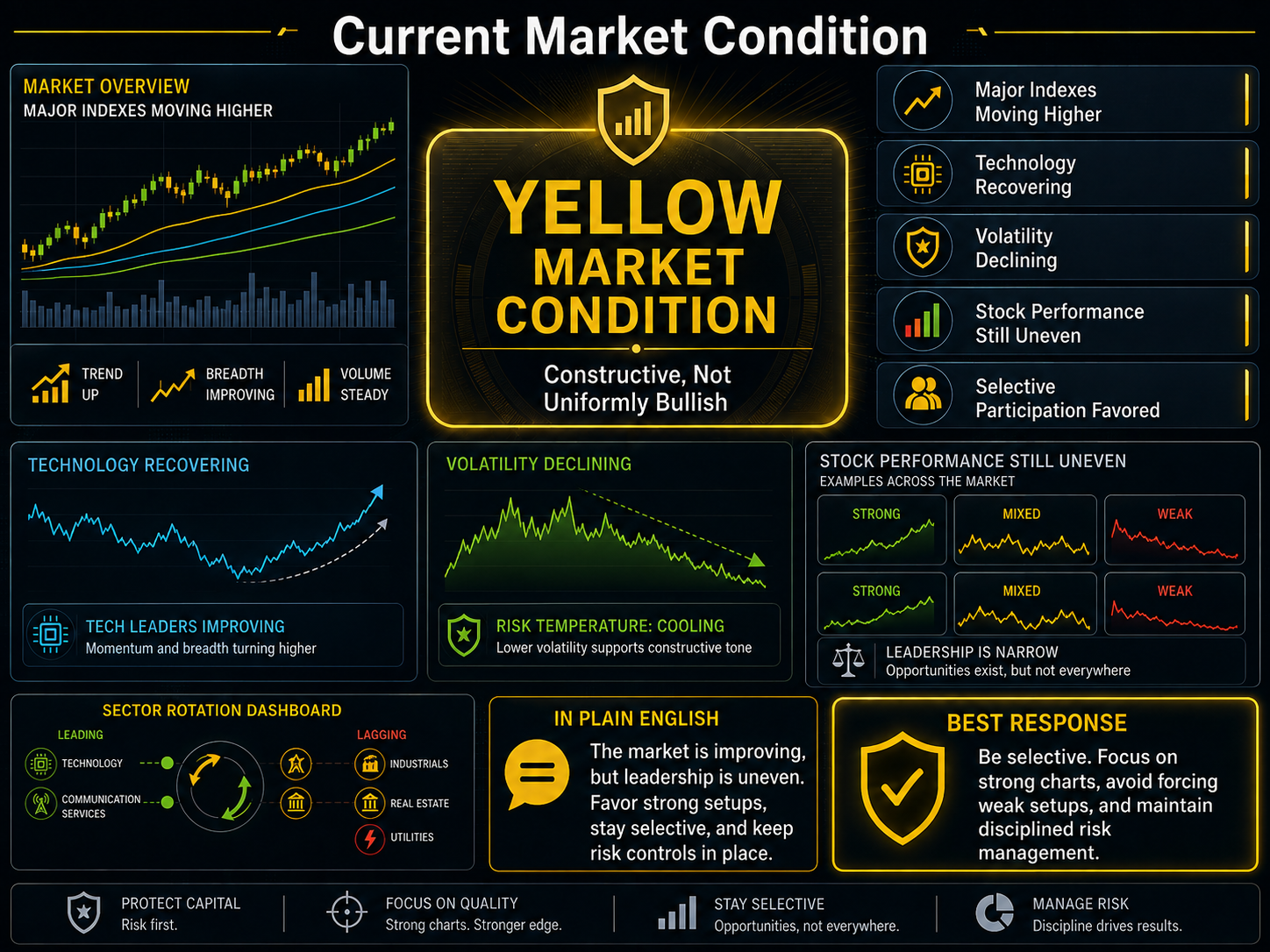
The market is constructive but not uniformly bullish.
The major indexes are moving in the right direction, technology is recovering, and volatility is declining. At the same time, individual stock performance remains highly uneven.
That favors selective participation rather than indiscriminate buying. Strong charts deserve attention, weak charts deserve patience, and risk management should remain in place regardless of how green the indexes look.
Stock Tips This Week

Most People Sell Covered Calls Wrong—And It Costs Them Their Winners
In this video, the central lesson is that covered calls work best as an ongoing management system rather than a one-time premium trade. Rolling a position can allow an investor to adjust strikes or expirations while remaining invested in an underlying company, but the strategy still begins with owning a stock worth holding. Consistency, position management, and stock quality matter more than simply chasing the largest available premium.
My SpaceX Trade Dropped 40%—And I’m Still Profitable
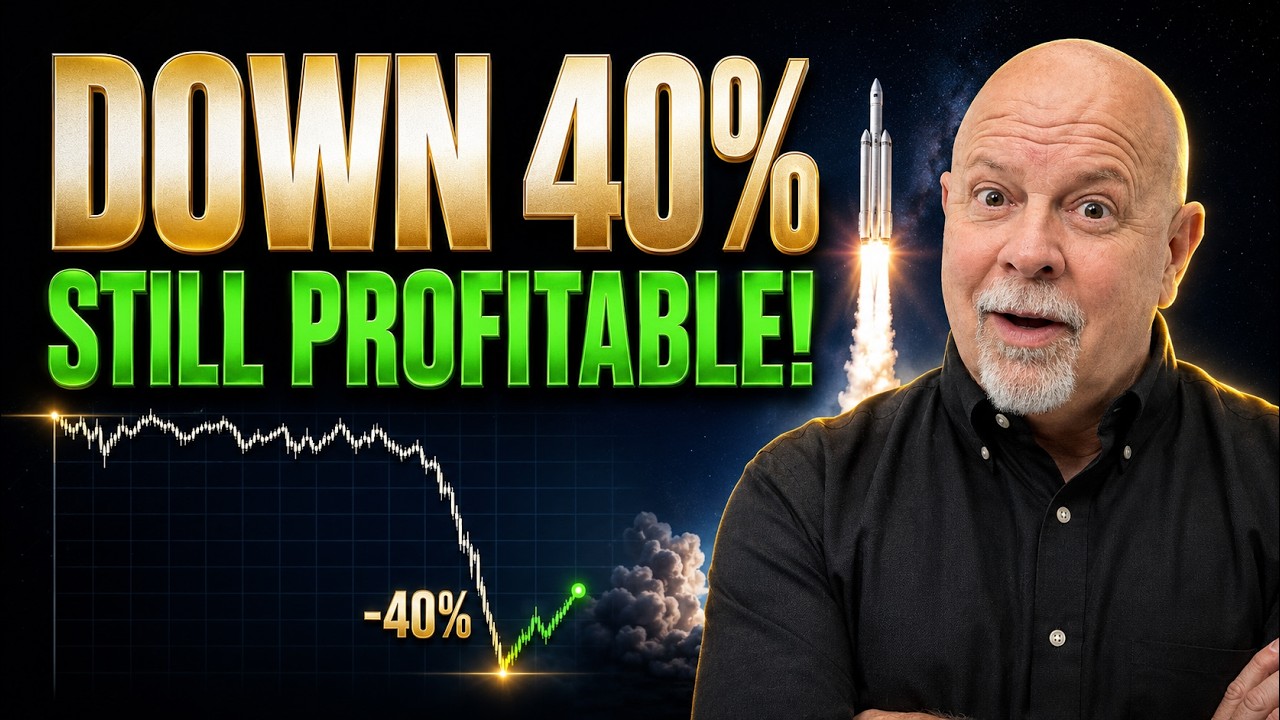
In this video, Mark walks through the mechanics of managing a volatile SpaceX position using in-the-money covered calls and repeated adjustments. The broader lesson is not that option income removes downside risk, but that active position management can change the economics of a longer-term holding. Investors still need to monitor strike selection, remaining option value, assignment risk, and the quality of the underlying position.

Economic War on Iran: What Happens Next for Oil, Bonds & the Fed?
In this video, the focus shifts to the conflicting signals coming from oil, Treasury bonds, credit markets, and the Federal Reserve. Falling oil despite supply concerns may reflect worries about weaker demand, while stronger Treasury prices and wider credit spreads can signal rising economic caution. The practical takeaway is to watch multiple markets rather than relying on equities alone to understand shifts in risk sentiment.

Oil Supply Just Collapsed—What Happens Next?
In this video, Mark examines the combination of geopolitical oil risk, persistent inflation, higher interest rates, and softer economic growth. The concern is a stagflation-style environment in which the Federal Reserve has fewer easy choices. For income investors, the discussion highlights why periods of elevated volatility can produce more attractive option premiums, while emphasizing that higher premiums generally come with higher underlying risk.
The $4.7T Shift Nobody Talks About (and How to Create Income Before It Hits)
In this video, Mark outlines a potential wave of capital tied to tax refunds, corporate cash repatriation, and accelerated business depreciation. Different stages could favor different areas of the market, including consumer discretionary stocks, technology, financials, and industrial companies. The larger lesson is not to perfectly predict every rotation, but to combine sector awareness with a repeatable portfolio-income process and disciplined risk management.
Covered Call Portfolio Rebalancing Using Options Instead of Share Sales
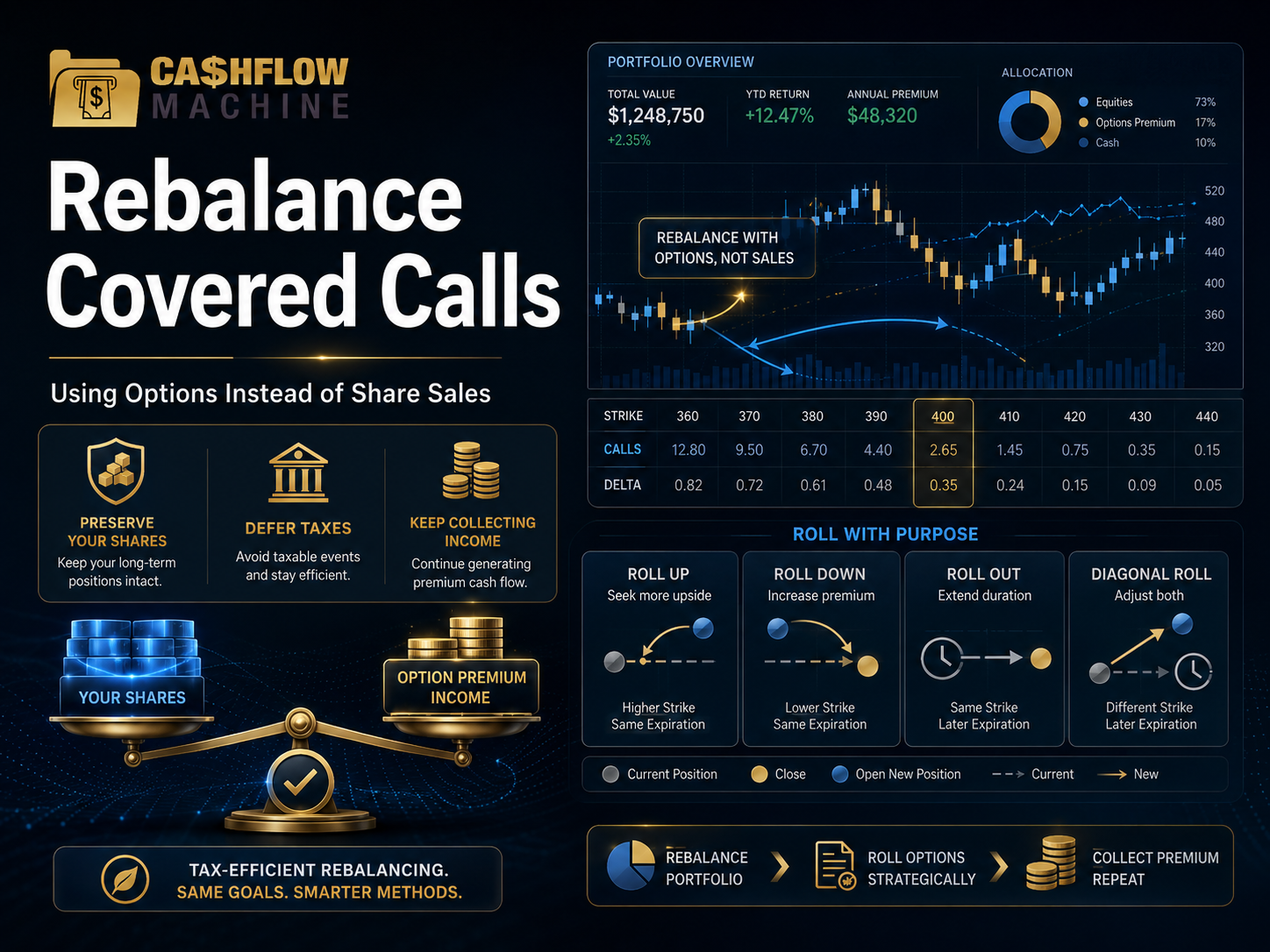
In this blog, the focus is on using option rolls as another tool for adjusting a covered-call portfolio. Rolling up, down, out, or diagonally can alter a position’s strike exposure, time horizon, and income profile without immediately changing the underlying share position. The strategy requires careful attention to taxes, assignment risk, transaction costs, and portfolio concentration; it should be viewed as a portfolio-management technique rather than a universal replacement for selling shares.
Upcoming Event

The Wealth Accelerator Strategy Room is scheduled for October 30 through November 1, 2026, at the Sheraton Sand Key Resort in Clearwater, Florida.
The three-day event is designed as a smaller, hands-on working session focused on building and refining an income-investing plan, chart reading, advanced position structures, CashFlowIQ tools, and market planning into year-end 2026 and early 2027. Attendance is intentionally limited to preserve the interactive format.
