
SpaceX Covered Call Case Study: How to Collect “Juice” While Managing IPO Risk
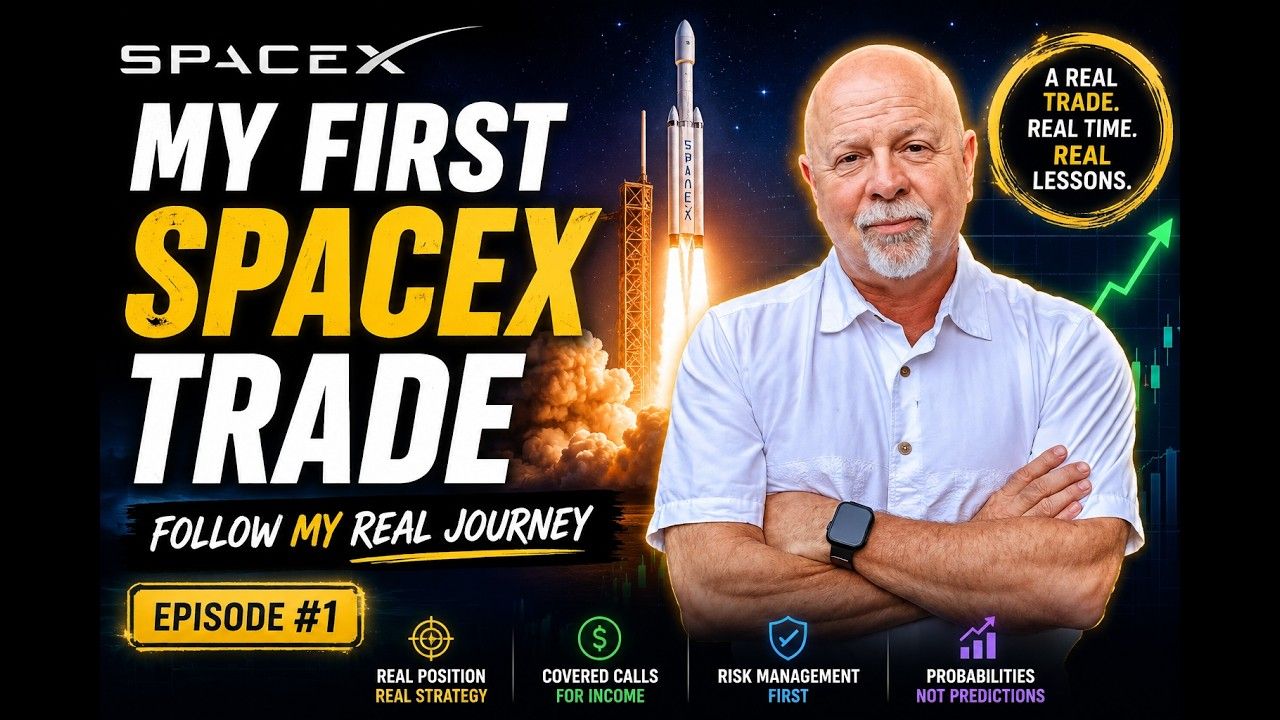
SpaceX Covered Call Case Study: How to Collect “Juice” While Managing IPO Risk
SpaceX has quickly become one of the most exciting new stocks in the market. But instead of simply buying and hoping, Mark is using it as a live teaching example for covered calls.
In this first video of the SpaceX covered call series, Mark explains how he thinks about income, downside cushion, synthetic positions, and what he calls the “juice” inside an option contract.
The key lesson is simple: you do not need to predict every move in a stock. You need a structure, a plan, and a way to get paid while managing risk.
Key Takeaways
Why Mark Uses Covered Calls
Mark opens the lesson by explaining why he believes covered calls are one of the best ways to trade stocks. In his view, buying a stock and simply hoping it rises is not enough of a system.
Covered calls allow an investor to own a stock, or a stock-like base position, and sell call options against it. The option buyer pays premium for the right to buy the position at a specific price before a specific date.
That premium is income. And for Mark, the income is the main reason to use the strategy.
The SpaceX Covered Call Series Begins
This video begins what Mark plans to make into a longer SpaceX covered call series. SpaceX recently went public, options are now trading, and the stock has already shown major volatility.
That makes it a useful teaching example. IPO stocks can move quickly, implied volatility can be high, and option premiums can become large. But the same conditions that create opportunity also create risk.
Mark makes it clear that viewers should not copy the trade. The purpose is to learn how the strategy behaves and how the position can be managed over time.
Covered Call Basics: Strike Price and Expiration
A covered call is a contract. The seller gives someone else the right to buy the stock, or stock-like position, at a certain price before a certain date.
The certain price is called the strike price. The certain date is called the expiration date.
When Mark sells the call option, he receives money upfront. That money is the option premium, and it is the income part of the covered call trade.
Covered Call Vocabulary
- Strike price: The price where the option buyer has the right to buy the stock.
- Expiration date: The deadline for the option contract.
- Premium: The money received for selling the option.
- Intrinsic value: The in-the-money portion of the option price.
- Extrinsic value: The time and volatility value, which Mark calls the juice.
Intrinsic Value vs. Extrinsic Value
Mark explains that every option price has two major components: intrinsic value and extrinsic value.
Intrinsic value is the amount the option is already in the money. Extrinsic value is the extra value created by time, volatility, demand, and uncertainty.
Mark calls extrinsic value the juice. The juice is what he trades for because it represents the income portion of the option contract.
Mark’s Three Covered Call Styles
Mark teaches three covered call styles: Balance Point, Rocket, and Fortress.
The Balance Point strategy uses at-the-money calls. The Rocket strategy uses out-of-the-money calls. The Fortress strategy uses in-the-money calls.
In this SpaceX case study, Mark focuses on the Fortress strategy because the stock is volatile and he wants more downside cushion.
Why Mark Chose the Fortress Strategy for SpaceX
SpaceX had already made a large move after its IPO. Mark believed the stock had a real chance to pull back after the initial excitement, so he did not want to chase maximum upside.
Instead, he chose a deep in-the-money covered call structure. The goal was to collect income and build protection if SpaceX moved lower.
This is the core idea behind the Fortress strategy: protect the account first, collect the juice, and let the probabilities work over time.
The Synthetic Base Position
In this example, Mark did not simply buy common shares. He used a synthetic-style base position through a deep in-the-money call.
A synthetic-style position can act somewhat like owning the stock, but it also introduces additional complexity. It may involve leverage, option pricing risk, liquidity risk, and expiration management.
That is why Mark repeatedly frames this as education, not something to copy.
Why Synthetics Require Caution
- They are more complex than owning shares
- They can involve leverage
- They depend on option pricing and liquidity
- They require expiration management
- They may create more risk if the trader does not understand the structure
The SpaceX Trade Setup
Mark explains that he entered the SpaceX position after the IPO, not on the IPO day itself. The stock had already moved higher, and he expected that it could eventually fade back toward a lower level.
Because of that expectation, he structured the covered call deep in the money. He was not trying to make a killing. He was trying to create a protected income trade.
The idea was to use the high implied volatility in SpaceX options to collect meaningful extrinsic value while still building a cushion on the downside.
The Trade Logic
- SpaceX had already surged after the IPO
- IPO stocks can fade after early excitement
- Implied volatility was high
- Option premium was rich
- An in-the-money call could create downside cushion
- The goal was income and probability, not prediction
Why the Short Call Can Help When the Stock Falls
One important concept in the video is how the short call behaves when the stock pulls back.
When Mark sells a call, he receives premium. If the value of that sold call later drops, the short call position becomes profitable because it could be bought back for less than it was sold for.
However, the long base position can lose value at the same time if the stock falls. This is why the entire trade must be analyzed together.
The short call can help offset downside movement, but it does not remove all risk.
The Power and Limits of Downside Cushion
The in-the-money covered call gives Mark a cushion because part of the short call’s value is already intrinsic. If the stock falls toward the short strike, the short call can lose value and help offset losses in the base position.
That is why Mark likes using in-the-money calls on volatile names. They can create a more conservative bullish position than simply buying the stock outright.
But there is still a limit. If SpaceX falls far enough, the base position can still lose money. The cushion helps, but it does not eliminate risk.
Assignment Risk and Why Juice Matters
Because the short call is deep in the money, some traders may worry about early assignment. Mark addresses this directly.
His point is that early assignment is less likely when the option still has significant extrinsic value. If the option buyer exercises early, they may give up the remaining juice in the option.
That risk can change closer to expiration or when extrinsic value becomes very small. This is why covered call traders need to monitor their positions.
Why a Trading Plan Is Essential
Mark emphasizes that every investor should have a trading plan before entering a position.
A good trading plan answers the important questions before emotions take over. What happens if the stock rises? What happens if it falls? What happens if it goes sideways? What happens near expiration?
The plan is what turns a trade from a guess into a process.
Why Covered Calls Are Still Bullish
Mark also makes an important clarification: covered calls are still bullish strategies.
The trader still benefits most when the base position holds up or moves higher. If the underlying stock falls sharply, the base position can lose value, and the premium may not fully offset the decline.
This is why covered calls are not bearish trades. They are income-focused bullish trades with some downside cushion.
The Bigger Lesson From SpaceX
SpaceX may be an exciting long-term company, but Mark does not want to simply buy and hold while hoping everything works out.
His approach is to participate through a structured income strategy. That means using premium, cushion, and probability rather than relying on prediction.
This is the broader lesson of the series: traders can study exciting stocks without becoming emotional about them.
The Bottom Line
This first SpaceX covered call case study introduces the core ideas behind Mark’s income approach: own or control a base position, sell premium against it, focus on the juice, and manage the trade with a written plan.
The SpaceX example is useful because the stock is new, volatile, and full of investor excitement. That creates rich premium, but it also creates real risk.
Mark’s goal is not to predict whether SpaceX goes straight up or crashes down. His goal is to show how a covered call trader can use probabilities, income, and downside cushion in a disciplined way.
The main takeaway: do not trade excitement. Trade a plan.
Want to learn how to generate income with covered calls?
Join the Income Accelerator and learn how to use covered calls, strike selection, trade adjustments, and income-focused portfolio management.
