
The Hidden Cost of Overtrading: Why More Action Often Leads to Less Profit
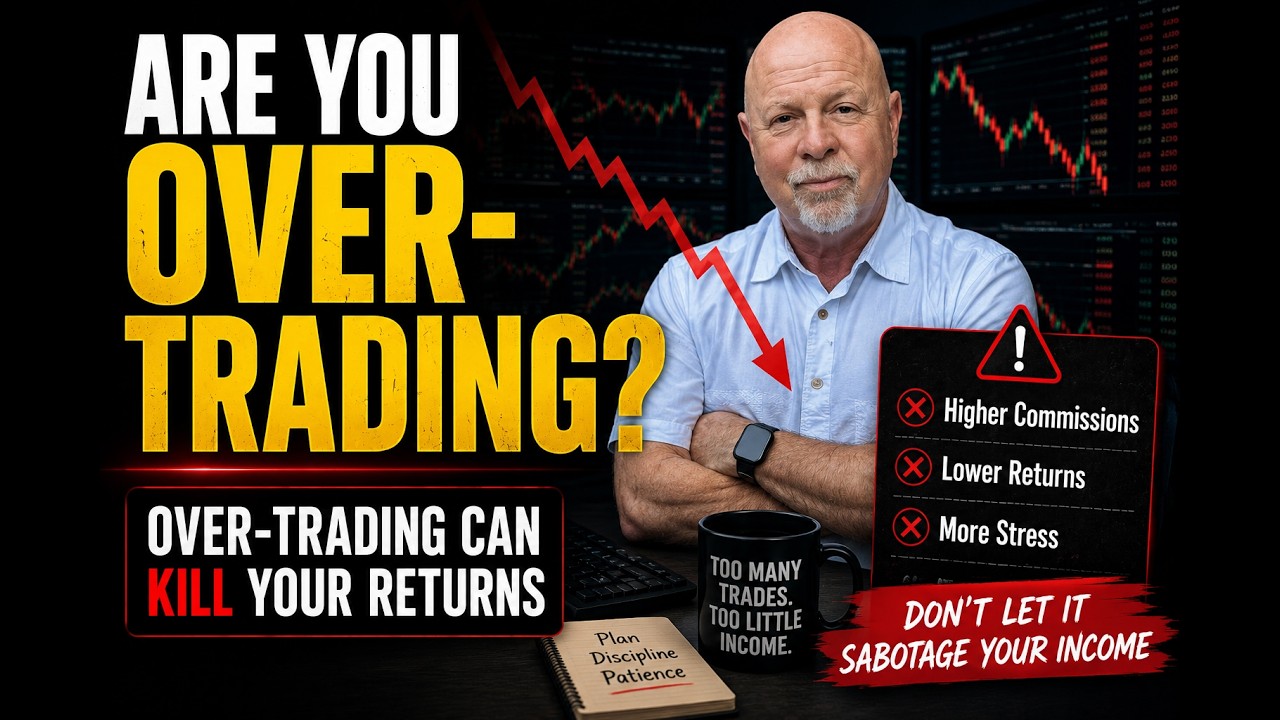
Why Overtrading Quietly Destroys Returns and Mindset
In this week’s market lesson, Mark Yegge explains why overtrading can quietly destroy both your returns and your mindset.
From obsessively checking positions to constantly adjusting trades without a plan, Mark shows how too much action creates slippage, stress, decision fatigue, and emotional burnout. His message is simple: real wealth is usually built through discipline, systems, and patience, not nonstop activity.
Key Takeaways
Why Overtrading Feels Productive
For many traders, the market feels irresistible.
There is always another setup, another headline, another stock everyone seems to be talking about. One day it is AI. The next day it is semiconductors, gold, crypto, or some hot momentum name that suddenly looks impossible to ignore.
That constant flow of opportunity creates a dangerous temptation: overtrading. In this latest lesson, Mark Yegge explains why overtrading may be one of the biggest silent killers of long-term performance, not just financially, but mentally as well.
Overtrading Usually Feels Responsible
That is part of the problem.
When traders are constantly watching the market, adjusting positions, opening new trades, or reacting to every move, it feels like they are being responsible. It feels like they are staying on top of things.
But Mark argues that this often creates the exact opposite result.
Instead of improving performance, micromanaging trades can lead to worse timing, more emotional decisions, more slippage, more stress, and lower long-term returns. In other words, activity can create the illusion of control while quietly damaging the account.
The Symptoms of Overtrading
Mark points out several common signs that a trader may be overtrading.
The first is checking positions obsessively throughout the day.
Stocks go up and down. That is their nature. Whether you look at a one-minute chart or a one-year chart, there will always be movement. But constantly watching every tick can make traders feel every small fluctuation as if it demands action.
That is where problems begin.
Another sign is adjusting trades without a defined plan. If a trader is making decisions based on moment-to-moment emotion instead of technical triggers, rules, or probabilities, they are no longer following a system. They are just reacting. Mark also warns against opening too many positions simply to stay busy. Many traders confuse diversification with control, but sometimes spreading attention across too many names creates more mistakes, not fewer.
Why Too Many Positions Create Decision Fatigue
One of Mark’s strongest points is that every position demands mental energy.
In a covered call framework, a single position already comes with decisions:
- When do you sell the call?
- When do you roll it?
- What do you do before earnings?
- What if the stock moves sharply?
- What about dividends?
- What if assignment becomes likely?
Now imagine doing that across 10 positions at the same time.
That is exhausting.
Mark compares it to the reason high-performing leaders like Steve Jobs or Mark Zuckerberg became known for wearing nearly the same clothes every day. The fewer trivial decisions they had to make, the more energy they could save for higher-value thinking. Trading works the same way. The more unnecessary decisions you create, the more likely you are to make poor ones when they matter most.
The Financial Cost of Overmanagement
Overtrading does not just wear you out emotionally. It can also directly reduce returns.
Mark highlights one major reason: slippage.
Whenever you trade something with a spread between the bid and ask, frequent entries and exits cost money. Even if commissions are small today, slippage still matters. Traders may give up part of the spread entering a trade, then give up part of it again exiting.
Do that repeatedly, and those small losses add up quickly. This matters even more in positions that are less liquid than they first appear. A trader might assume a well-known ETF or stock will trade smoothly, only to realize that options spreads are wider than expected. Every unnecessary adjustment then becomes a hidden tax on performance. The more you trade, the more opportunities you create for friction to eat away at returns.
Emotional Capital Matters Too
One of the most valuable ideas in this lesson is Mark’s concept of emotional capital.
Most traders think only about financial capital. But emotional capital matters just as much.
Why? Because money is emotional.
It represents time, effort, sacrifice, and stored value. Every trade decision carries emotional weight because every dollar in the account means something. That is why market noise can be so draining. Too much exposure to opinions, headlines, intraday movement, and second-guessing can erode confidence. Traders start doubting themselves. They hear someone else make a bearish case and suddenly want to reverse a position they had carefully planned. Or they hear a bullish story and feel pressure to jump into a trade they were never supposed to take. This is how discipline breaks down. Mark’s advice is to protect emotional capital just as carefully as financial capital, because once your mindset is exhausted, your trading usually suffers next.
Boring Systems Often Work Best
This is where Mark makes one of his most practical observations: the best systems are often the most boring systems.
That may not sound exciting, but it is usually true.
A good system is repeatable. It reduces unnecessary choices. It is based on probabilities rather than hope. And most importantly, it does not require constant entertainment to work.
That is why Mark teaches a covered call framework. In his view, the strength of covered calls is not just the income. It is the structure. You buy the stock or build a base position, sell calls against it, target a consistent level of premium, and let time decay work in your favor. It is not flashy. But boring can be powerful when it keeps you disciplined.
Focus on Setups, Not Opinions
Another major lesson here is the difference between having a system and chasing opinions.
Mark urges traders to focus on time premium and trade setups, not on whether a TV personality, market guru, or financial commentator happens to sound convincing that day.
Opinions are endless.
What matters is whether your setup fits your plan.
- Is the market direction helping or hurting this trade?
- Does this stock fit my system?
- What are my adjustment rules?
- What is my risk if I am wrong?
- When do I defend, and when do I let it ride?
These are the kinds of questions that keep traders grounded in process rather than emotion.
Review Weekly, Not Emotionally
Mark also recommends something simple but powerful: review results weekly instead of reacting constantly during market hours.
That shift matters.
During the trading day, everything feels urgent. Prices move, news breaks, emotions spike, and even small changes can feel like emergencies. But outside market hours, especially on a calm weekend review, you can evaluate trades with far better judgment. This helps traders spot patterns, see mistakes more clearly, and make decisions based on logic instead of adrenaline. It is one of the easiest ways to reduce emotional overreach.
When to Adjust and When to Let It Ride
A big part of avoiding overtrading is having rules before the trade begins.
Mark stresses the importance of preset guidelines:
- When do you take profits?
- When do you roll up or down?
- When do you defend?
- When do you exit?
- When do you admit the trade is wrong?
He mentions a 75% guideline in many cases. If most of the premium has already been captured, it may make sense to take the trade off rather than squeeze for the last few cents and expose yourself to unnecessary risk.
That is the kind of rule that reduces emotional improvisation. Instead of asking, “What do I feel like doing now?” the trader asks, “What does my plan say?” That is a massive difference.
You Are Not the Market
Near the end of the lesson, Mark makes an important philosophical point: your identity is not the market.
This matters more than many traders realize.
When people become overly attached to every move in their account, they begin tying their self-worth to the screen. A bad trade feels like personal failure. A winning day feels like validation. That emotional roller coaster is exhausting and unsustainable. A better mindset is to view trading as a process, not an identity. You are not supposed to react to every tick. You are supposed to follow a plan.
Final Thoughts
Overtrading rarely looks dangerous in the moment.
It feels active. It feels engaged. It feels like effort.
But over time, it can quietly destroy both performance and peace of mind.
Mark Yegge’s message is clear: if you want to build wealth, stop trying to trade your way to excitement. Build a system instead. Protect your emotional capital. Review your trades calmly. Reduce unnecessary decisions. Let the math work. Let time decay work. Let discipline work. Because in the end, the traders who last are not usually the busiest ones. They are the ones who learn how to stay patient, stay structured, and stay boring long enough to win.
Want to learn how we generate income with a more disciplined, rules-based approach instead of reacting to every market move?
Watch the free masterclass and learn how disciplined traders use covered calls, structured trade management, and repeatable systems to reduce noise and stay consistent.
Join Elite for the Full System
Serious investors can go deeper inside Elite, where we teach covered calls, trade management, and a structured income system designed to reduce noise and increase discipline.
