
Insider Tips - Weekly Stock Market Report - Week May 11, 2026
Insider Tips — May 11, 2026
This week’s market tone is clearly constructive. After moving through a more mixed yellow phase recently, the market timing model is now showing four green lights, which signals a more favorable environment for buying and holding strong stocks. The key message is simple: the market may not feel perfect, but the evidence is leaning bullish.
The strongest leadership continues to come from technology, especially semiconductors, AI-related infrastructure, electronics, and data-center-adjacent names. The Nasdaq and S&P 500 are pushing into all-time-high territory, while volatility has cooled meaningfully. That combination usually tells us that panic has left the tape and investors are becoming more willing to put money to work.
At the same time, this is not a market where discipline should disappear. Several leaders have already made big moves. Some are breaking out cleanly, while others are getting extended or even parabolic. The opportunity is real, but so is the risk of chasing late.
Technical Analysis
The most important technical development this week is the move from a partly mixed market into a fully green reading. Last week, the market had improved but was not yet fully convincing, with two green lights and two red lights. This week, all four signals have turned green, suggesting stronger alignment across the broader system.
The Nasdaq is showing clear leadership and is sitting at or near all-time highs, reflecting the strength in technology and semiconductor names. The S&P 500 is also pressing into new-high territory, confirming that the rally is not limited to only a few speculative names.
The Dow Jones Industrial Average and the New York Stock Exchange are not quite as strong. They remain close to highs, but they are not leading the way the technology-heavy indexes are. That difference matters. It tells us this is still a leadership-driven market rather than a perfectly broad-based rally.
Volatility has also come down sharply. That is important because lower volatility often means fear has cooled, institutions are more willing to buy, and breakouts have a better chance of working. The market is not risk-free, but the tape is currently more supportive than defensive.
Market Trends I’m Calling Out
The dominant theme remains technology leadership. Out of the top industry groups discussed this week, nearly all are tied to semiconductors, electronics, telecom, scientific equipment, or broader technology. Only a small number of leading groups are outside tech, such as transportation and shipping.
AI continues to be the engine behind much of the move. It is not just chip designers anymore. The strength is spreading into storage, data-center infrastructure, electronics, and companies tied to the hardware layer of artificial intelligence.
The other key theme is momentum. Several stocks have already moved sharply from breakout levels. That is good if you are already positioned, but dangerous if you are late and chasing. The better approach is to look for proper bases, strong relative strength, clean volume confirmation, and entries that still offer a reasonable risk-reward setup.
The final theme is income discipline. In a green market, it is easy to focus only on capital gains. But covered calls can still play a role, especially for investors who want to generate premium while participating in quality stocks. The goal is not to predict perfectly. It is to stack probabilities in your favor.
Individual Stocks: What I’m Seeing
Apple
Apple is moving into a potential breakout area after building the right side of a consolidation. The important detail is volume. A breakout becomes much more meaningful when buyers show up with conviction, and Apple’s volume is acting like a stamp of approval so far.
The stock has been quietly setting up, and now it is starting to confirm that setup. As long as the breakout holds and volume remains supportive, Apple deserves attention.
Nvidia
Nvidia has been consolidating for months and is now back in a buy-zone discussion depending on how the pattern is being measured. The stock has already moved sharply from lower levels, which reinforces an important lesson: fundamentals alone do not explain every move.
The company did not suddenly become dramatically different in a few weeks, but the chart changed. That is why technical analysis matters. Price and volume show how investors are actually behaving.
Tesla
Tesla is trying to repair its chart after a downtrend. It has moved back above the 50-day moving average and has put together several positive sessions.
The concern is that the move has not been backed by truly powerful volume. That makes the setup less convincing. Around the 435 area, there may be resistance or limited upside unless stronger buying appears. Tesla is improving, but it still has work to do.
Micron
Micron stands out as one of the stronger semiconductor-related names, with excellent relative strength and a move into all-time-high territory. Compared with AMD, the preference here leans toward Micron because of its current technical strength and cleaner leadership profile.
When a stock breaks out from the right industry group with strong relative strength, it can move faster than many investors expect. Micron is a good example of why industry leadership matters.
AMD
AMD has already made a major move, rising sharply from its breakout area in a short period. The stock is clearly strong, and it remains tied to the AI and semiconductor theme.
The warning is not about weakness. The warning is about chasing. A stock that is already up dramatically can continue higher, but it can also reverse hard when the move becomes too extended. If you are already in, strength is welcome. If you are not, patience matters.
Bloom Energy
Bloom Energy recently made a powerful move and is now pulling back to fill gaps and digest gains. That kind of technical correction can be healthy after a big breakout.
The key is whether the pullback stays controlled. With strong relative strength still intact, the chart remains interesting, but this is not a place to ignore risk.
GE Aerospace
GE Aerospace is improving after moving back above its 50-day moving average. The stock gapped up recently and is now trying to hold that important level.
The 50-day line is a key test. If GE Aerospace can stay above it and rebuild momentum, the setup becomes more constructive.
Gold / GLD
Gold-related exposure is more complicated. GLD remains below the 50-day moving average, which keeps it out of a clean buy zone from a trend-following perspective.
There may still be an inflation or macro hedge argument, but technically, it is not yet in ideal shape. For income-focused investors, holding an asset and selling covered calls can be one way to generate cash flow while waiting, but the chart itself still needs improvement.
SanDisk
SanDisk is benefiting from the AI data-center theme. Storage, hard drives, and SSD demand are becoming part of the broader AI infrastructure story.
The stock is at all-time highs and sits in a leading industry group. That combination makes it a clear leadership name, though investors still need to avoid chasing too far above proper entries.
Intel
Intel has made a dramatic move and is showing very high relative strength. The stock has effectively doubled over a short period, which is impressive but also creates a parabolic risk profile.
This is not an easy short, because strong stocks can stay strong longer than expected. But when a move becomes vertical, traders should watch carefully for reversal signals.
Broadcom
Broadcom is in a buy area but has not yet produced the kind of volume needed for a decisive breakout. The stock is not weak, but it needs more confirmation.
It may form a handle or continue moving sideways before making a stronger attempt. For now, the setup is constructive but not fully confirmed.
Hims & Hers
Hims & Hers looks weak compared with the market leaders. The stock has struggled to regain momentum and has not shown the same constructive price behavior as stronger names.
In a green market, weak stocks should stand out for the wrong reasons. If a stock cannot rally when the market is healthy, that is a warning sign.
Robinhood
Robinhood is also showing poor relative strength. Even when it bounces, it has not been able to hold those moves.
That is not the kind of behavior investors want in a market where other stocks are breaking out and hitting highs. Capital should generally favor strength over laggards.
Palantir
Palantir is a reminder that loving a company and buying a good chart are not the same thing. The stock formed what looked like a late-stage base, failed near the highs, and then rolled over sharply.
The problem now is overhead supply. Investors who bought higher may be waiting to sell when the stock recovers to their entry price. That selling pressure can make it harder for the stock to quickly reclaim prior highs.
Philadelphia Semiconductor Index
The semiconductor index is also pressing into high territory, confirming the strength in the group. However, the move has become steep.
If the index pulls back, a meaningful retracement would not be surprising. That would not necessarily end the theme, but it could reset some of the overheated action.
Key Takeaways
- The market timing system has shifted fully green, creating a more favorable backdrop for buying strong stocks.
- Technology, semiconductors, AI infrastructure, electronics, and data-center-related names remain the clear leadership groups.
- The Nasdaq and S&P 500 are stronger than the Dow and broader NYSE, so leadership is still selective.
- Lower volatility suggests fear has cooled and investors are more willing to take risk.
- Strong stocks should be respected, but extended names should not be chased blindly.
- Relative strength matters. In this market, leaders are separating sharply from laggards.
- Covered calls can still be useful in a bullish market because they create income while keeping investors engaged with quality positions.
Conclusion
This is a green market, and the evidence supports a constructive stance. The strongest opportunities are still coming from technology and semiconductor-related leadership, especially names connected to AI infrastructure.
But a green market does not mean every stock is a buy. Some names are breaking out properly. Others are already extended. Some former favorites are lagging badly. The discipline is to focus on the right stocks, in the right industries, at the right points on the chart.
The goal is not certainty. It is probability. When the market is green, the industry group is leading, the stock has strong relative strength, and the chart is breaking out with volume, the odds improve. That is where investors should focus their attention.
Current Market Condition

The current market condition is bullish but selective. The tape is green, volatility has eased, and major technology indexes are showing strength. The best action is concentrated in tech, semiconductors, AI infrastructure, electronics, and storage-related names.
This is a market where investors should be open to opportunity, but still careful with entries. Strong stocks can keep moving, but chasing vertical moves after large gains can create unnecessary risk.
Stock Tips This Week
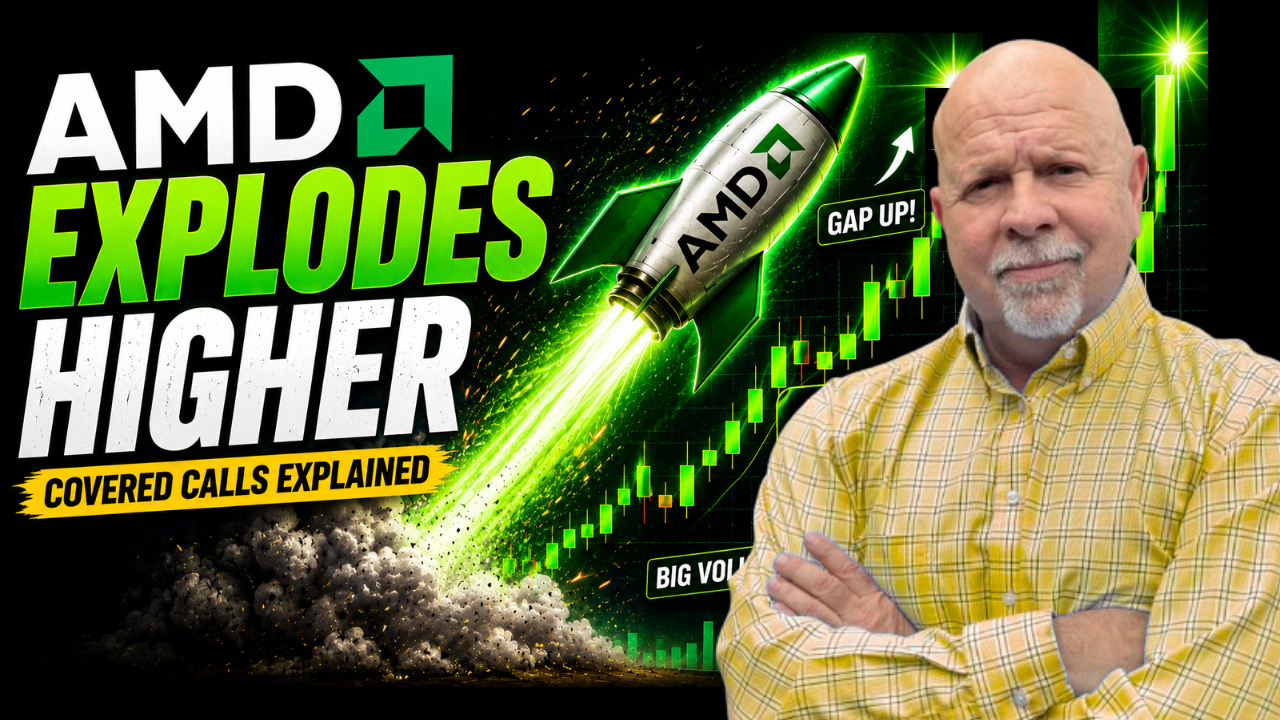
AMD Broke Out After Earnings: Why Covered Calls Still Make Money on the Way Up
In this video, the focus is AMD’s powerful post-earnings breakout and the bigger lesson around covered calls. The key takeaway is that covered calls are not automatically “bad” when a stock rises. If structured correctly, investors can still benefit from stock ownership while collecting option premium. The video also reinforces the value of buying strength, watching volume, and respecting AI-related leadership.

Covered Call Income vs Rental Property Income: A Real Numbers Comparison
In this blog, covered call income is compared with rental property income through the lens of cash flow, labor, liquidity, and risk. The useful lesson is that income investors should compare net results, not just headline income. Rental properties can generate durable cash flow, but covered calls may offer more flexibility, less operational burden, and easier scalability for investors focused on monthly income.

How to Avoid Covered Call Assignment: 5 Techniques That Work
In this blog, the core lesson is that assignment risk can often be managed before it becomes a problem. The article emphasizes choosing lower-delta strikes, avoiding dangerous calendar periods like earnings and ex-dividend dates, closing calls when time value disappears, and rolling up and out when needed. For investors who want to keep core shares, assignment management is essential.

How to Report Covered Call Income on Your Taxes: 1099 Guide
In this blog, covered call tax reporting is explained in plain English. The main idea is that each covered call generally ends in one of a few outcomes: expiration, closing at a gain or loss, or assignment. Understanding how those outcomes appear on a 1099 can help investors stay organized and avoid confusion when tax season arrives.

How to Profit From a Sideways Market With Covered Calls
In this blog, the focus is on using covered calls when stocks are moving sideways. A flat market can feel frustrating for capital-gain investors, but it can be productive for income investors because option premium decays over time. The article highlights range identification, strike selection, 21-to-45-day expirations, and closing trades around 50% of maximum profit.

Covered Call Payoff Diagram Explained: Visualizing Your Risk and Reward
In this blog, the covered call payoff diagram is used to make risk and reward easier to understand. The key lesson is that a covered call has three clear zones: loss below breakeven, profit potential up to the strike, and capped upside above the strike. Seeing the trade visually helps investors avoid surprises before they enter a position.
Podcast Episode This Week

In this podcast, Mark sits down with college student and entrepreneur Lucy Taylor for a conversation centered on financial learning, mindset, and the importance of building knowledge early. For readers who want to improve not just their market tactics but their broader money foundation, this episode offers a useful reminder: long-term wealth begins with education, process, and better decision-making habits.
