
ETF vs. Single-Stock Covered Calls: Which Strategy Fits Your Income Plan?
ETF vs. Single-Stock Covered Calls: Which Strategy Fits Your Income Plan?
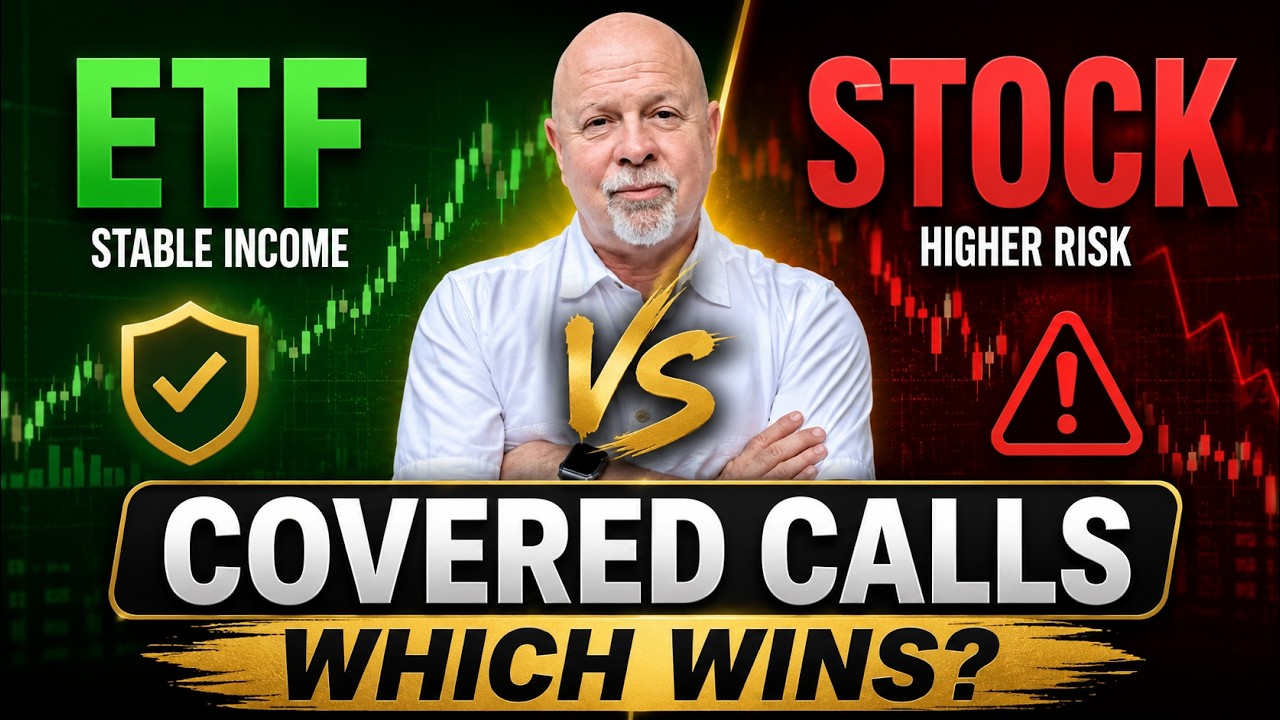
In this lesson, Mark breaks down one of the biggest decisions covered call investors face: should you sell covered calls on broad ETFs like SPY and QQQ, or on individual stocks like Apple, Microsoft, Nvidia, Tesla, and other large-cap names?
Both approaches can generate income, but they carry very different risks. ETFs may be more diversified and easier to manage, while single stocks may offer higher premiums with more concentrated risk.
Key Takeaways
ETF vs. Single-Stock Covered Calls: The Trade-Off Most Investors Miss
When investors first start learning about covered calls, they often run into a decision that looks simple on the surface.
Should you sell covered calls on broad ETFs like SPY and QQQ, or should you sell covered calls on individual stocks like Apple, Microsoft, Nvidia, Tesla, or other large-cap names?
At first, it may seem like a simple income comparison. One option chain pays one amount. Another option chain pays more. So the higher premium must be better, right?
Not necessarily.
Covered calls are not just about collecting premium. They are also about deciding what you are willing to own, how much volatility you are willing to sit through, and how actively you want to manage a position when the market moves against you.
That is why ETF covered calls and single-stock covered calls should not be treated as the same tool. They may both generate income, but they behave very differently.
Why ETF Covered Calls Are Often the Better Starting Point
For many investors, especially retirees or people who want a more manageable income strategy, broad ETFs are often the cleaner place to begin.
An ETF like SPY gives exposure to hundreds of large U.S. companies. QQQ gives exposure to a basket of large Nasdaq-oriented companies. IWM gives exposure to small-cap stocks.
That diversification does not remove market risk. If the market falls, ETFs can still fall. But it does reduce single-company risk.
With a single stock, one earnings report, one product issue, one regulatory headline, or one CEO-related event can create a major move. With a broad ETF, the risk is spread across many holdings.
For investors learning covered calls, that matters. It allows them to focus on the mechanics of the strategy without also having to monitor every company-specific headline.
Covered call mechanics include:
- How premium changes as expiration approaches
- What happens when the ETF rises above the strike price
- What happens when the ETF falls
- How assignment works
- How rolling works
- How bid-ask spreads affect execution
- How implied volatility affects option premium
Broad ETFs like SPY and QQQ also tend to have very liquid options markets. Liquidity matters because it affects fills, slippage, rolls, and adjustments. A tight bid-ask spread can make a meaningful difference over time, especially if positions are being managed regularly.
ETF covered calls may not always produce the highest premium. In many market environments, the income may be more moderate than what a high-volatility single stock can offer.
But boring is not necessarily bad. For an income strategy, boring can be useful. Boring can be repeatable. Boring can be easier to manage when the market gets uncomfortable.
Why Single-Stock Covered Calls Can Be Tempting
Single-stock covered calls are where many investors start to get excited.
A volatile stock like Nvidia, Tesla, Meta, or another high-beta name may offer much more premium than a broad ETF. When you compare option chains side by side, the single stock may appear to pay two or three times as much.
That can be tempting.
But the market is not paying extra premium because it is generous. The market pays extra premium because there is extra risk.
Single-stock risk may include:
- Earnings risk
- Headline risk
- Product risk
- Regulatory risk
- Valuation risk
- Volatility risk
- Company-specific event risk
The premium is compensation for accepting that risk.
So the better question is not, “Which one pays me more?”
The better question is, “Which risk do I actually want to carry, and am I being paid enough to carry it?”
That distinction is critical.
A covered call is not a full hedge. The premium collected gives you some downside cushion, but if the underlying stock falls sharply, that premium may not come close to offsetting the loss.
If a stock drops 15% or 20% after earnings, a few weeks or months of premium can disappear very quickly. That is why single-stock covered calls should be treated as a concentration strategy, not free income.
Position Sizing Matters More With Single Stocks
One of the biggest mistakes covered call investors make is putting too much capital into one high-premium stock.
They see a large premium and assume the opportunity is better. But if that one stock becomes too large a portion of the portfolio, one bad event can damage the entire strategy.
That is why position sizing is so important.
As an educational framework, some investors may consider limiting any one single-stock position to a small percentage of covered call capital. For example, a 5% maximum per individual stock is one way to think about risk control.
That does not mean 5% is right for everyone. Some investors may want less. Some may avoid single stocks completely.
The principle is what matters: no single stock should become so large that one bad event can derail the entire portfolio.
A Simple Filter for Single-Stock Covered Calls
Before considering a single-stock covered call, it helps to use a clear filter.
A stock should generally be something you would be willing to own even without the option premium. Selling a covered call does not magically turn a poor investment into a good one.
None of these rules eliminate risk. But they can help reduce avoidable mistakes.
The ETF Core and Single-Stock Sleeve Framework
Covered calls on ETFs versus individual stocks should not always be viewed as an either-or decision.
It can be an allocation decision.
One educational framework is to divide covered call capital into two parts: an ETF core and a smaller individual-stock sleeve.
The ETF core is designed for diversification, simplicity, and stability. The single-stock sleeve is designed for potentially higher premium, but with tighter position size controls and more active monitoring.
For example, a hypothetical investor might study a model where 70% of covered call capital is allocated to broad ETFs and 30% is allocated to carefully selected individual stocks.
That is not a recommendation. It is simply a framework.
The point is structure. The ETF core helps reduce single-company risk. The single-stock sleeve may increase premium potential. Together, they may create a more balanced approach than going all-in on one side.
Covered Call ETFs: Convenience vs. Control
Covered call ETFs can also enter the conversation.
Funds like QYLD, XYLD, and similar income-oriented ETFs attempt to package the covered call process for investors. They may be convenient because investors do not have to personally select strikes, expirations, or manage individual option trades.
But convenience has trade-offs.
When you buy a covered call ETF, you are outsourcing the decisions. You do not personally choose the strike price. You do not choose the expiration. You do not decide when to roll. You do not decide how much upside to leave open.
For some investors, that simplicity may be attractive. For others, learning to manage covered calls directly may provide more control.
The key is to be honest about what you want. Do you want simplicity, or do you want control? Do you want convenience, or do you want to build the skill yourself? There is no free lunch. There are only trade-offs.
The Bottom Line
ETF covered calls and single-stock covered calls can both be useful, but they are not the same.
ETF covered calls may provide a more diversified foundation. They may be easier to manage, easier to understand, and less exposed to single-company surprises.
Single-stock covered calls may offer higher premium potential, but they also bring more concentrated risk. That risk must be controlled through position sizing, liquidity standards, stock selection, and discipline around earnings and other major events.
The mistake is treating all premium as equal.
A 1% premium on a diversified ETF is not the same risk as a 3% premium on a volatile individual stock. The premium is different because the risk is different.
Covered calls can generate income, but they do not eliminate risk. They can reduce cost basis by the amount of premium collected, but they do not protect against a major decline in the underlying position. They can create cash flow, but they can also cap upside.
That is why education matters. Before putting real money at risk, understand the trade-offs, the mechanics, and the risk management rules behind the strategy.
Want to learn how we generate income regardless of market direction?
Watch the free masterclass:
