
Insider Tips - Weekly Stock Market Report - Week July 13, 2026
Insider Tips — July 13, 2026
Green Market, Uneven Leadership: The Rally Is Improving, but Selectivity Still Matters
The market entered the July 13 review in a stronger position, moving from a yellow condition into green and maintaining that status for seven consecutive trading days. That shift suggests the probabilities are once again leaning toward higher prices, giving investors more room to participate.
However, this is not a market where every chart is working. The Dow Jones Industrial Average and NYSE Composite are demonstrating stronger broad-market participation, while the Nasdaq, semiconductors, housing stocks, and several AI-related names remain in more complicated technical positions. Volume has also been relatively light, which means the market’s improvement still needs confirmation.
The practical stance is cautiously constructive. Investors can participate in quality setups, but stock selection, chart position, position sizing, and trade management remain essential. A green market creates opportunity—it does not remove risk.
Technical Analysis
Nasdaq Holds Its Line in the Sand
The Nasdaq Composite is holding above its 50-day moving average after bouncing from that important support level. This is constructive because the 50-day line often acts as a dividing point between a healthy intermediate trend and a market beginning to lose institutional support.
The concern is volume. The bounce has not been accompanied by the kind of strong buying activity that would provide clear confirmation. The Nasdaq remains technically viable, but it still needs stronger demand and cleaner momentum before it can be considered fully healthy.
The S&P 500 Looks Slightly Stronger
The S&P 500 has also rebounded from its 50-day moving average and currently has a healthier technical structure than the Nasdaq. It is holding above support and moving in the right direction, although it has not yet produced the decisive breakout that would remove all doubt.
Continued strength above the 50-day line would support the bullish case. A return below it—particularly on rising volume—would be a warning that the recent improvement is losing momentum.
Broader Indexes Are Showing Leadership
The Dow Jones Industrial Average and NYSE Composite have been the stronger indexes. Both recently reached record territory and remain above their major and shorter-term moving averages.
This matters because it shows that the market is not being driven entirely by a small group of technology companies. Broader participation can make a rally more durable, although the relatively low trading volume means investors should still watch for confirmation.
Volatility Is Declining
Market volatility has been moving lower, indicating that investors are becoming less defensive. Falling volatility generally creates a more favorable environment for bullish positions because fear is declining and capital is becoming more willing to remain invested.
Low volatility should not be mistaken for the absence of risk. It is simply one supporting signal within the broader market picture.
Semiconductors Are Stabilizing, Not Yet Leading
The Philadelphia Semiconductor Index resembles the Nasdaq. It has pulled back from its recent high, tested the 50-day moving average, and is attempting to stabilize.
Holding that level would keep the semiconductor trend constructive. A decisive break below it could add pressure to technology and AI-related stocks, particularly because several memory and chip names are already displaying weak weekly structures.
Housing Remains Vulnerable
The housing index has also bounced from its 50-day moving average, but the larger technical pattern is less convincing. The index failed to reclaim its previous high and appears to be forming a lower second peak.
That creates the possibility of a double-top pattern. Housing remains especially sensitive to interest-rate expectations, making Federal Reserve commentary and economic headlines during the week of July 13 important potential catalysts.
Market Trends I’m Calling Out
Broader Leadership Is Improving
One of the most constructive developments is the strength outside the largest technology stocks. The Dow and NYSE Composite are outperforming the Nasdaq, suggesting that capital is rotating into a wider range of industries.
Transportation, electronic components, oil and gas, and managed-care companies are appearing among the stronger industry groups. Broader leadership is healthy, but investors still need to determine whether the rotation is sustainable or merely temporary.
The AI Trade May Be Cooling
Artificial intelligence remains a major long-term economic and investment theme, but the market may be entering a more selective stage. Several memory and semiconductor-related charts are weakening, while software has moved toward the bottom of the industry rankings discussed in this week’s review.
The competitive environment is also changing. Lower-cost open-source and international AI models are becoming more capable, potentially placing pressure on pricing and the assumption that growth across the AI ecosystem will continue at the same pace.
This does not mean the AI trend is over. It means investors may need to separate durable businesses from companies whose valuations depend on uninterrupted growth and enthusiasm.
Defensive and Cyclical Groups Are Rotating Higher
Oil and gas strength may reflect geopolitical uncertainty, while the improvement in transportation and managed care suggests that investors are searching for leadership outside crowded growth trades.
Rotation can create opportunity, but it can also produce short-lived moves. The strongest candidates will generally combine improving relative strength, institutional volume, earnings support, and constructive chart patterns.
Consumer-Sensitive Areas Are Sending Mixed Signals
Weakness in leisure, retail, housing, and parts of the software market may indicate that investors are beginning to price in slower economic activity. That slowdown is not necessarily confirmed by the broader economy, but these groups deserve attention because markets often begin adjusting before economic data fully reflects the change.
Covered-Call Income Still Requires Defense
A favorable market does not eliminate the need to manage covered-call positions. The foundation remains the same: buy the right stock, in the right market, at the right place on the chart, and then use the option premium to generate income.
The premium is not a substitute for stock quality or risk management. When the underlying stock weakens, traders must understand how to roll, defend the short strike, accept assignment, reduce exposure, or exit.
Individual Stocks: What I’m Seeing
Apple
Apple has recovered impressively after a high-volume gap below its 50-day moving average initially created a bearish signal. Instead of continuing lower, the stock quickly reclaimed support and returned toward its recent high.
The recovery is constructive, but earnings risk is approaching. Apple often strengthens ahead of earnings, but the announcement can also produce a sharp move in either direction. Investors should avoid assuming that the current trend eliminates event risk.
Nvidia
Nvidia is attempting to reverse after bouncing from its 200-day moving average on the daily chart and its 40-week moving average on the weekly chart. That rebound is encouraging, but the stock has not completely repaired its downtrend.
The 50-day moving average is now a critical test. Holding and reclaiming that area with stronger volume would improve the setup. Until then, Nvidia remains an early-stage research candidate rather than a clean, fully confirmed breakout.
GE Aerospace
GE Aerospace continues to display one of the stronger trends among the stocks reviewed this week. Its recent pullback occurred on relatively light volume, which is generally more constructive than a decline driven by aggressive institutional selling.
The larger trend remains positive as long as support holds and selling volume does not expand.
Bloom Energy
Bloom Energy is showing a more difficult pattern. Wide weekly price ranges, elevated volume, and a high-volume downside candle suggest an active battle between buyers and sellers.
The stock’s test of that selling area has not produced a convincing recovery. A weekly close near the low would indicate that sellers remain in control and would weaken the technical outlook further.
SanDisk, Micron and the Memory Trade
SanDisk has developed a weekly pattern that may indicate a topping process, while its rebound has lacked strong volume. Micron and the Roundhill DRAM ETF are showing similar structures.
When several related securities weaken together, the message carries more weight than weakness in a single stock. The memory group may be signaling cooling enthusiasm within part of the broader AI and semiconductor trade.
SpaceX
The SpaceX position remains in a defensive phase as price tests the lower portion of its recent consolidation range. The stock’s weakness has required repeated covered-call adjustments to move the defensive strike lower and preserve as much intrinsic-value protection as possible.
The lesson is not that covered calls make a declining position risk-free. The lesson is that a structured defense plan can reduce damage, create additional income, and prevent hope from becoming the primary risk-management strategy.
Tesla
Tesla remains in consolidation after a prolonged downtrend. Recent delivery-related news briefly supported the stock, but the move was not enough to create a lasting technical breakout.
The company may need a stronger catalyst connected to robotaxis, Optimus, artificial intelligence, or another major growth initiative. Until price exits the current range, patience is more appropriate than prediction.
UnitedHealth Group
UnitedHealth has recovered from its recent bottom, and managed care has improved substantially in the industry rankings. However, the stock still faces significant overhead supply created by previous high-volume declines.
That supply can produce selling whenever price returns to areas where investors previously became trapped. The recovery is worth watching, but buying after an extended short-term move would introduce chase risk.
Axon Enterprise
Axon is attempting to recover from its lows, supported by continued demand for public-safety technology, body cameras, and related systems. Technically, however, relative strength remains limited.
The stock needs stronger price and volume confirmation before it can be considered a leadership-quality setup.
Qualys
Qualys stands out as a stock worth researching. It has recovered strongly from a major decline, returned toward an important price zone, and continues to demonstrate an improving earnings trend.
The stock has already doubled from its low, so this is not an attempt to pick a bottom. The more relevant question is whether it can hold its recovery, establish support, and begin another sustained advance from a technically valid entry area.
Key Takeaways
- The market has moved into green territory, improving the probability of further gains.
- The Nasdaq and S&P 500 are holding their 50-day moving averages, but stronger volume would provide better confirmation.
- The Dow and NYSE Composite are showing healthier broad-market leadership.
- Semiconductors, memory stocks, software, and parts of the AI trade remain technically mixed.
- Housing must hold its 50-day moving average as investors assess interest-rate and Federal Reserve developments.
- Industry leadership is rotating toward transportation, energy, electronic components, and managed care.
- Even in a green market, covered-call traders need clear rules for defense, rolling, assignment, and position exits.
Conclusion
The market’s move from yellow to green is a meaningful improvement. Major indexes are holding important support, volatility is declining, and broader-market leadership is becoming more visible.
At the same time, the rally is not uniform. Technology still needs confirmation, the memory trade is weakening, housing remains rate-sensitive, and several individual stocks are carrying substantial overhead supply.
The correct response is not maximum aggression. It is disciplined participation. Focus on stocks with strong fundamentals, constructive technical structures, improving relative strength, and clearly defined risk. Let the market confirm its strength, and remain prepared to reduce exposure when a position stops behaving as expected.
Current Market Condition
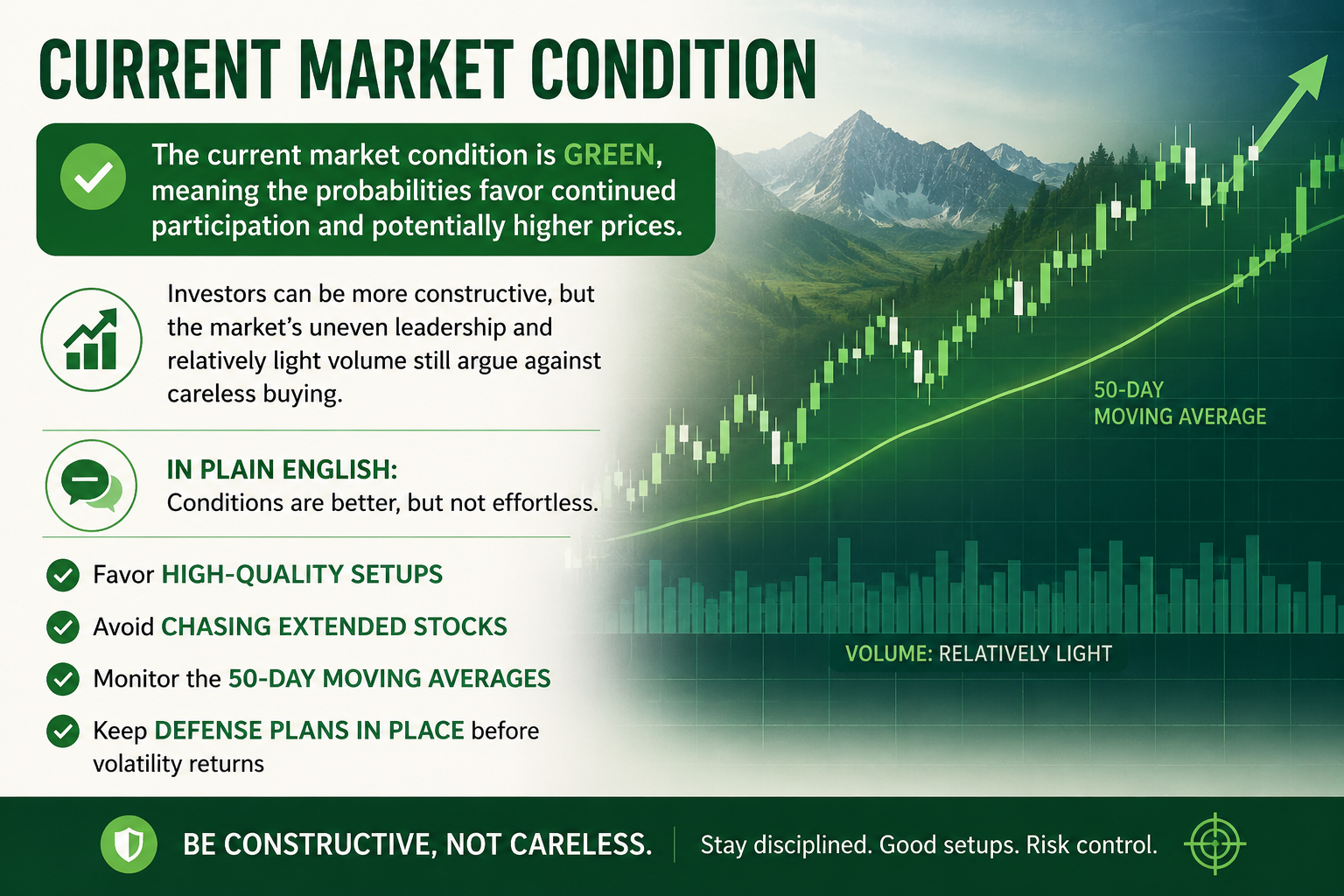
The current market condition is green, meaning the probabilities favor continued participation and potentially higher prices. Investors can be more constructive, but the market’s uneven leadership and relatively light volume still argue against careless buying.
In plain English, conditions are better, but not effortless. Favor high-quality setups, avoid chasing extended stocks, monitor the 50-day moving averages, and keep defense plans in place before volatility returns.
Stock Tips This Week
Why Covered Call Education Matters Now

In this video, Mark explains why a more selective investment environment may require investors to understand what they own rather than relying entirely on passive exposure. Covered calls can provide income, but the strategy still depends on stock quality, chart position, option selection, and a plan for managing downside risk.
SpaceX Covered Call Defense: Rolling From 145 to 135

In this video, Mark demonstrates how he defended a SpaceX position by buying back the 145 short call and rolling down and out to the 135 strike. The adjustment created additional downside cushion and reinforced an important principle: defend according to a predefined rule before the stock moves through the protection level.

Covered Call Early Assignment Risk Before the Ex-Dividend Date
In this blog, investors learn why deep in-the-money calls may be assigned early when the remaining time value is smaller than an upcoming dividend. Reviewing positions before the ex-dividend date allows traders to decide whether to accept assignment, roll the call, or close the position rather than being surprised.

Covered-Call Opportunities in Spin-Offs and Mergers
In this blog, Mark examines how spin-offs and pending mergers can create temporary pricing inefficiencies and elevated option premiums. These are advanced strategies because deal failure can produce sudden losses, making smaller position sizes, detailed research, and strict circuit breakers especially important.
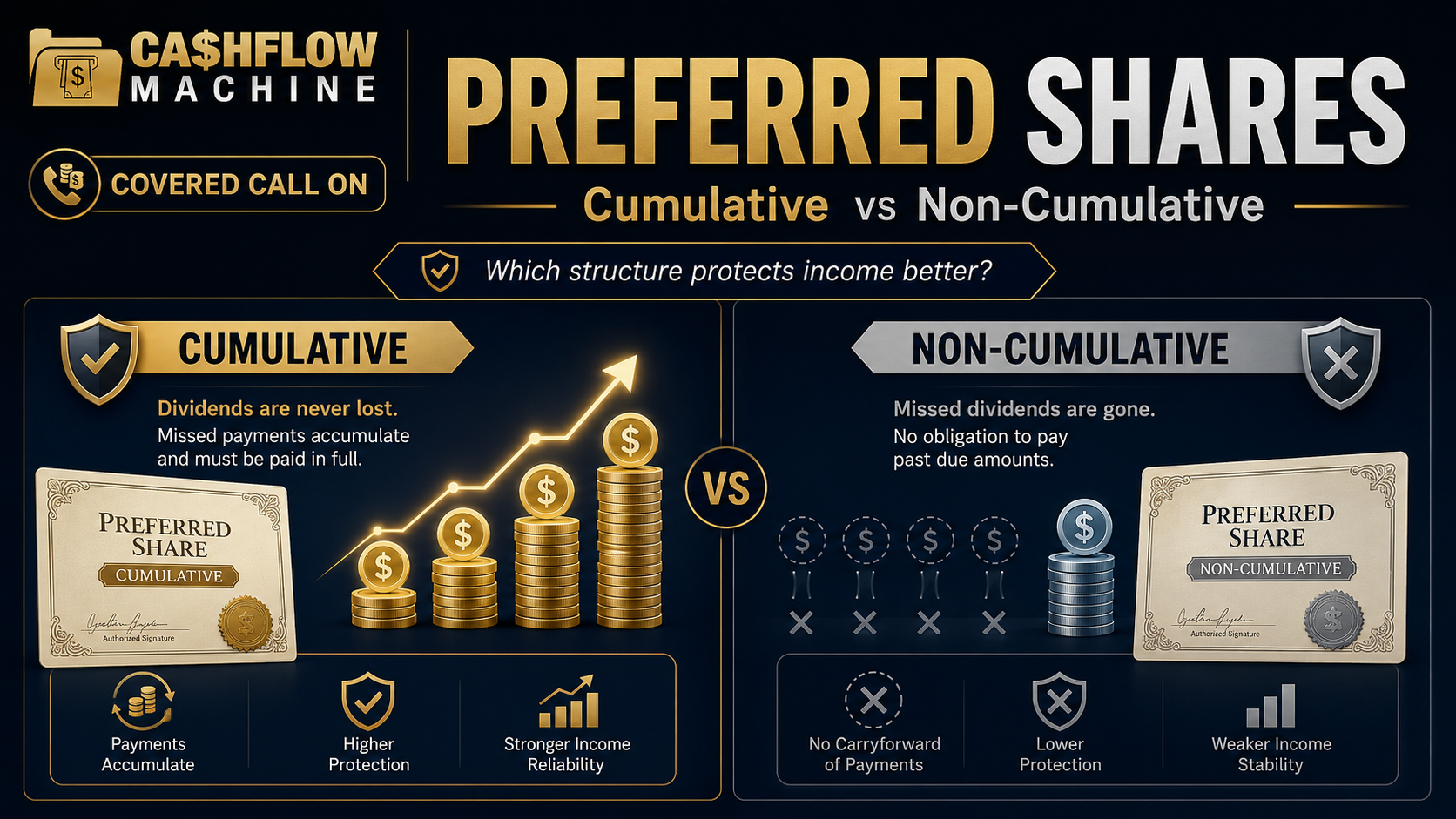
Covered Calls on Preferred Shares: Cumulative vs. Non-Cumulative
In this blog, the focus is on the structural difference between cumulative and non-cumulative preferred shares. Cumulative issues preserve a claim on missed dividends, while non-cumulative dividends can disappear permanently, making prospectus review, liquidity, call provisions, and issuer quality essential considerations.

Covered Calls on Closed-End Funds Trading Below NAV
In this blog, Mark discusses combining closed-end funds trading below net asset value with covered calls. A discount may provide a valuation cushion, but investors must monitor NAV deterioration, leverage, distribution coverage, option liquidity, and the possibility that the discount continues to widen.
