
Insider Tips - Weekly Stock Market Report - Week April 27, 2026
Insider Tips — April 27, 2026
The market remains in a green condition for the second week in a row, and the tone has improved meaningfully from the weakness we saw several weeks ago. The major story this week is that technology leadership has returned, with the Nasdaq pushing to new highs and semiconductors showing strong momentum.
That said, this is no longer the earliest part of the move. The best entries were likely when the market still felt uncomfortable, not after the indexes had already recovered sharply. That does not mean the opportunity is gone, but it does mean selectivity matters more now. In a green market, the bias can stay constructive, but discipline becomes even more important.
The main opportunity this week is continued strength in tech, AI, semiconductors, and select breakout names. The main risk is chasing extended moves too late, especially in stocks that have already run hard or still have weak relative strength. This is a market where strength should be respected, but poor charts should not be excused.
Technical Analysis
The Nasdaq is the clear leader right now. After spending several weeks below the 50-day moving average, it formed a sharp V-shaped recovery and has now moved to new highs. While V-shaped bottoms are not always ideal because they can leave stocks extended quickly, this one came with strong upside energy and multiple gap-up moves.
The S&P 500 is also acting well, consolidating near all-time highs. That is constructive. A pause near highs can be healthy if it gives leading stocks time to build new setups rather than becoming too stretched.
The Dow is not as strong as the Nasdaq or S&P 500, but it has improved. It is above the 50-day and 8-day moving averages, which keeps the broader picture positive, even if leadership is clearly tilted toward tech rather than old-economy industrial names.
The NYSE Composite is also firming up, with a potential cup-and-handle type look and a recent bounce near the 50-day area. Taken together, the major indexes are supportive. The broader market is not perfect, but it is healthy enough to keep a bullish stance.
Volatility is also confirming the improvement. The VIX has moved back down toward its 200-day moving average, which suggests panic is coming out of the market. Lower volatility generally supports risk appetite, but it can also create complacency. That is why the message this week is constructive, but not careless.
Market Trends I’m Calling Out
The first major theme is that tech is leading again. After a period where technology stocks were under pressure, the Nasdaq has reclaimed leadership and the AI trade is back in focus.
The second theme is semiconductor strength. Nvidia, AMD, Broadcom, Micron, and Intel are all showing signs that money is flowing back into chip-related names. This continues to be one of the most important areas of the market because it connects directly to AI infrastructure, data centers, and computing demand.
The third theme is that relative strength matters more than headlines. In a green market, the best opportunities are often the stocks making progress despite uncertainty. Strong charts deserve attention. Weak charts deserve patience.
The fourth theme is that hard assets are consolidating, not necessarily broken. Gold, Bitcoin-related names, and other hard-asset plays still have a longer-term argument if monetary expansion and government debt remain major concerns. But from a trading standpoint, they need to prove themselves on the chart.
Finally, this is a market where not every rebound should be trusted. Some stocks are coming up the right side of bases. Others are simply bouncing after big declines. There is a big difference between a healthy setup and a damaged chart trying to repair itself.
Individual Stocks: What I’m Seeing
Tesla
Tesla remains a complicated story. Fundamentally, the market is trying to revalue the company from a car manufacturer into more of an automation, AI, self-driving, and robotaxi platform. That transformation may be meaningful over time, but the chart is not confirming strength yet.
The stock bounced toward the 50-day moving average recently but could not hold it. Relative strength is fading, and the chart still looks weak. This is not a clean buy setup right now. Tesla needs to show renewed strength before it becomes technically attractive again.
Nvidia
Nvidia continues to be one of the most important leadership names in the market. The stock has formed a sharp recovery and is pushing toward a key breakout area around the prior highs.
The important thing now is volume. A breakout is much more convincing when it happens with strong institutional demand. Nvidia has already moved well, but the ideal setup would be a powerful candle through resistance with heavy volume. The stock remains a major watch-list name.
Apple
Apple is moving up the right side of its chart and has regained the 50-day moving average. That is a positive change in character.
The key area to watch is around the prior resistance zone. Apple needs to clear and hold that level with volume to confirm a stronger move. The bigger strategic question is whether Apple can convince investors that AI will become a more meaningful part of its growth story. The chart is improving, but confirmation still matters.
Broadcom
Broadcom is sitting near a breakout area, but the move has not been especially clean yet. The stock attempted to push higher but did not show the kind of volume that would make the breakout more convincing.
This is still a constructive setup, especially given strength in semiconductors. But like Nvidia, Broadcom needs real volume at the breakout point. A stock can be in the right area and still require patience.
MicroStrategy and Bitcoin Exposure
MicroStrategy has quietly made a major move from its lows and is acting much stronger than many investors may realize. Because it is tied closely to Bitcoin, it continues to behave like a leveraged Bitcoin proxy.
The iShares Bitcoin Trust is also reflecting strength in Bitcoin, but MicroStrategy has been the more aggressive move. That makes it interesting, but also higher risk. If Bitcoin continues to act well, MicroStrategy can keep attracting attention. But traders should remember that leverage works both ways.
Amazon
Amazon is breaking out and deserves attention. The company continues to focus on efficiency, cost savings, layoffs, and AI-driven productivity improvements.
From a market perspective, that combination matters. Investors are rewarding companies that can grow while becoming more efficient. Amazon is a massive business, but it continues to find ways to absorb more market share and improve margins. The chart is constructive.
Alphabet
Alphabet is building a constructive pattern and may be coming up the right side of a cup. The stock could form a handle before attempting a more decisive breakout.
The broader AI story remains important here. Alphabet has enormous product depth, infrastructure, and distribution. While newer AI competitors get plenty of attention, Alphabet appears to be playing the long game. Technically, the setup is early-stage and worth watching.
Micron
Micron has recovered from a post-earnings selloff and has been building the right side of a V-shaped move. The stock is now pressing toward a potential breakout area.
The semiconductor group is acting well, and Micron benefits from that broader strength. The key is whether the breakout can hold and whether volume supports the move. So far, the recovery is encouraging.
AMD
AMD is one of the strongest charts discussed this week. The stock broke out on volume, pulled back lightly, and then continued higher. That is textbook action.
Even though the stock has moved above the traditional sell-zone area, the relative strength is still powerful. When a stock is acting this well, selling too early can be a mistake. AMD remains one of the clearest examples of semiconductor leadership right now.
Intel
Intel has also shown a major move, with a strong breakout and follow-through. The stock has rallied sharply, helped by renewed enthusiasm in semiconductors and AI-related infrastructure.
The move is impressive, but after a large percentage gain, the risk of chasing increases. Intel may still be part of the leadership theme, but new entries require discipline.
UnitedHealth Group
UnitedHealth is coming up the right side of a long, wide consolidation. The chart is improving, but it still needs a decisive breakout with real strength.
The healthcare sector has not been the center of market leadership recently, so this is more of a developing setup than a confirmed leader. A move through resistance with volume would make the story more compelling.
Hims & Hers Health
Hims & Hers is trying to repair its chart, but it still has a lot of work to do. The prior selling pressure was heavy, especially on volume, and that leaves overhead supply.
The company may be improving its story, but the chart is not yet healthy. A move back toward the 50-day moving average would be a start, but this is not a clean leadership setup yet.
SoFi
SoFi is another stock where the story may sound better than the chart. The stock is above its 50-day moving average, but it remains far below prior highs and has a lot of overhead supply.
That matters because many trapped holders may look to sell into strength. Until SoFi clears that supply and shows sustained accumulation, it remains a difficult chart.
Robinhood
Robinhood has a similar issue. The stock corrected sharply from its highs and is still trying to rebuild. The business may be fine, but the market has not fully rewarded it yet.
There is also heavy competition in the brokerage and financial technology space. Until the chart improves, this is another name where patience is the better strategy.
Gold and GLD
Gold had a strong move earlier, followed by a sharp pullback and several gap-downs. Now GLD is consolidating below the 50-day moving average.
The longer-term argument for gold remains intact if government spending, debt, and money creation remain concerns. Hard assets can benefit in that environment. But technically, GLD is not actionable until it gets back above the 50-day moving average with strength.
Key Takeaways
- The market remains green, but the move is getting more mature.
- Technology has reclaimed leadership, with the Nasdaq pushing to new highs.
- Semiconductors are one of the strongest themes in the market right now.
- Breakouts need volume. Price alone is not enough.
- Tesla, SoFi, Robinhood, and Hims still need more chart repair.
- Amazon, AMD, Nvidia, Alphabet, and Micron are among the more constructive setups.
- Hard assets may still have a long-term case, but gold needs technical confirmation before becoming attractive again.
Conclusion
This is a constructive market, but not one that rewards carelessness. The indexes are strong, volatility has cooled, and leadership has returned to tech. That supports a bullish stance.
At the same time, the market has already moved for two weeks, and some stocks are now extended. This is where discipline matters. Focus on strong charts, clean breakouts, volume confirmation, and relative strength. Avoid chasing weak names just because the broader market is green.
The next step is simple: watch whether leading stocks can continue to break out with volume, and whether the major indexes can hold near their highs without volatility returning. In a market like this, the goal is not to predict every move. The goal is to stay aligned with strength while managing risk.
Current Market Condition
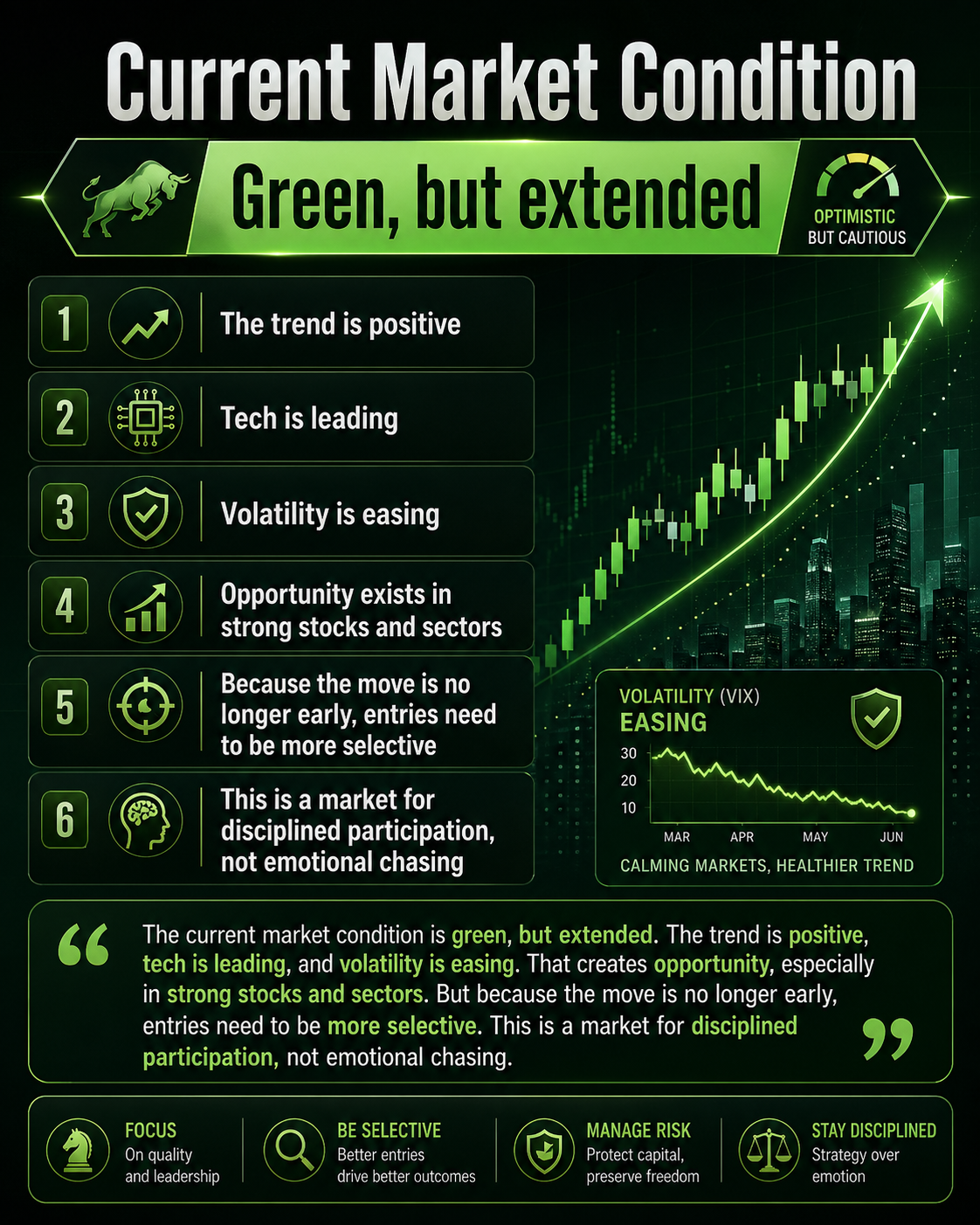
The current market condition is green, but extended. The trend is positive, tech is leading, and volatility is easing. That creates opportunity, especially in strong stocks and sectors. But because the move is no longer early, entries need to be more selective. This is a market for disciplined participation, not emotional chasing.
Stock Tips This Week

2 Breakout Stocks to Watch in a Volatile Market
In this video, the focus is on Astera Labs and TE Connectivity as two stocks showing relative strength while the broader market deals with headline risk. The practical lesson is that a green market still favors bullish setups, but traders should build watchlists first and manage risk because not every breakout works. The article specifically emphasizes relative strength, preparation, and waiting for proper confirmation rather than chasing late moves.

Building Passive Income With Covered Calls: The 20-Minute-Per-Week System
In this blog, covered calls are framed as a structured income strategy for investors who already own quality stocks. The key idea is that covered calls are not completely passive, but they can be managed with a simple weekly routine: scan positions early in the week, check for major moves midweek, and handle expirations or new trades on Friday. The biggest takeaway is that income strategies still need rules, cash reserves, diversification, and a commitment not to chase high premiums blindly.

Covered Calls vs. Selling Puts: Which Income Strategy Is Right for You?
In this blog, the difference between selling covered calls and selling cash-secured puts is explained in a practical way. Covered calls begin with stock ownership and generate income from shares already held, while cash-secured puts begin with cash and are used when an investor is willing to buy a stock at a lower price. The most useful takeaway is that these are not competing strategies; they can work together through the wheel strategy, where investors collect premium while waiting to buy and then collect call premium once shares are owned.

AAPL Covered Calls: A Step-by-Step Example Using Apple Stock
In this blog, the Apple covered-call example shows why liquid, widely held mega-cap stocks can be attractive candidates for premium-selling strategies. The article highlights Apple’s options liquidity, moderate implied volatility, and quality-company profile, then walks through how strike selection and expiration choice affect income and assignment risk. The practical lesson is that covered calls work best when the underlying stock is strong enough to own, the option market is liquid, and the investor has a plan for earnings, rallies, and position concentration.

The 10 Most Expensive Covered Call Mistakes
In this blog, the focus is on risk management for anyone selling covered calls. The biggest mistakes include selling through earnings without a plan, chasing unusually high premiums, setting strikes below cost basis, ignoring ex-dividend dates, trading illiquid options, and having no assignment plan. The broader message is that covered calls are only as strong as the system behind them. A strategy that looks conservative can become risky quickly when traders make inconsistent decisions.
Podcast Episode This Week

EP-185: The Right Franchise for You with Matt Stevens
In this podcast, Mark Yegge speaks with franchise expert Matt Stevens, also known as “The Franchise Guy,” about how franchising works and what investors or entrepreneurs should understand before choosing a franchise path. For readers focused on building wealth beyond the stock market, the episode offers a useful look at business ownership, systems, and how to evaluate whether a franchise model fits your goals.
