
Insider Tips - Weekly Stock Market Report - Week April 20, 2026
Insider Tips — April 20, 2026
This week’s market action had a very different feel from the anxious tone that often hangs over a fresh rebound. The message from the latest market update was simple: conditions have turned meaningfully greener, and the market is starting to reward investors who were willing to act when the signal first changed. That matters, because the hardest time to buy is usually right after a weak stretch, when headlines are still negative and confidence is low.
What stands out now is the combination of improving price action and easing fear. Major growth-heavy benchmarks have pushed higher, several leadership names are climbing the right side of their bases, and volatility has come down enough to suggest money is moving off the sidelines. The main opportunity here is obvious: leadership is reasserting itself, especially in technology and AI-linked names. The main risk is just as clear: volume has not fully confirmed every breakout move, so discipline still matters.
The overall stance this week is constructive, but not reckless. This looks more like a market that deserves participation than one that invites chasing. The setup favors investors who can stay flexible, add exposure carefully, and let price prove the case.
Technical analysis
The technical backdrop improved notably this week. The Nasdaq, tracked here through QQQ, has shown renewed strength after what had been a weak and erratic chart for much of the prior stretch. The recent move higher has been sharp, with a gap up and a push back toward fresh highs. That is a meaningful shift in tone, particularly because so many previously damaged AI-related names have started to reverse higher at the same time.
The S&P 500, represented by SPY, is telling a similar story. It is moving up the right side of its pattern and effectively breaking out. From a pure price perspective, that is bullish. The caveat is volume. The move is real in price terms, but not every part of it has come with the kind of heavy participation that would make the breakout feel fully convincing.
The Dow has improved as well, even if it remains a step behind the strongest areas of the market. It is back above the 50-day moving average and climbing, which supports the broader risk-on message. The New York Stock Exchange Composite also looks healthy, and that matters because it captures a wider mix of industries than the narrower growth benchmarks.
Then there is the VIX, which may be one of the most important confirming signals in this setup. Volatility has eased, and the “panic” has come out of the market. That shift does not guarantee a straight line higher, but it does reinforce the view that fear is subsiding and capital is becoming more willing to re-enter equities.
One additional theme from the update is the role of oil. The argument is that falling oil prices can ease inflation pressure, especially through transportation costs, and that this creates a friendlier backdrop for equities. Whether that becomes the market’s dominant macro driver remains to be seen, but for now it fits with the week’s broader bullish tone.
Market trends I’m calling out
- The market is rewarding early discipline again
One of the strongest ideas in this week’s update is that investors rarely feel good at the actual turning point. The first green signal often arrives while sentiment is still negative. That is exactly why it matters. By the time the move feels comfortable, much of the easy progress may already be gone.
- AI leadership is reasserting itself
Many of the names highlighted this week sit in the AI, semiconductor, storage, and infrastructure trade. That is not random. The market is once again favoring companies tied to compute, memory, hardware demand, and enabling infrastructure. Even after earlier weakness, leadership appears to be rotating back toward these themes.
- Price is improving faster than volume
This is the biggest caution flag. The charts look better. Breakouts are happening. Bases are resolving upward. But in several cases, the volume is only decent or even underwhelming. That does not invalidate the move, but it means investors should distinguish between an emerging uptrend and an all-clear signal.
- Breadth is improving, even beyond the obvious leaders
The strength is not isolated to one or two mega-cap names. The Nasdaq, S&P 500, Dow, and NYSE Composite are all improving. That suggests a healthier market environment than one driven by only the largest stocks.
- Lower fear is creating room for stocks to work
As volatility fades, investors become more willing to commit capital. The falling VIX is not just a side note. It helps explain why setups that looked shaky a few weeks ago are now gaining traction.
Individual stocks (what I’m seeing)Apple (AAPL)
Apple looks constructive as it climbs the right side of a consolidation and holds above both the 50-day and 200-day moving averages. The stock appears to be working its way back toward prior highs, and the recent action suggests steady institutional support rather than a speculative surge. It may not be the fastest mover in the group, but the chart has a stable, methodical look.
Nvidia (NVDA)
Nvidia is starting to look like a classic right-side recovery candidate. The key point from the update is that it is advancing through its consolidation and approaching an important prior level near the top of the pattern. The big tell will be whether it can push through on stronger volume. That would make the move far more convincing. Until then, it remains strong, but still in the prove-it phase.
SanDisk (SNDK)
SanDisk was framed as one of the strongest stocks in the group, with standout relative strength and recent all-time highs. Even after a small pullback from those highs, the stock still looks like a leader. This is the kind of name that can stay extended longer than investors expect when a theme has real momentum behind it. The question is less about strength and more about entry discipline.
Micron (MU)
Micron is another stock benefiting from the improving tone in semiconductors and AI infrastructure. It is moving up the right side of its consolidation and appears to be in a buyable area according to the update. Among the chip-related names, Micron looks like a straightforward example of a chart that has repaired itself and is now trying to resume leadership.
AMD (AMD)
AMD also appears to be coming out of a buy zone and beginning to stretch higher. That can be encouraging, but it also means the easy entry may be passing. The stock still looks healthy, yet the tactical question is whether to chase strength or wait for a better setup. In this kind of market, that distinction matters.
Intel (INTC)
Intel may be one of the more interesting charts in the group simply because expectations have been so muted for so long. The update described the stock as surprisingly strong, with a breakout that carried into a sell zone before some profit-taking appeared. That is notable. Even if Intel is not the first name investors associate with current leadership, the chart suggests it has earned a closer look.
Alphabet (GOOGL)
Alphabet is doing many of the right things technically, especially as it moves up the right side of a cup-like pattern. The concern is conviction. The price action looks better than the volume profile underneath it. In other words, the chart is improving, but the move does not yet feel fully sponsored. It is worth watching, but it has less confirmation than some of the stronger names discussed this week.
Amazon (AMZN)
Amazon’s setup looks promising because of the size and duration of its consolidation. Long bases can create powerful moves when they finally resolve higher, and that is the argument here. Small gap-ups and improving price action add to the appeal. If the stock can challenge and clear the upper end of its range, it may become one of the more interesting large-cap setups in the market.
Key takeaways
- The market tone has improved meaningfully, especially since the green signal appeared last week.
- Nasdaq and S&P 500 strength suggests risk appetite is returning.
- Falling volatility supports the case for renewed equity participation.
- AI, semiconductors, and infrastructure names are acting like leadership again.
- Price action is strong, but volume remains the main caution flag.
- The best entries usually feel uncomfortable at first, which is why discipline matters.
- This is a market for selective buying, not emotional chasing.
Conclusion
This week’s market has the look of a rebound gaining credibility. Fear has cooled, leaders are acting better, and several important indexes are back in healthier technical positions. That does not mean every breakout will work, and it does not remove the need for patience. But it does mean the environment has improved enough to justify paying attention and participating thoughtfully.
The best approach here is still a disciplined one. Focus on quality setups. Watch volume closely. Respect support levels. And remember that strong markets reward process far more consistently than prediction. Going into next week, the big question is whether price strength can keep broadening out and whether volume begins to confirm what charts are already suggesting.
Current Market Condition
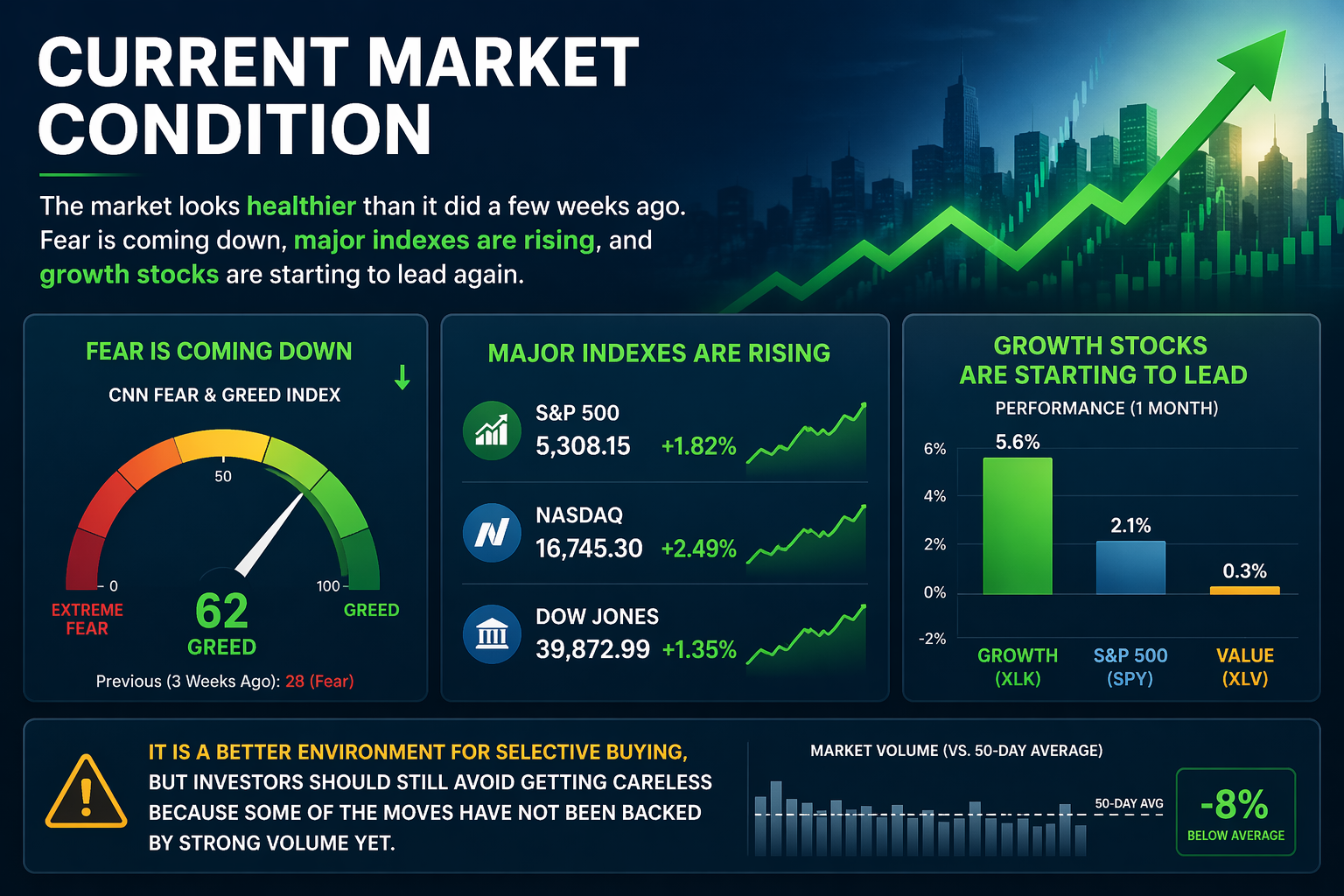
The market looks healthier than it did a few weeks ago. Fear is coming down, major indexes are rising, and growth stocks are starting to lead again. It is a better environment for selective buying, but investors should still avoid getting careless because some of the moves have not been backed by strong volume yet.
Arizona - Event Wrap Up

Arizona 2026: The Strategy Room – Recap
What an incredible weekend in Arizona.
We just wrapped up our Wealth Accelerator Live: The Strategy Room in Chandler, and it delivered exactly what it was designed to do — bring together a focused group of serious traders ready to take their execution to the next level.
The turnout was perfect.
Not too big. Not too small.
Just the right room of committed individuals who showed up ready to learn, share, and grow.
Over the three days, we went deep — not just into strategy, but into real execution.
From market context and system alignment to advanced trade setups and portfolio decisions, every session was built around one goal:
Turning knowledge into action.
But what made this event truly special wasn’t just the content — it was the people.
We had a room full of engaged, eager traders who:
-
Asked great questions
-
Shared openly about their journeys
-
Supported each other in real time
By the end of the weekend, something powerful had formed…
Not just better traders — but a community.
Attendees walked away with:
-
A clearer trading plan
-
Stronger decision-making frameworks
-
Greater confidence in their process
-
And new relationships with like-minded traders on the same path
And yes — we had a lot of fun along the way.
From the Friday night kickoff and cocktail reception…
To the deep-dive sessions on Saturday…
To the focused integration and clarity on Sunday…
All set against the backdrop of a beautiful Arizona environment that made the entire experience even more memorable.
This wasn’t a conference.
It was a Strategy Room.
And for those who were there — you felt it.
If you joined us this weekend, thank you for being part of something special.
And if you missed it…
Stay close.
We’re just getting started.
Stock Tips This Week

Covered Call Trading Psychology: Why mindset matters
In this Blog, one of the most useful reminders is that covered call success is often more about behavior than mechanics. The article focuses on emotional traps like FOMO, fear of assignment, revenge trading, and overconfidence, while making the case for a rules-based approach where investors think in terms of process and consistency rather than reacting to every individual outcome.

GLD Covered Calls: Turning gold into an income asset
In this Blog, the focus is on a practical idea for income-focused investors: using covered calls on GLD to generate cash flow from an asset that otherwise does not produce income. The value here is not just the premium itself, but the combination of gold exposure, liquidity, and options depth that can make GLD a useful income overlay for investors who already want gold in their portfolio.

How to Track Covered Call Income
In this Blog, the message is clear that a strong strategy still needs measurement. The main lesson is that covered call investors should track more than premium alone, including win rate, holding period, reduced cost basis, trade outcomes, and assignment patterns. Done well, tracking turns a series of trades into a system that can actually be evaluated and improved.

Selling Covered Calls for Beginners
In this Blog, newer options investors get a practical starting point. It explains covered calls in simple terms: own at least 100 shares, sell a call against the position, collect premium up front, and accept that upside is capped beyond the strike. It also reinforces the importance of choosing quality stocks or diversified ETFs rather than chasing unstable names just because premiums look attractive.

SPY Covered Calls Strategy
In this Blog, SPY is framed as a cleaner covered call vehicle than many individual stocks. The core advantages are liquidity, broad diversification, and reduced single-stock gap risk, which makes SPY a sensible option for investors who want index exposure paired with a repeatable income process.

Weekly vs Monthly Covered Calls Strategy
In this Blog, the discussion centers on one of the most common covered call questions: weekly versus monthly cadence. The big takeaway is that the decision is not just about gross premium. Shorter-dated options may benefit more from accelerated time decay, but they also create more decisions, more assignment friction, and more room for inconsistency. In practice, the better choice is often the one an investor can execute steadily over time.
