
Insider Tips - Weekly Stock Market Report - Week May 18, 2026
Insider Tips — May 18, 2026
This week’s market tone is best described as a yellow light. The broader trend is still constructive, and several major leadership stocks remain near highs, but the market is no longer giving investors a clean green-light environment. After pushing toward or through all-time highs, the indexes are starting to show signs of hesitation.
That does not mean the bull case is broken. It means the market may need to breathe. Strong markets rarely move in a straight line. They advance, pause, shake out weaker hands, and then either resume higher or begin a deeper correction. Right now, the message is not panic. It is discipline.
The practical stance this week is simple: do not rush into new positions just because strong stocks have been working. This is the kind of environment where investors should review holdings, trim weaker names, respect technical signals, and keep capital focused on the best setups.
Technical Analysis
The key technical shift this week is the market’s move from a cleaner green condition into a more cautious yellow condition. Last week, the market still had broad confirmation, with multiple green signals suggesting that stocks were generally moving higher. This week, the picture is more mixed, with roughly half the signals positive and half flashing caution.
The most important technical marker is the 21-day moving average. When the market begins closing below that short-term trend line, it often signals a loss of immediate momentum. It does not automatically mean a major decline is coming, but it does suggest that buyers are no longer in full control.
The Nasdaq remains strong on a bigger-picture basis. It recently pushed to all-time highs and is still trading close to those highs. However, the gap down on increased volume deserves attention. A gap below the market can sometimes become a magnet, especially if traders begin testing whether recent buyers have conviction.
The S&P 500 looks similar: strong overall, but no longer effortless. The Dow is less compelling and appears more range-bound than decisive. The New York Stock Exchange is sending a more cautious message, with a larger down candle on higher volume. That kind of action can be an early warning that broader participation is weakening.
Volatility remains relatively contained. The VIX has moved up from lower levels, but it is not signaling panic. That matters. A slightly rising VIX in a market near highs is not a crisis; it is a reminder that risk is increasing from a very calm baseline.
Market Trends I’m Calling Out
The first major theme is leadership concentration. The strongest action is still coming from familiar areas: AI, semiconductors, select mega-cap technology, and crypto-adjacent names. That is where the market’s energy remains concentrated.
The second theme is extension risk. Several leading stocks have already moved sharply. They may still be great companies and strong charts, but a great stock can still be a poor new entry if it is too far above a clean buy zone.
The third theme is portfolio gardening. In a yellow-light market, the goal is not to abandon every position. The goal is to identify what is working, what is lagging, and what no longer deserves capital. Weak positions tend to reveal themselves when the market stops rising easily.
The fourth theme is AI infrastructure remains the dominant growth story. Semiconductors, cloud infrastructure, data center demand, and related hardware names continue to attract attention. That trend remains powerful, but investors still need to separate leadership from laggards.
Finally, crypto liquidity and regulation are becoming more important. Names tied to Bitcoin, stablecoins, and crypto-market infrastructure are worth watching as Washington continues to discuss frameworks that could affect the industry.
Individual Stocks: What I’m Seeing
Apple
Apple is breaking out and trading in an extended area above its recent base. That is constructive for holders, but it is not a spot to chase aggressively. The better opportunity was earlier, before the move became obvious. For now, Apple remains a leadership name, but new entries require patience.
Nvidia
Nvidia is in breakout mode and continues to benefit from the AI infrastructure theme. The stock recently moved sharply higher and is now approaching an area where traders may begin thinking about profit-taking. A pullback that fills part of the recent gap is not necessarily bearish; it may simply be the stock digesting a strong move.
Tesla
Tesla appears to be forming a handle-like structure, with the key buy area discussed around the 450 level. The recent selling has come on relatively light volume, which makes the pullback less concerning. After a move from roughly 375 toward 450, some profit-taking is normal.
Strategy / MicroStrategy
Strategy remains closely tied to Bitcoin’s direction. The stock has already had a major move this year and continues to build its Bitcoin exposure. Relative strength is not perfect, but the stock remains worth watching because of its direct connection to the crypto trend.
AMD
AMD broke out recently and is now in a holding period. There may still be a gap that wants to be filled, but the broader relative strength remains impressive. The AI trade continues to support the setup.
Micron Technology
Micron has also benefited from the AI and semiconductor momentum. The stock is in a profit-taking zone after a strong move, and the recent gap down on slightly above-average volume is worth noting. For now, this looks more like consolidation than breakdown.
Broadcom
Broadcom remains part of the same AI infrastructure conversation. The chart is sitting in a consolidation-breakout area, which makes it one to monitor closely. Like many of the strongest AI-related names, the key is avoiding emotional entries after big moves.
Amazon
Amazon is trying to break out but has not yet held the move convincingly. The earnings reaction helped, but the stock still needs follow-through. Until that happens, Amazon remains a watchlist candidate rather than a clear leadership breakout.
Alphabet
Alphabet is extended from its prior buy zone and recently ran into the psychologically important 400 area. Round numbers often act as resistance, and this one appears to have mattered. Even with the pullback, Alphabet’s underlying business momentum and chart strength remain notable.
Meta Platforms
Meta is one of the weaker-looking charts in the group. A stock trading below both its 50-day and 200-day moving averages is not generally a buy candidate. There are stronger charts elsewhere, and in a yellow market, relative weakness should not be ignored.
Microsoft
Microsoft remains a high-quality business, especially with continued growth in Azure and Microsoft 365. The chart, however, does not look as strong as the business story. There may also be investor concern around its exposure to OpenAI-related uncertainty. For now, the message is simple: the company may be strong, but the stock is not acting like a leader.
Circle
Circle is worth adding to the watchlist as a crypto-infrastructure name. The discussion around stablecoins, liquidity, and potential regulatory clarity could become an important theme. That said, this is not necessarily an immediate buy. It is a name to watch for a cleaner technical setup.
Gold and GLD
Gold remains part of the broader risk-management conversation, but GLD was down during the update. That is a useful reminder that not every day needs to be profitable. Strong investing is not about forcing trades every session; it is about following the process.
Key Takeaways
- The market has shifted into a yellow-light condition, which calls for caution rather than panic.
- Closing below the 21-day moving average is a short-term warning signal.
- The Nasdaq and S&P 500 remain near highs, but recent gap-down action deserves attention.
- AI and semiconductor names continue to lead, but many are now extended.
- This is a good time to trim weak positions and focus capital on the strongest setups.
- Volatility is rising slightly, but the VIX is not signaling broad panic.
- Crypto-related names deserve attention as regulatory and liquidity themes develop.
Conclusion
This is not a market that demands fear. It is a market that demands discipline.
When conditions turn yellow, the goal is to slow down, review positions, and avoid chasing stocks that have already made their move. Strong investors do not need to act on every tick. They need a plan, a process, and the patience to wait for clean opportunities.
The next thing to watch is whether the major indexes regain short-term support or continue drifting toward their 50-day moving averages. If leadership stocks consolidate constructively, the bull trend can remain intact. If weakness broadens, risk should be reduced further.
Current Market Condition
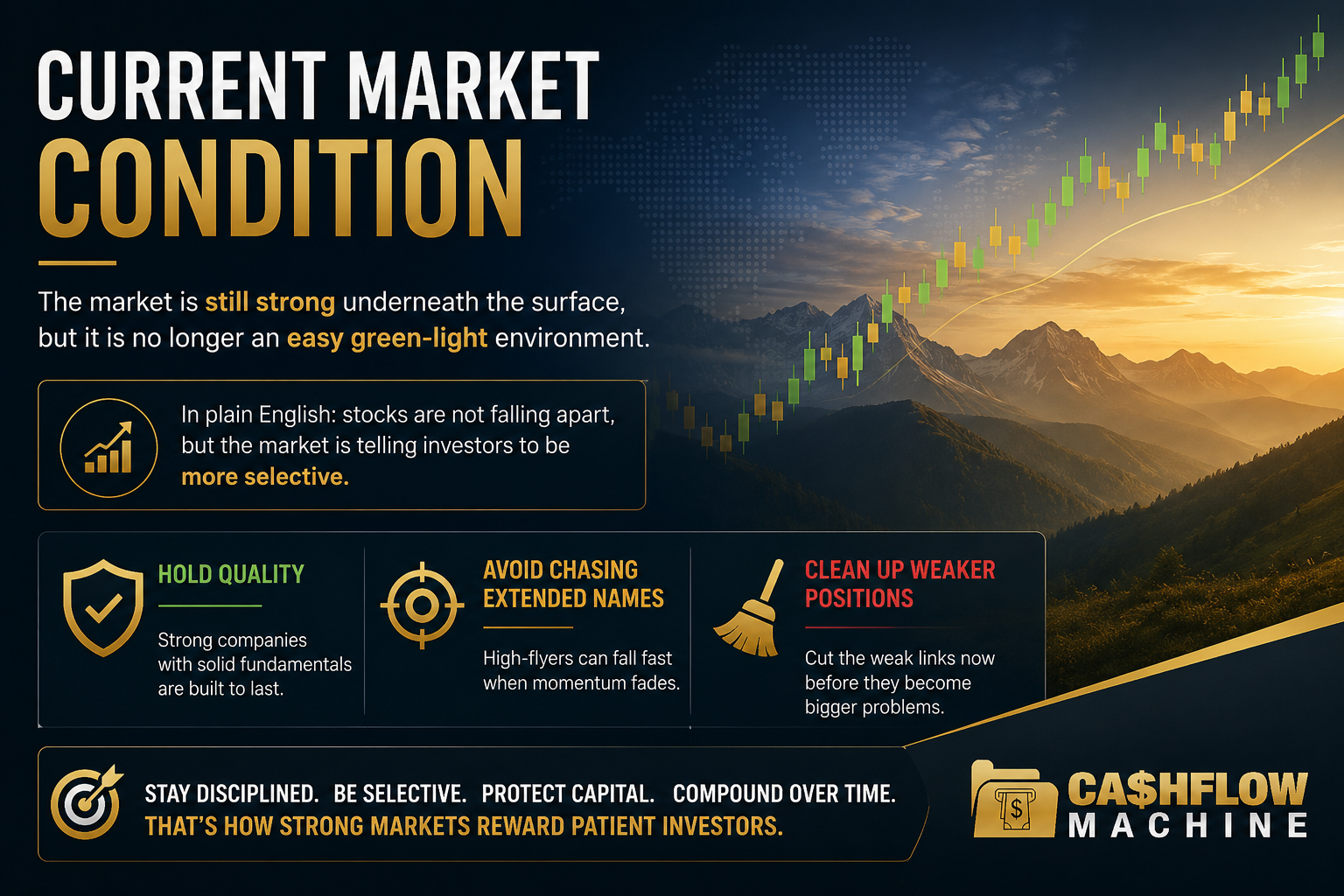
The market is still strong underneath the surface, but it is no longer an easy green-light environment. In plain English: stocks are not falling apart, but the market is telling investors to be more selective.
This is a time to hold quality, avoid chasing extended names, and clean up weaker positions before they become bigger problems.
Stock Tips This Week

The Hidden Cost of Overtrading: Why More Action Often Leads to Less Profit
In this video, the main lesson is that more activity does not always mean better performance. Overtrading can drain both financial and emotional capital through slippage, stress, decision fatigue, and constant second-guessing. The practical takeaway is to build a rules-based system, review positions calmly, and avoid reacting to every market move.
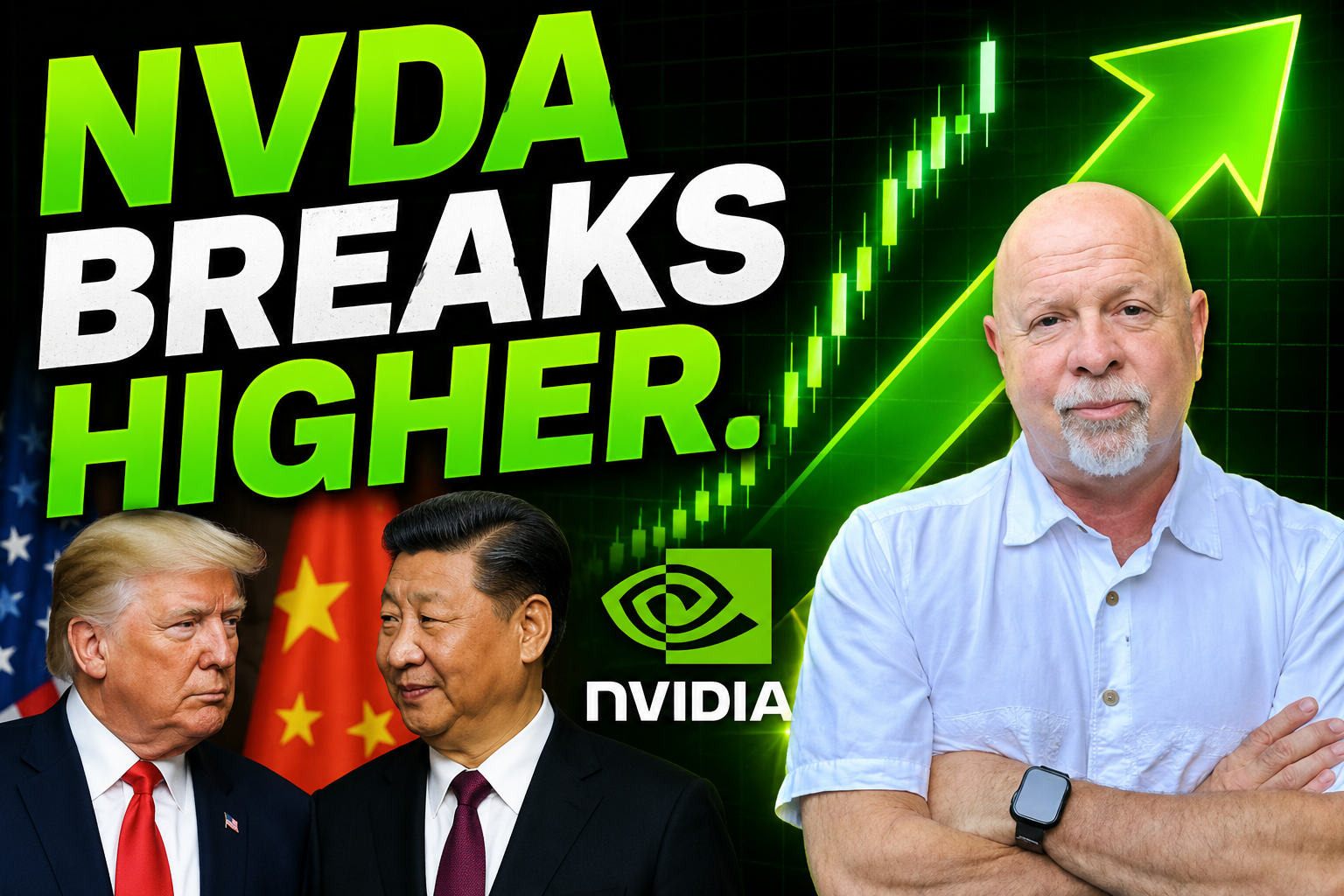
Nvidia Is Breaking Out Again: What Mark Yegge Sees in the AI Infrastructure Trade
In this video, Nvidia is used as a case study in how powerful breakouts often come after long consolidations. The key lesson is that AI infrastructure remains a major market theme, but investors still need to respect entry points. Nvidia may remain strong, but chasing after a fast move adds risk.

Covered Calls on ETFs vs Individual Stocks: Which Is Better for Income?
In this blog, the focus is the trade-off between smoother ETF income and higher single-stock premium. ETFs may offer better diversification and cleaner risk control, while individual stocks can generate richer income but require stricter sizing and discipline.

How Covered Call Income Protects Your Portfolio During Inflation
In this blog, covered calls are framed as one way to generate income when inflation pressures remain elevated. The key idea is that higher volatility can increase option premiums, but investors still need to manage expirations, strike selection, and upside participation carefully.

Covered Call Position Sizing: How Much Capital Per Trade?
In this blog, the emphasis is on position sizing as the foundation of a durable covered call plan. The lesson is simple: even a good strategy can become dangerous if too much capital is concentrated in one stock, sector, or trade.

Can You Sell Covered Calls on Growth Stocks? Strategy and Risks
In this blog, growth stocks are presented as useful but higher-risk candidates for covered calls. The premiums can be attractive, especially in names like Nvidia, Tesla, or AMD, but investors must allow more upside room and avoid treating volatile growth stocks like conservative income holdings.

Covered Call Strategy for Early Retirement: The Income Plan That Lets You Quit at 50
In this blog, covered calls are discussed as part of an early-retirement income framework. The central idea is to turn a quality portfolio into a potential monthly cash-flow engine while still managing risk across different sleeves of the portfolio.

ITM vs OTM Covered Calls: Which Strike Type Generates More Real Income?
In this blog, the key lesson is that in-the-money and out-of-the-money covered calls serve different purposes. ITM calls can offer more downside cushion, while OTM calls leave more room for upside. The right choice depends on market trend, volatility, and income goals.
Podcast Episode This Week

EP-188 — Be The Decamillionaire with Justin Goodbread
In this podcast, Justin Goodbread joins Mark Yegge on the Wealth Architect Podcast to discuss what it really takes to become a decamillionaire. The episode focuses on the mindset, systems, and business strategies needed to scale from small business owner to true financial freedom.
