
Insider Tips - Weekly Stock Market Report - Week July 20, 2026
Insider Tips — July 20, 2026
A Porpoising Market: Tech Weakness, AI Rotation, and the Case for Caution
The market spent another week struggling to establish a clear direction. Like an inexperienced pilot overcorrecting during a landing, investors have been reacting sharply to every headline—pushing prices lower in moments of fear and then quickly reversing course when buyers return.
That back-and-forth action has created a frustrating environment for trend-focused investors. The broad market is not collapsing, but it is not providing the clean, consistent leadership that supports aggressive positioning either. Technology stocks are under the most pressure, while several broader indexes remain relatively constructive.
The practical stance is caution without panic. Investors should protect capital, reduce emotional decision-making, and let the market establish a clearer trend before increasing exposure.
Technical Analysis
The major indexes continue to tell different stories.
The broader market is currently in a Yellow condition, signaling that participation is still possible, but risk should be managed carefully. The VTI and S&P 500 are Yellow, while the technology-heavy Nasdaq is showing a Red condition. The Dow is also Yellow.
The Nasdaq Composite remains trapped in a wide trading range and appears vulnerable to another test of the 25,000 area. Its recent gap lower reinforces the need for caution, particularly in technology and semiconductor stocks.
The S&P 500 looks healthier. It is attempting to bounce from its 50-day moving average, which remains an important dividing line. Holding that level would support the broader market, while a decisive break below it could signal that weakness is spreading beyond technology.
The Dow is trying to hold its 21-day moving average, and the NYSE Composite remains comfortably above its 50-day moving average. That relative strength suggests the market’s weakness is still concentrated rather than universal.
Volatility has increased, with the VIX reaching its 200-day moving average. That deserves attention, but it does not yet resemble a full-scale volatility event. For now, the VIX is signaling rising uncertainty rather than outright panic.
Market Trends I’m Calling Out
Technology Is Carrying Most of the Weakness
The most important development is the deterioration in technology leadership. The Nasdaq is weaker than the broader market, and former AI leaders are no longer moving higher automatically.
Semiconductors, memory stocks, hardware companies, and some AI-related infrastructure names have experienced significant corrections. This does not necessarily mean the entire AI investment cycle is over. It does suggest that valuations and expectations are being reassessed.
The AI Trade Is Losing Some Air
AI-related stocks previously attracted capital almost regardless of valuation. That environment is changing.
As AI software becomes more competitive and increasingly commoditized, investors may begin questioning how much of a premium chipmakers, energy providers, data-center suppliers, and other infrastructure companies deserve. The underlying AI trend may remain powerful while individual stocks still experience meaningful corrections.
Stocks that rise in a near-vertical “hockey stick” pattern can surrender gains surprisingly quickly. Investors should avoid assuming that a strong long-term narrative protects a stock from short- and intermediate-term downside.
The Broader Market Is Holding Up Better
Although technology is under pressure, the S&P 500, Dow, and NYSE Composite are showing better relative strength. This suggests that capital may be rotating rather than leaving the market entirely.
That rotation could eventually create new opportunities outside the crowded AI trade. Until leadership becomes clearer, however, investors should remain selective and avoid forcing trades simply because one part of the market has declined.
Emotional Trading Remains a Major Risk
The opening 30–45 minutes of the session can produce exaggerated moves as institutional orders, overnight news, and emotional retail decisions collide. Sharp declines during this period can pressure investors into selling positions they intended to hold.
Not every early decline is manipulation, and not every sell-off will reverse. The lesson is to avoid making major decisions solely because of chaotic opening action. A defined trading plan, predetermined exit rules, and appropriate position sizing can help prevent emotional overreaction.
Individual Stocks: What I’m Seeing
Apple
Apple has staged an impressive recovery from its earlier high-volume decline and reached a new high despite broader market uncertainty. That relative strength stands out, particularly with earnings approaching.
The chart appears constructive, but investors should still consider earnings risk and avoid chasing an extended move. Even strong stocks can become volatile when expectations are elevated.
Nvidia
Nvidia has spent several months moving sideways and is beginning to show signs of a potential downtrend. It may still offer shorter-term trading opportunities, but the chart is no longer displaying the persistent upside momentum that previously defined the stock.
The key question is whether buyers can reclaim control and establish a new series of higher highs and higher lows. Until then, caution is appropriate.
SanDisk
SanDisk has been trending lower for approximately three weeks and has fallen below its 50-day moving average. The stock recovered from its early weakness, suggesting that some buyers may be stepping into an oversold condition.
A bounce alone would not confirm a durable bottom. The stock needs to stabilize and eventually reclaim important moving averages before the technical picture becomes convincingly constructive.
Micron
Micron’s chart closely resembles SanDisk’s, reinforcing the idea that the selling is affecting the broader memory-chip group rather than one isolated company.
The stock may be entering an oversold area, but investors should distinguish between a short-term relief rally and an actual trend reversal. Improving price structure and sustained buying volume would offer stronger confirmation.
AMD
AMD appears somewhat healthier than other semiconductor names but remains close to its 50-day moving average. A decisive recovery above that level would improve the technical outlook.
Failure to reclaim it would leave the stock vulnerable to continued weakness. AMD may become an important indicator of whether semiconductor leadership can stabilize.
Dell Technologies
Dell has suffered a particularly sharp decline, demonstrating how quickly momentum stocks can lose value when sentiment changes. The move also highlights the potential defensive role of properly structured in-the-money covered calls.
Covered-call protection can reduce the effect of a decline, but it does not eliminate risk. Investors still need clear adjustment rules, position limits, and a point at which the underlying stock is no longer worth defending.
The SpaceX Position
The position discussed this week continues to serve as a practical example of “defending your position.” As the underlying price declined, the short-call strike was progressively rolled lower to maintain downside protection and preserve as much capital as possible.
This approach can potentially offset part of a stock’s decline through intrinsic value and time decay. However, repeated rolls require active management and can extend the time spent in a struggling position. The objective is risk control—not pretending that the underlying decline does not matter.
Caterpillar
Caterpillar has declined for three consecutive weeks after benefiting from enthusiasm surrounding AI infrastructure and data-center construction. The correction is substantial enough to question whether the stock’s previous valuation had moved too far ahead of its fundamentals.
The stock is attempting to find support, but the chart has not yet provided convincing evidence that the decline is finished. Investors should wait for stabilization rather than trying to predict the exact bottom.
Palantir
Palantir had been trading from a late-stage base, making it increasingly vulnerable to a breakdown. That weakness has now appeared.
The company may still have a compelling long-term business story, but technical deterioration should be respected. A strong narrative does not replace disciplined risk management.
Key Takeaways
- The overall market condition is Yellow, while technology remains under greater pressure.
- The S&P 500’s 50-day moving average is an important level to monitor.
- Weakness in semiconductors, memory stocks, and AI infrastructure suggests that the AI trade is undergoing a broader reassessment.
- Relative strength in the Dow and NYSE Composite indicates that the entire market is not deteriorating equally.
- An oversold bounce is not the same as a confirmed bottom or new uptrend.
- Covered calls can provide downside protection, but they require clear adjustment rules and do not remove underlying-stock risk.
- Protecting capital is more important than participating in every market move.
Conclusion
This is a market where patience matters more than prediction. The indexes are moving in different directions, technology leadership is weakening, and emotional reactions are producing sharp intraday swings.
Investors do not need to abandon the market entirely, but they should avoid aggressive exposure until conditions improve. Focus on stocks demonstrating genuine relative strength, respect important moving averages, and define your downside risk before entering any position.
Most importantly, protect the account. Losses become harder to recover as they grow, and there is nothing wrong with holding additional cash when the market is not offering clean opportunities. Let the market settle, wait for confirmation, and resist the temptation to overreact to every short-term move.
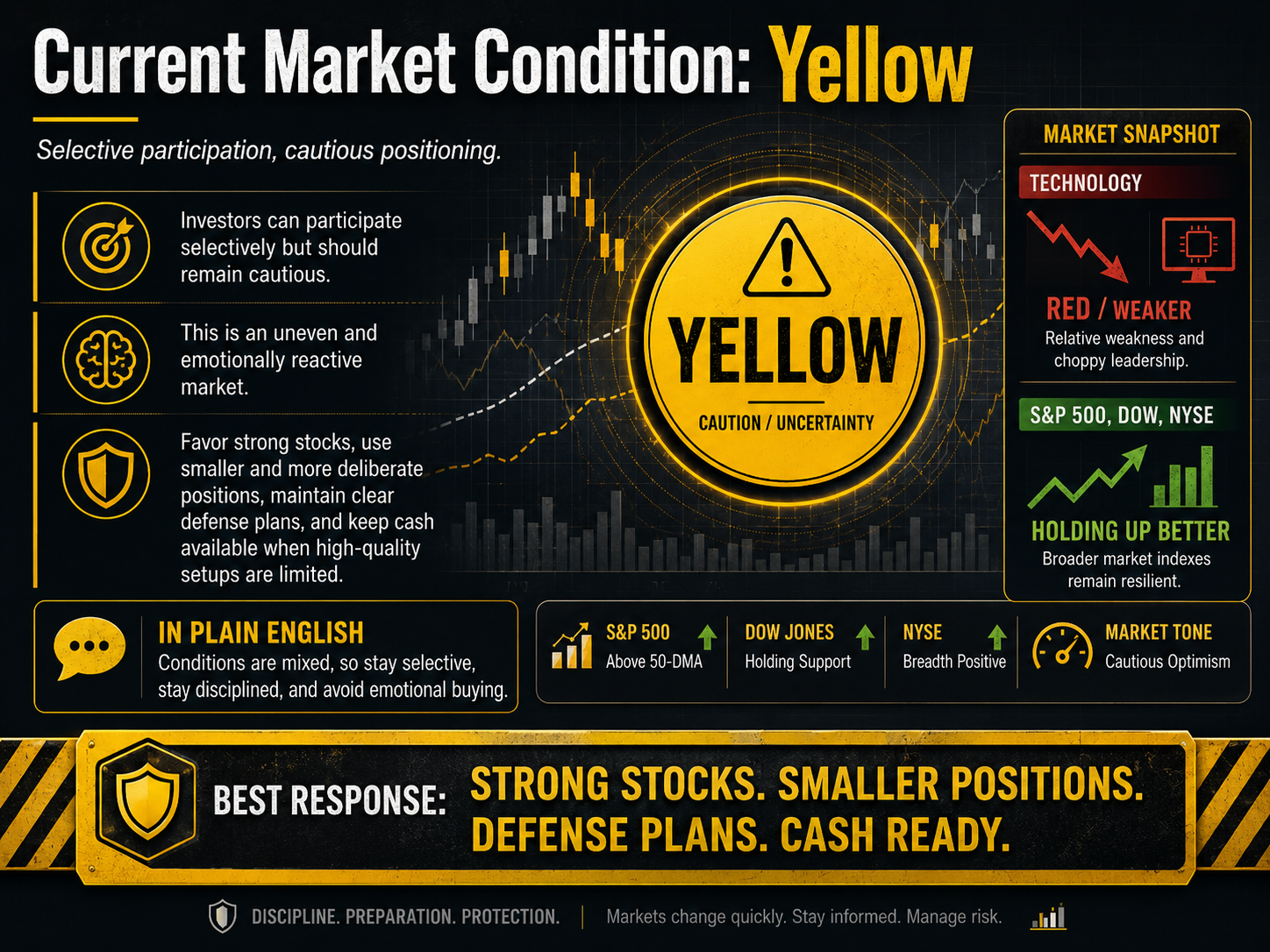
Current Market Condition
The current market condition is Yellow, meaning investors can participate selectively but should remain cautious. Technology is in a weaker Red condition, while the S&P 500, Dow, and broader NYSE market are holding up better.
In plain English, this is an uneven and emotionally reactive market. Favor strong stocks, use smaller and more deliberate positions, maintain clear defense plans, and keep cash available when high-quality setups are limited.
Stock Tips This Week
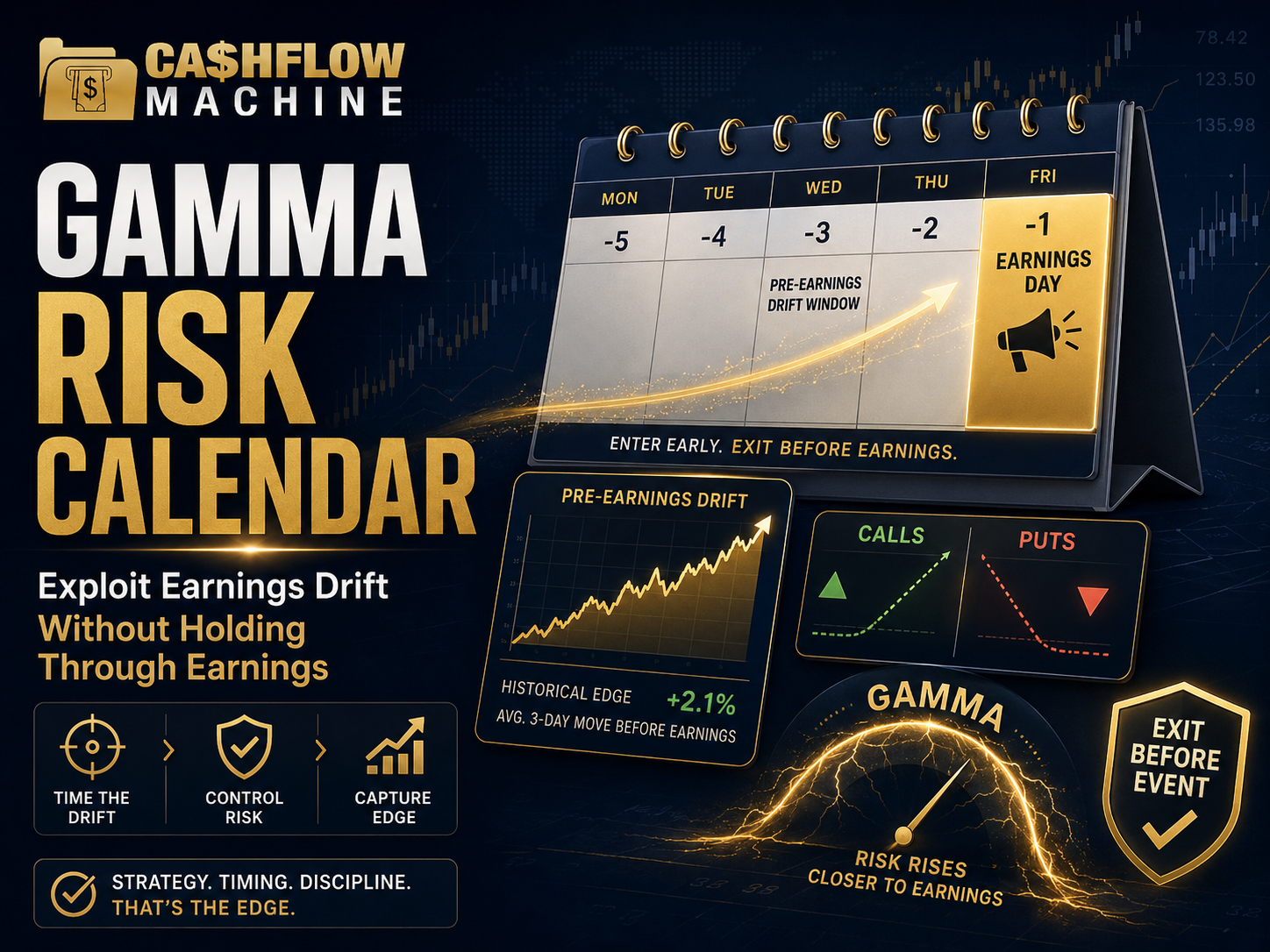
Gamma Risk Calendar: Exploit Earnings Drift Without Holding Through Earnings
In this blog, learn how traders can study the price drift that sometimes develops ahead of earnings while avoiding the binary risk of holding through the announcement. The central lesson is to define the trade window carefully and exit before earnings rather than relying on an unpredictable post-report move.
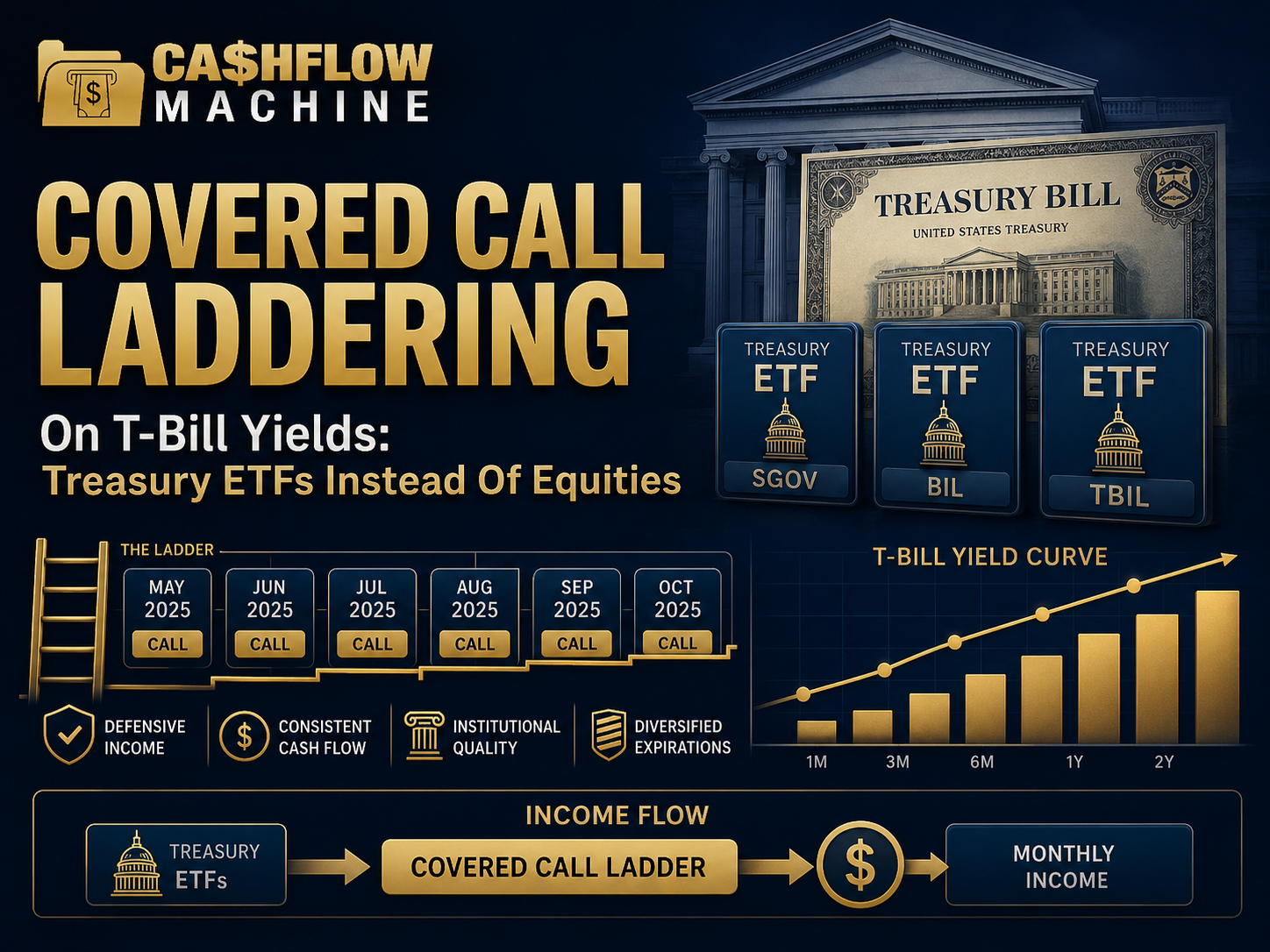
Covered Call Laddering on T-Bill Yields: Treasury ETFs Instead of Equities
In this blog, explore how Treasury ETFs may be incorporated into a covered-call ladder to combine interest-rate exposure with option income. The strategy may reduce company-specific risk, but investors should still consider duration, liquidity, changing yields, and how call premiums affect total return.
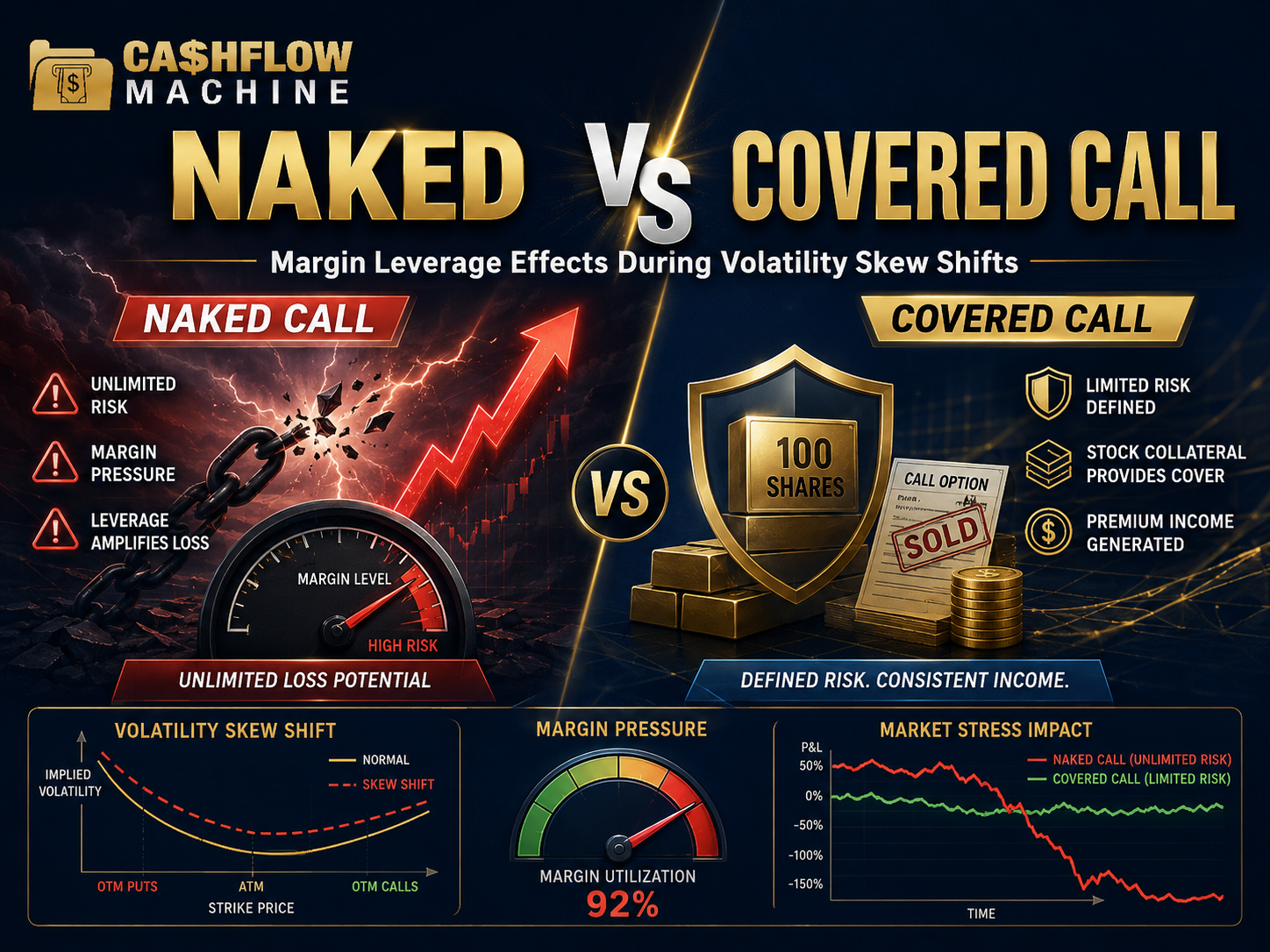
Naked vs. Covered Call Writing on Margin: Leverage Effects During Volatility-Skew Shifts
In this blog, compare the defined ownership structure of covered calls with the substantially greater risk of writing naked calls on margin. It also examines how leverage requirements and changing volatility skew can alter risk quickly, especially when the underlying stock makes a sharp move.

Covered Call Assignment and Wash-Sale Rules: Avoiding Unintended Tax-Loss Harvesting
In this blog, examine how covered-call assignment can interact with wash-sale rules when shares are sold at a loss and a substantially identical position is acquired within the relevant period. Careful recordkeeping and professional tax guidance can help investors avoid unexpected adjustments to deductible losses.
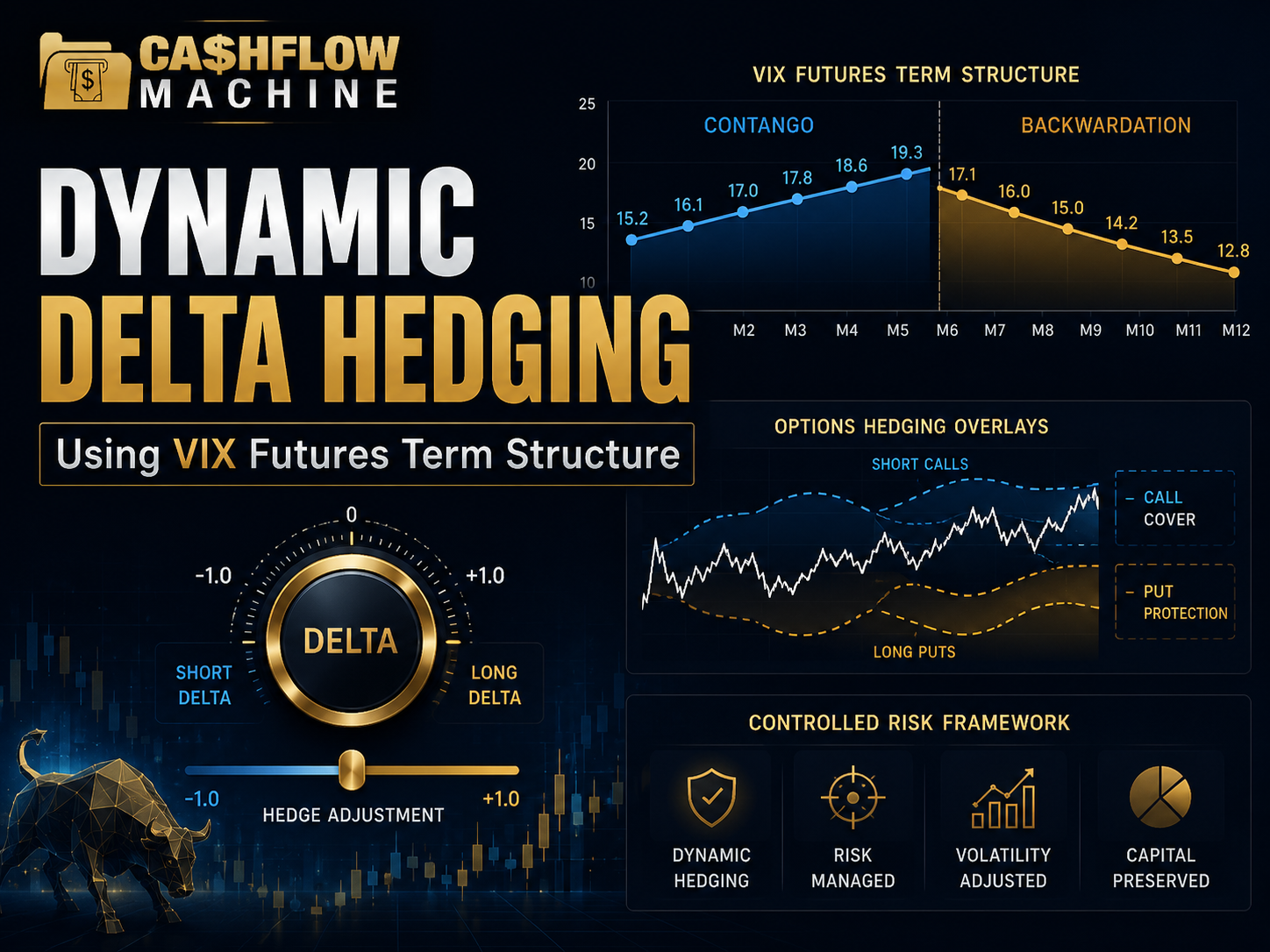
Dynamic Delta Hedging for Covered Calls Using VIX Futures Term Structure
In this blog, explore an advanced approach to adjusting covered-call exposure as option delta and volatility conditions change. The VIX futures term structure may provide additional context about market stress, but dynamic hedging requires close monitoring and disciplined adjustment rules.

Covered-Call Writing on REITs: Dividend Capture and the Price Reset After the Ex-Date
In this blog, learn how REIT dividends, option premiums, early-assignment risk, and the typical ex-dividend price adjustment can interact within a covered-call position. Investors should evaluate the complete return profile rather than treating the dividend as additional risk-free income.
