
Insider Tips - Weekly Stock Market Report - Week November 02, 2026
Insider Tips — November 02, 2026
Stock Market Turns Risk-Off: Tech Sell-Off, Sector Rotation & Stocks to Watch
After a difficult final week of October, the stock market enters November in a defensive position. Friday brought another substantial decline and a late-session recovery, but the rebound did not erase the developing downtrend. The Nasdaq 100 and S&P 500 remain in red market conditions, while the relatively stronger Dow has moved back to yellow after briefly showing green.
Selling has spread beyond familiar AI and semiconductor leaders into several energy-related stocks. Yet the market is not moving uniformly: healthcare and medical technology are attracting attention, and mortgage-related stocks ranked first among industry groups in Mark Yegge's latest review. That divergence suggests rotation, not simply an across-the-board retreat.
For now, protecting capital takes precedence over capturing a quick rebound. The more constructive assignment is to identify stocks forming sound bases, establish risk-controlled trading plans, and wait for stronger market confirmation. Veeva Systems, JFrog, and Etsy are three potential watchlist candidates—not automatic purchases in a red market.
Technical Analysis
Major Indexes: Different Levels of Weakness
Nasdaq 100 (QQQ) — RED. QQQ remains under pressure as selling persists in AI, chips, and other technology shares. Friday's large candle included a late recovery, but the index has not reversed its short-term downtrend. A meaningful improvement would require renewed buying and a recovery of important chart levels.
S&P 500 (SPY) — RED. SPY is also showing a defensive signal, indicating that weakness extends beyond the most prominent technology companies. A one-day bounce would not be enough to establish a durable change in trend; sustained price improvement is the more important test.
Dow Jones Industrial Average (DIA) — YELLOW. The Dow has held up better than the other indexes. It was green during a period when the Nasdaq and S&P were struggling, although its signal has since cooled to yellow. That relative resilience supports the possibility of money moving toward less technology-dependent groups.
What Volume and Moving Averages Reveal
The 50-day and 200-day moving averages are central to this week's stock reviews. Heavy-volume gaps below support suggest active selling, while repeated tests of the same moving average can weaken confidence in that level. Investors should look for stocks that reclaim lost ground on convincing volume, not merely those that have fallen far enough to appear inexpensive.
Market Trends I'm Calling Out
AI Leadership Is Being Reassessed
The long-term growth story for artificial intelligence has not disappeared, but recent price action demonstrates that enthusiasm and technical strength are different things. Nvidia and SanDisk are struggling, and selling has affected businesses tied to chips, computing infrastructure, and related investments. Strong industry prospects do not prevent a stock from correcting sharply after a major advance.
Energy Demand Does Not Guarantee Rising Energy Stocks
AI data centers require substantial electricity, a theme that previously helped fuel enormous advances in energy-related names. Bloom Energy and Constellation Energy now illustrate the other side of that trade: impressive long-term demand can coexist with deteriorating charts. Some alternative-energy areas may be attracting interest, but leadership within the broader energy space is uneven.
Healthcare and Mortgages Show Relative Strength
Mark observed capital moving toward healthcare and medical technology, while mortgage-related companies topped his industry ranking. This does not establish that every stock in those groups is healthy. It does suggest investors should study where money is flowing rather than assume the whole market will recover together.
Watchlist Building Is the Practical Opportunity
Stocks showing strength while major indexes are red may warrant additional research. Still, relative strength is a screening clue, not a license to ignore market conditions. The objective is to prepare potential entries and exit rules before a recovery, instead of chasing the first convincing-looking rally.
Individual Stocks (What I'm Seeing)
Apple (AAPL): Holding Its Ground
Apple is among the more constructive technology charts reviewed. Despite Friday's dip, it remains above its major moving averages and near a potential buy zone, with relative strength trending higher. That makes it worth monitoring if the broader market stabilizes, although a red market argues against rushing into a new position.
Nvidia (NVDA): The 200-Day Test
Nvidia gapped lower on elevated volume and continued its downtrend, although it closed above the 200-day moving average. Mark noted that the stock has tested this level repeatedly in recent months. Recovering the downside gap with strong volume would be an encouraging development; another failed test would raise concerns about support.
Tesla (TSLA): Waiting for the Handle
Tesla may be building a cup-with-handle pattern. Mark identified roughly $410 as a possible early entry if a proper handle develops, with the larger cup pivot closer to $453. A potential golden cross adds interest, but neither signal is complete. The better approach is to watch the pattern mature rather than anticipate a breakout.
SpaceX (SPCX): A Possible Downside Pattern
SpaceX was discussed in the context of a potential ABCD decline, sometimes called a lightning-bolt pattern. Mark suggested approximately $130 as a possible downside reference before a more constructive recovery. This is a chart scenario, not a forecast. Unverified merger rumors involving Tesla should not influence an investment decision.
SanDisk (SNDK): A Former Leader Corrects
After a substantial earlier advance, SanDisk has weakened and is challenging its 200-day moving average, or 40-week equivalent. Mark also sees a possible ABCD downside structure on the weekly chart. The immediate issue is whether long-term support holds; prior gains alone are not evidence that selling has finished.
Bloom Energy (BE): Momentum Meets Risk
Bloom Energy's earlier surge illustrated intense interest in electricity supply for data centers. Its subsequent pullback is a reminder that even compelling growth themes can become crowded trades. Rather than extrapolating the previous rally, investors should monitor whether the stock develops a new base and regains technical stability.
Constellation Energy (CEG): Failed Breakout
Constellation Energy could not sustain its double-bottom breakout and fell below both its 50-day and 200-day moving averages. An attempted recovery also struggled. Until the chart improves, the stock remains an example of why investors must separate favorable energy-demand narratives from actual price behavior.
Veeva Systems (VEEV): Fresh Base, Extended Entry
Veeva has emerged from a lengthy decline with stronger weekly closes, improving relative strength, and a golden cross. Its cup-shaped base makes it an interesting medical-technology-related watchlist candidate. However, Mark considered it slightly extended beyond the preferred buy zone, so a better-defined pullback or consolidation could be more useful than chasing current momentum.
JFrog (FROG): A Developing Software Setup
JFrog has recovered from a sharp earlier decline and is moving up the right side of a new consolidation. Mark highlighted a possible breakout area around $105–$106, while noting that a smaller early entry would require its own confirmation. The company's approximately 24% three-year sales growth adds a fundamental reason to investigate the setup, but price and volume still determine execution.
Etsy (ETSY): Relative Strength With Mixed Fundamentals
Etsy has built an orderly pattern and displayed several consecutive weeks of improving relative strength. Mark saw it within a potential buy zone. Earnings growth looked encouraging in his review, although revenue growth was less impressive. That combination makes Etsy a research candidate, not a flawless setup or an exception to the broader market's risk controls.
CashFlowIQ: Test the Plan, Not Just the Idea
Mark also demonstrated how CashFlowIQ can help outline stock entries, covered-call income strategies, downside protection, and historical backtests, including approaches using LEAPS. Such tests can clarify how rules performed in past periods, but hypothetical returns do not predict actual results. A trading plan still needs position sizing, exit criteria, and a realistic assessment of stock and option risk.
Key Takeaways
-
Follow the market condition. QQQ and SPY are red; the relatively stronger Dow is yellow.
-
Protect capital first. Avoid forcing bullish trades while selling pressure dominates.
-
Respect technical damage. Downside gaps, high volume, and repeated support tests matter.
-
Study rotation selectively. Healthcare and mortgages are stronger areas, not blanket buy signals.
-
Build a watchlist. VEEV, FROG, and ETSY offer setups worth researching as conditions evolve.
-
Keep option income in perspective. Covered-call premiums cannot offset unlimited losses in the underlying shares.
-
Wait for confirmation. Prepare in advance, then reassess when market signals improve.
Current Market Condition
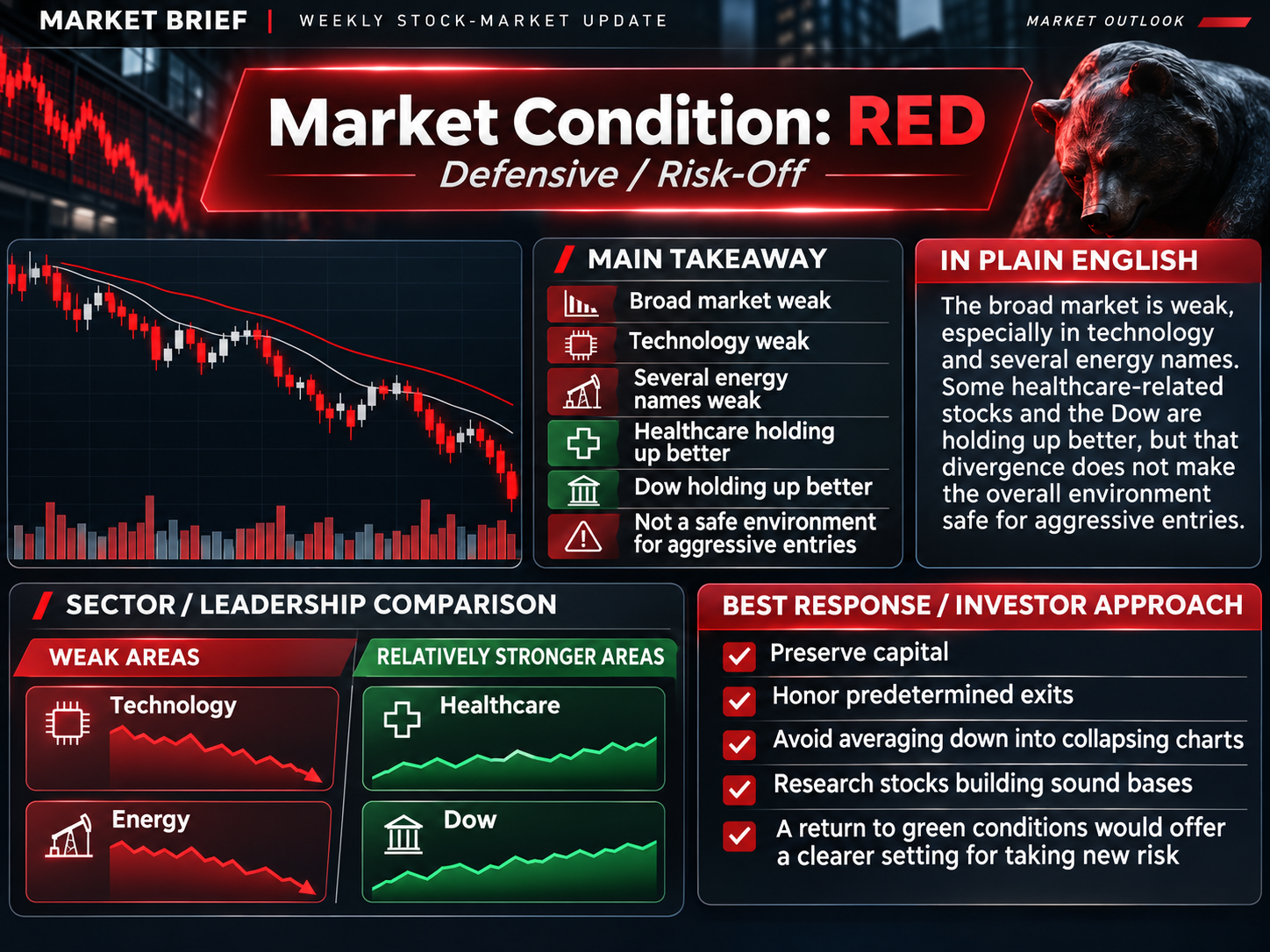
Market Condition: RED — Defensive / Risk-Off
The broad market is weak, especially in technology and several energy names. Some healthcare-related stocks and the Dow are holding up better, but that divergence does not make the overall environment safe for aggressive entries.
Best Response: Preserve capital, honor predetermined exits, avoid averaging down into collapsing charts, and research stocks building sound bases. A return to green conditions would offer a clearer setting for taking new risk.
Conclusion
This week's Market Pulse is about preparation rather than prediction. The correction has exposed weakness in former leaders while revealing emerging strength elsewhere. Investors need not capture the exact bottom to participate in a later advance; they need a plan they can execute when conditions justify it.
For covered-call investors, the discipline extends beyond collecting premiums. The underlying stock, assignment exposure, and exit strategy all matter. Stay selective, maintain flexibility, and let improving price action—not impatience—determine the next move.
Prepare the watchlist. Protect the capital. Wait for confirmation.
Stock Tips This Week

Covered Call Rolling A Deep In The Money Call Before Expiration
In this blog… Mark Yegge explains how investors can manage deep-in-the-money covered calls before expiration rather than passively accepting an unwanted assignment. The article explores three approaches: rolling up and out to preserve additional upside, extending the expiration at the same strike, and rolling down and out for a more defensive position. It also examines remaining time value, net credits or debits, and situations where allowing assignment may be preferable to rolling. The central lesson is that rolling should improve the position's risk-and-reward structure, not merely postpone a difficult decision.

Covered Call On Retirement Accounts Ira Tax Advantages Vs Taxable
In this blog… the discussion examines how account selection can affect the long-term results of a covered-call strategy. It compares traditional IRAs, Roth IRAs, and taxable brokerage accounts, emphasizing differences in tax treatment, compounding, investment flexibility, and access to funds. The article also explores the trade-offs between tax-advantaged growth and taxable-account benefits such as tax-loss harvesting. Investors are encouraged to consider how account structure fits their income needs, investment horizon, and overall financial plan.
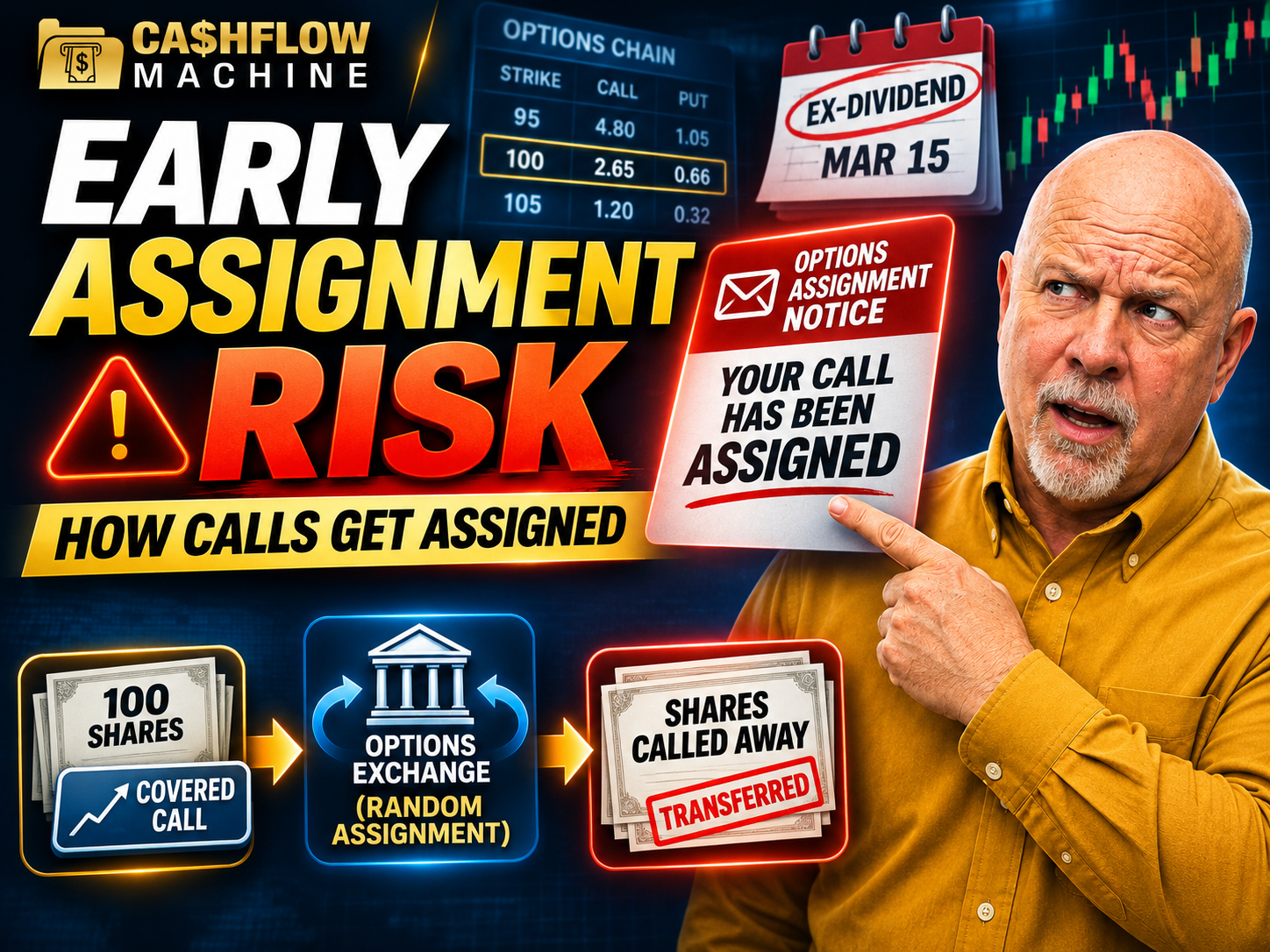
Covered Call Early Assignment Risk And How Options Exchanges Assign Calls
In this blog… Mark explains why covered-call sellers can lose their underlying shares before an option reaches expiration. Particular attention is given to deep-in-the-money calls, declining extrinsic value, and ex-dividend dates, when early exercise can become economically attractive to option holders. The article examines the assignment process and practical responses, including reviewing dividend calendars, adjusting strikes, closing positions, and considering a roll before assignment occurs. The key takeaway is to make assignment an anticipated possibility rather than an unexpected disruption to an income strategy.
Podcast Episode This Week

EP-199 – You Built It; Now Architect It!
In this episode of the Wealth Architect Podcast, Mark Yegge explores why building wealth is only the beginning of a successful financial journey. He introduces five interconnected disciplines of wealth architecture: earning, growing, generating cash flow, protecting, and eventually transferring wealth. The conversation considers how stocks, real estate, covered calls, Bitcoin, gold, tax planning, and trusts can fit within a coordinated financial strategy. For investors who have already accumulated assets, the episode offers a broader perspective on balancing income, risk, liquidity, and long-term financial objectives.
EVENT

A Small Gathering with Lasting Impact
Our Clearwater Wealth Accelerator Strategy Room brought together a close-knit group for an experience that was personal, practical, and full of energy. We kept the event small by design, giving everyone more time with Mark for one-on-one guidance, thoughtful conversation, and hands-on work.
Together, we explored CashFlowIQ, refined trading plans, and looked ahead to building a strategy for 2027. Just as meaningful were the connections made along the way—from working side by side to sharing meals, stories, and plenty of laughs.
Attendees left with deeper knowledge, stronger connections, and practical ideas they can carry into the year ahead. It was a wonderful few days of learning, collaboration, and fun in Clearwater.
